Every summer, the world’s most powerful central bankers step away from their trading desks to gather in the hillside town of Sintra, Portugal.
Hosted by the European Central Bank (ECB), the Sintra Forum (held June 29 through July 1) is where policy czars drop their guarded scripts and talk about where the global economy is heading.
What Is the Sintra Forum, and Why Does It Move Markets?
For new traders, Sintra is worth watching because it can offer clues on where interest rates are headed next. And when major central banks move at different speeds, the currencies they manage often move right along with them.
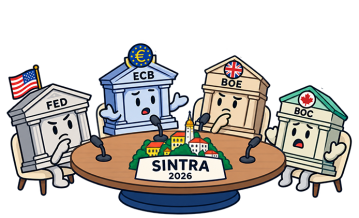 This week, the ECB’s three-day Sintra forum gave traders a clear snapshot of who’s leaning where. The ECB doesn’t make interest rate decisions at Sintra, but the speeches can still move markets because they show how policymakers are really thinking outside the usual press conference script.
This year’s event carried extra weight. Fed Chair Kevin Warsh made his first major international appearance since taking office in May, joining ECB President Christine Lagarde, Bank of England Governor Andrew Bailey, and Bank of Canada Governor Tiff Macklem on a panel moderated by CNBC’s Sara Eisen.
Four of the world’s biggest central banking names sat at the same table, fielded the same questions, and made one thing pretty clear: they’re not all reading from the same playbook.
Is There Anything All Four Actually Agreed On?
So, did all four central bankers actually agree on anything?
More than you might think. Every speaker made it clear that inflation is still too high and that the 2% target isn’t up for debate. But the more significant shared moment was their collective retreat from forward guidance, the central banking practice of signaling future rate moves in advance.
After the 2008 financial crisis, forward guidance became a go-to tool for central bankers. Sintra 2026 may have marked its retirement party.
Lagarde said it plainly for the ECB: “forward guidance is not in the cards.” Warsh refused to tip his hand on the July or September Fed meetings. Bailey and Macklem took a similar line. As Warsh put it on stage, “We have found common cause.”
For newer traders, this means that without a pre-announced policy path, every major data release hits harder. Jobs reports, inflation readings, and PMI updates now carry more weight because markets don’t have an official rate roadmap to lean on. The policy signal isn’t coming ahead of time anymore. It’s coming from the data itself.
Promoted: Scale Your Data Driven FX Strategy
With Sintra 2026 putting central bank divergence back in focus, traders now have to react to report without the old forward guidance safety net. That means your strategy needs more than a good macro read. It needs discipline, risk control, and room to grow when the setup actually plays out.The5ers has spent the last 10 years building a funding model designed for serious traders, which is why over 1.6 million traders worldwide trust them to provide capital and scaling opportunities. Learn more about The5ers Disclosure: We may earn a commission from our partners if you sign up through our links, at no extra cost to you.
The Four-Way Split
Behind the unified front against forward guidance, each central banker is battling a completely unique domestic economic reality.
The ECB looks like the most aggressive mover right now
In June, it raised the deposit facility rate by 25 basis points to 2.25%, its first hike since 2023, after the Iran conflict helped push Euro Area inflation to 3.2% in May. Lagarde said the move was driven by the data, not by caution alone, and the ECB’s own forecasts don’t see headline inflation returning to target until 2028. Markets are now pricing in at least one more hike this year.
Warsh’s Fed is more in watch mode
The Fed’s target range is still 3.50% to 3.75%, while U.S. inflation hit a three-year high of 4.2% in May, partly tied to the Iran war’s energy shock. Softer oil prices since the ceasefire have raised hopes that inflation may have peaked, but Warsh didn’t sound ready to declare victory. He told the panel, “we’re going to deliver price stability,” and pushed back on political pressure for cuts. He also gave traders nothing firm on September, which means incoming data still gets the final say.
Bailey’s Bank of England sounded the most patient
The BOE voted seven to two to hold rates at 3.75% in June, and Bailey’s Sintra tone backed up that wait-and-see approach. He noted that the jump in UK bond yields since the Iran war has already done some tightening for the bank, without an actual rate hike. UK inflation may still climb toward 3.2% later this year, but Bailey signaled the BOE has time to see how much of that pressure actually filters through.
Macklem had the softest domestic story of the group
Canada’s economy looks weaker, inflation is still above target, and the Bank of Canada doesn’t sound eager to lean hard either way. That is, the BOC is holding steady because it has inflation on one side and growth worries on the other. Not exactly a clean trading signal, but hey, central banking was never built for tidy little bow wrapping.
The FX Takeaway From Sintra’s Central Bank Split
Policy divergence is about interest rate differentials, or the gap between yields in two countries.
The basic idea is simple: higher rates can make a country’s assets more attractive to investors looking for yield. To buy those assets, they need that country’s currency first. That extra demand can help the currency firm up against lower-yielding rivals.Based on Sintra, the ECB entered the week with the clearest policy tailwind for the euro. It’s already hiking again, and Lagarde didn’t sound eager to back away from the inflation fight. But the market threw in a curveball. Euro Area CPI slowed to 2.8% in June, below the 3.1% forecast and down from May’s 3.2% reading. That cooled calls for more aggressive ECB hikes, and EUR/USD traded lower on Wednesday even with Lagarde sounding hawkish.
That’s the real lesson. Divergence is rarely a clean one-way trade. A hawkish central bank can still see its currency weaken if the data supporting that hawkish stance starts to fade.
For the pound, the risk is that the BOE stays patient while the ECB keeps moving. Sterling’s current rate at 3.75% is still higher than the ECB’s 2.25%, but markets care less about where rates are today and more about where they’re likely going next.
For CAD, the setup looks less friendly. A soft Canadian economy, a Bank of Canada stuck on hold, and a potentially hawkish Fed next door could leave the Loonie vulnerable against the dollar.
Quick Takeaways
- All four central bank heads at Sintra backed away from forward guidance. With no pre-announced policy signals, economic data releases are likely to drive sharper, faster market reactions going forward.
- The ECB is currently the most active hiker of the four. The BOE and BOC are the most patient. The Fed is hawkish in tone but non-committal on timing.
- Central bank divergence works through interest rate differentials: the faster a bank hikes relative to its peers, the more its currency tends to attract yield-seeking capital.
- Divergence is not a clean signal. Cooling inflation data can offset a hawkish central bank tone quickly, as Wednesday’s EUR/USD price action showed.
Watch For
Today’s US jobs report (8:30 am ET) is the first major data test of Warsh’s no-guidance regime. Consensus sits near 115,000 jobs added in June with an unchanged unemployment rate of 4.3%. Under the old forward-guidance playbook, the Fed’s stated preferences would have given markets an anchor. Under Warsh’s new approach, the data speaks for itself. The dollar tends to follow.
This article covers the diverging hawkish and dovish signals on display at the Sintra Forum, and newer traders may not be familiar with what those signals mean for the currencies these central banks manage. Premium members can read our lesson:
📖 Hawkish vs. Dovish: How to Read Central Bank Language
Reading this helps you understand the hawkish/dovish policy spectrum, how central bank speeches move currencies even on non-decision days, and how to translate diverging stances into practical FX insights.
And if you’re not a Premium subscriber yet, now’s a good time to sign up.
With Babypips Premium, you get full access to School of Pipsology lessons that help you understand not just what central bankers said at Sintra, but how to decode the language of any central bank and what it means for the pairs you trade.