


Chip stocks slid after Broadcom CEO Hock Tan compared some AI investing to casino gambling and China’s CXMT flagged progress on a new memory chip.
SK Hynix fell more than 9% and Samsung more than 7% in Seoul on Tuesday, Oct. 13, after Micron’s 3.88% drop on Monday. Neither story shows AI chip demand cracking. CXMT has not shared specs or yields, and Broadcom forecasts $230 billion in AI chip sales by fiscal 2028.
Chip Stock Slide: Key Takeaways
- Tan’s remark: At a Singapore event on Monday, Oct. 12, Hock Tan said many AI investors have “no clue what they are investing in.”
- Seoul selloff: On Tuesday, SK Hynix fell 10.1%, Samsung fell 7.4%, and South Korea’s Kospi lost more than 5.4%, according to Forbes.
- U.S. chips: Micron fell 3.88% and the Philadelphia Semiconductor Index fell 2.67% on Monday.
- CXMT’s design: The company says it made “key progress” on 4F² DRAM and plans a server memory product by the end of 2026.
- Missing details: CXMT has not disclosed specs, yield rates, or customer approvals for the new design.
- Market share: CXMT held 10% of global DRAM revenue in Q2 2026, up from 4% a year earlier, per Counterpoint Research.
- What to watch: Real 4F² specs and yields from CXMT. Both could shape how memory stocks trade.
What Did the Broadcom CEO Say About AI Investing?
Hock Tan spoke at an event in Singapore on Monday, Oct. 12. Bloomberg reported his remarks, and Forbes repeated them. Tan said many investors have “no clue what they are investing in.” He warned of “extreme expectations only to find out that it’s almost like they are in a casino.”
Tan compared companies that test AI to children who burn through arcade tokens without learning much. He called OpenAI’s annualized revenue of about $50 billion in September a sign of strong demand. (Annualized means the total if the current pace lasted a full year.) He added that heavy training costs give little sign of long-term profit. Tan said access to financing could become the industry’s biggest limit, ahead of memory chip shortages.
Promoted: Think in Probabilities When the Headlines Get Loud.
Hock Tan’s casino remark and CXMT’s chip news hit traders before anyone had specs, yields, or customer approvals to check. You face that gap on most trades: you act on partial facts or you miss the move.
In “Thinking in Bets” (4.3 stars on 5K Amazon reviews), former poker champion Annie Duke explains why a good decision can lose money. A bad one can win. Treat each trade as a bet, weigh probabilities instead of guarantees, and you cut knee-jerk reactions and separate luck from skill.
Develop a probabilistic mindset with “Thinking in Bets” by Annie Duke!
Disclosure: We may earn a commission from our partners if you sign up through our links, at no extra cost to you.
What Did China’s CXMT Announce?
CXMT (ChangXin Memory Technologies) is a Chinese maker of DRAM. DRAM is the short-term memory that lets servers, phones, and PCs run apps fast. President Cao Kanyu told a Shanghai chip conference over the weekend that CXMT made “key progress” on a design called 4F². Korea JoongAng Daily, which cites the South China Morning Post, reported the remarks.
Every memory chip stores data in tiny cells. Today’s mainstream design, 6F², gives each cell a set amount of floor space. The 4F² design cuts that space by about 33%. In theory, that fits about 50% more cells on one chip. Engineers get there by standing the transistors upright instead of laying them flat. Think of stacking books on a shelf instead of spreading them across a table.
The announcement leaves big gaps. CXMT plans to release DDR5 RDIMM modules (memory built for data center servers) with 4F² by the end of 2026. It has not disclosed specs, yield rates (the share of chips that come out working), or customer approvals. CXMT has a record of delays. It targeted DDR5 mass production in 2022, but CXMT-based DDR5 products did not become common until late 2024.
The timeline matters because rivals are working on the same design. Seoul Economic Daily reports that Samsung targets mass production of sub-10 nanometer 4F² DRAM by 2028. On announced dates alone, CXMT would run about two years ahead.
How Far Did Chip Stocks Fall?
Micron fell 3.88% in New York on Monday, and the Philadelphia Semiconductor Index (a basket of major U.S. chip stocks) dropped 2.67%. The bigger damage came in Asia on Tuesday, Oct. 13.
Forbes reported SK Hynix down 10.1%, Samsung down 7.4%, and Kioxia down about 13%. SoftBank Group, a big AI investor, fell 8.5%, and TSMC slipped about 2%. The Kospi (South Korea’s main stock index) lost more than 5.4%. Intraday numbers differ by outlet, so treat the exact percentages as a range.
Reports linked the slide to both stories. Nobody can split the blame between them with confidence.
Promoted: A Seoul Selloff Tests Your Risk Rules Fast.
SK Hynix fell more than 9% and Samsung more than 7% on Tuesday. A small account makes every swing like that feel bigger.
FundedNext gives disciplined traders simulated trading accounts up to $200K. It imposes no time limits on challenges, and you earn a 15% profit share during your evaluation. Once funded, you keep up to a 95% profit split with guaranteed 24-hour payouts. You can trade CFDs or Futures during major news events.
Join over 400K traders who have received $300M+ in payouts. Ready to back your edge?
Learn More About FundedNext! Use code BP for discounts on both CFD & Futures plans! T&C apply.
Disclosure: We may earn a commission from our partners if you sign up through our links, at no extra cost to you.
Is the AI Chip Boom in Trouble?
Neither headline shows demand falling. Tan’s warning targets investor behavior. Broadcom forecasts AI chip revenue rising from about $58 billion this fiscal year to $230 billion in fiscal 2028. Banks are syndicating a $60 billion AI financing package tied to Anthropic’s lease of Google-designed chips. Broadcom’s credit rating supports $42 billion of the senior loans, which adds risk for Broadcom if customers miss payments.
CXMT has real momentum. Counterpoint Research says its share of global DRAM revenue reached 10% in Q2 2026, up from 4% a year earlier. That gain came before 4F² and 4F² has not shipped. Until CXMT publishes specs and yields, traders have to guess how big a threat the design is.
How did the Futures Markets React?
Index futures let you trade a stock index at a set price for a future date. The E-mini S&P 500 (ES) and E-mini Nasdaq-100 (NQ) trade about 23 hours a day on weekdays. That schedule lets them react to overnight news before the U.S. stock market opens.
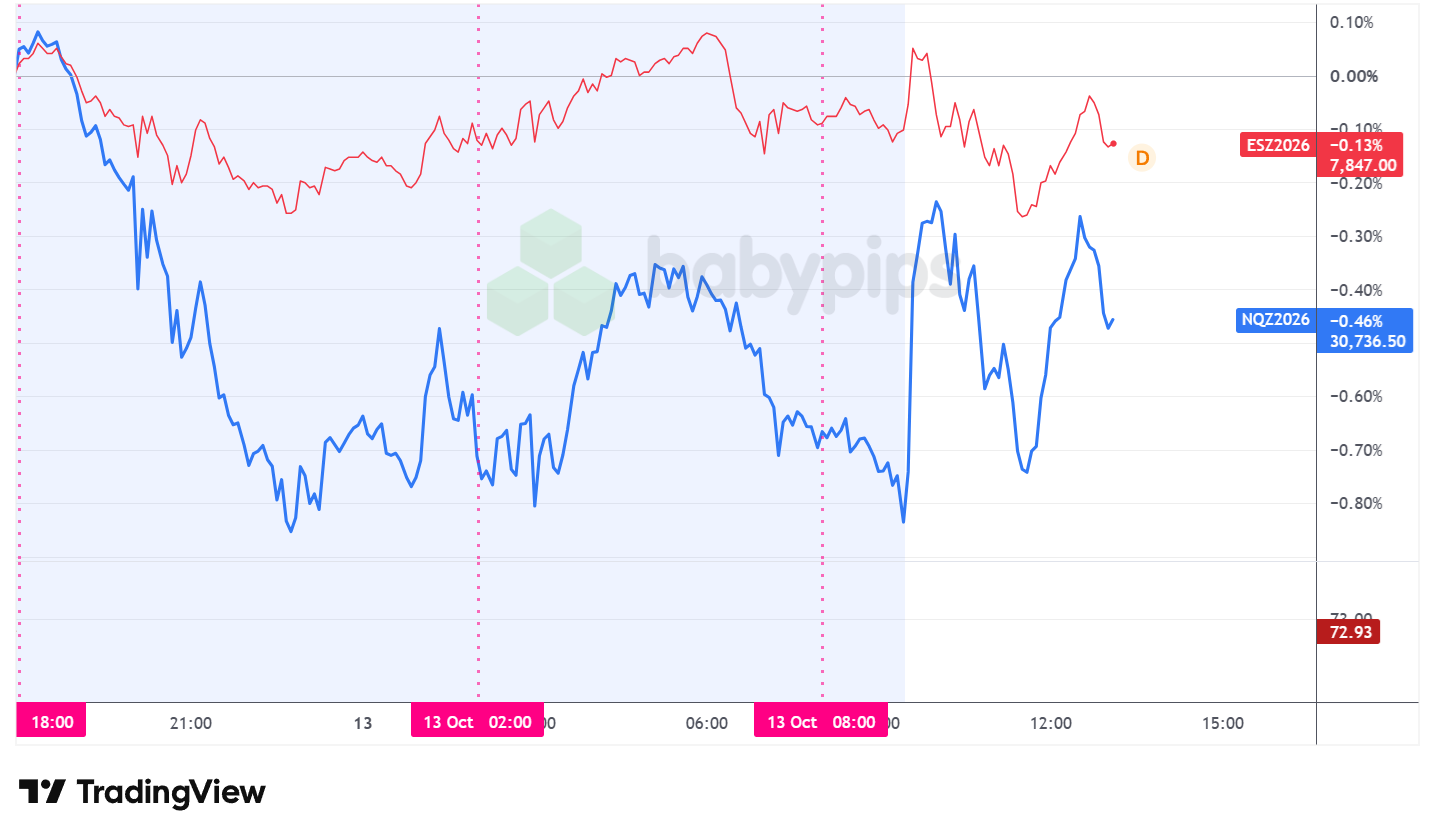
E-mini S&P 500 Futures vs. Nasdaq 100 Futures – Chart by Tradingview
Chips carry more weight in the Nasdaq 100 than in the S&P 500, which holds banks, energy producers, and health care companies. That mix can cushion the S&P 500 when chip stocks fall. In the same quotes, Micron traded down about 5% and the SMH chip fund (an ETF that holds major chip stocks) traded down about 1.8%. Nvidia slipped about 0.7%. Broadcom, the company behind the casino comment, fell about 0.3%. This is mainly the reason why we’re seeing far more underperformance in the Nasdaq 100 today vs. the S&P 500, especially during the Asia session when the news were released.
Futures use leverage (a small deposit controls a much larger position), so swings hit your account fast. One NQ point is worth $20 and one ES point is worth $50. A 190-point NQ drop costs about $3,800 per contract. Micro contracts cut those values to one tenth. Size your position so a gap through your stop does not wipe out your account.
Compare the two indexes as the day goes on. A wide gap between Nasdaq 100 and S&P 500 futures points to a chip-specific selloff. Matching drops point to a broader move away from risk. Neither reading is certain, so confirm it against live quotes.