Canada’s March inflation report showed headline CPI jumping to 2.4% y/y — its fastest pace in three months — as the Iran war drove gasoline prices to a record monthly surge.
But with the reading coming in below the 2.6% consensus and the Bank of Canada’s (BOC) preferred core measures holding steady or easing, traders read the data as less alarming than feared, sending the Canadian dollar broadly higher.
Statistics Canada reported that the consumer price index rose 0.9% month-over-month in March, up from 1.8% y/y in February, with a record 21.2% monthly jump in gasoline prices accounting for the bulk of the acceleration. The Iran war has throttled oil shipments through the Strait of Hormuz since late February, wiping out roughly a fifth of global supply and sending fuel costs soaring worldwide.
Critically for the BOC, underlying price pressures showed no meaningful spillover from the energy shock. CPI-median held steady at 2.3% y/y, while CPI-trim eased a tick to 2.2% — a five-year low. Core CPI excluding food and energy slipped to 1.9% from 2.0%, and three-month annualized core measures averaged just 1.4%, reflecting an economy with considerable slack absorbing the commodity shock.
Key Takeaways
- Headline CPI rose to 2.4% y/y in March, up from 1.8% in February, but came in below the 2.6% consensus forecast
- Core CPI excluding food and energy slowed to 1.9% y/y from 2.0%; three-month annualized core measures averaged just 1.4%
- Monthly CPI gained 0.9%, the largest monthly increase in over a year; the monthly print also missed the 1.1% forecast
- The BOC’s preferred core measures held firm: CPI-median was unchanged at 2.3% y/y; CPI-trim eased to 2.2%, a five-year low
-
Gasoline prices surged a record 21.2% month-over-month — the largest monthly increase in Statistics Canada’s records — and rose 5.9% y/y (the y/y figure was partly muted by the consumer carbon levy still in prices from March 2025)
- Energy prices rose 3.9% y/y and 13.1% m/m overall; natural gas fell 18.1% m/m, insulated from global disruptions by its North American supply base
-
Food purchased from stores rose 4.4% y/y (up from 4.1%), with fresh vegetables jumping 7.8% — the largest increase since August 2023 — due to adverse growing conditions for cucumbers, peppers, and celery
- Lingering base-year effects from the December 2024–February 2025 GST/HST break dampened restaurant food prices, which slowed sharply to +3.2% y/y from +7.8% in February
- Rent ticked up to 4.2% y/y from 3.9%; shelter rose 1.7% y/y overall
Link to official Statistics Canada Consumer Price Index (March 2026)
The March data provided the BOC’s first look at how the Iran war is filtering through to Canadian prices ahead of its April 29 rate decision. The picture was one of a supply-side energy shock contained largely at the pump, with the broader economy’s slack acting as a buffer against pass-through to underlying prices.
Market Reactions
Canadian Dollar vs. Major Currencies: 5-min
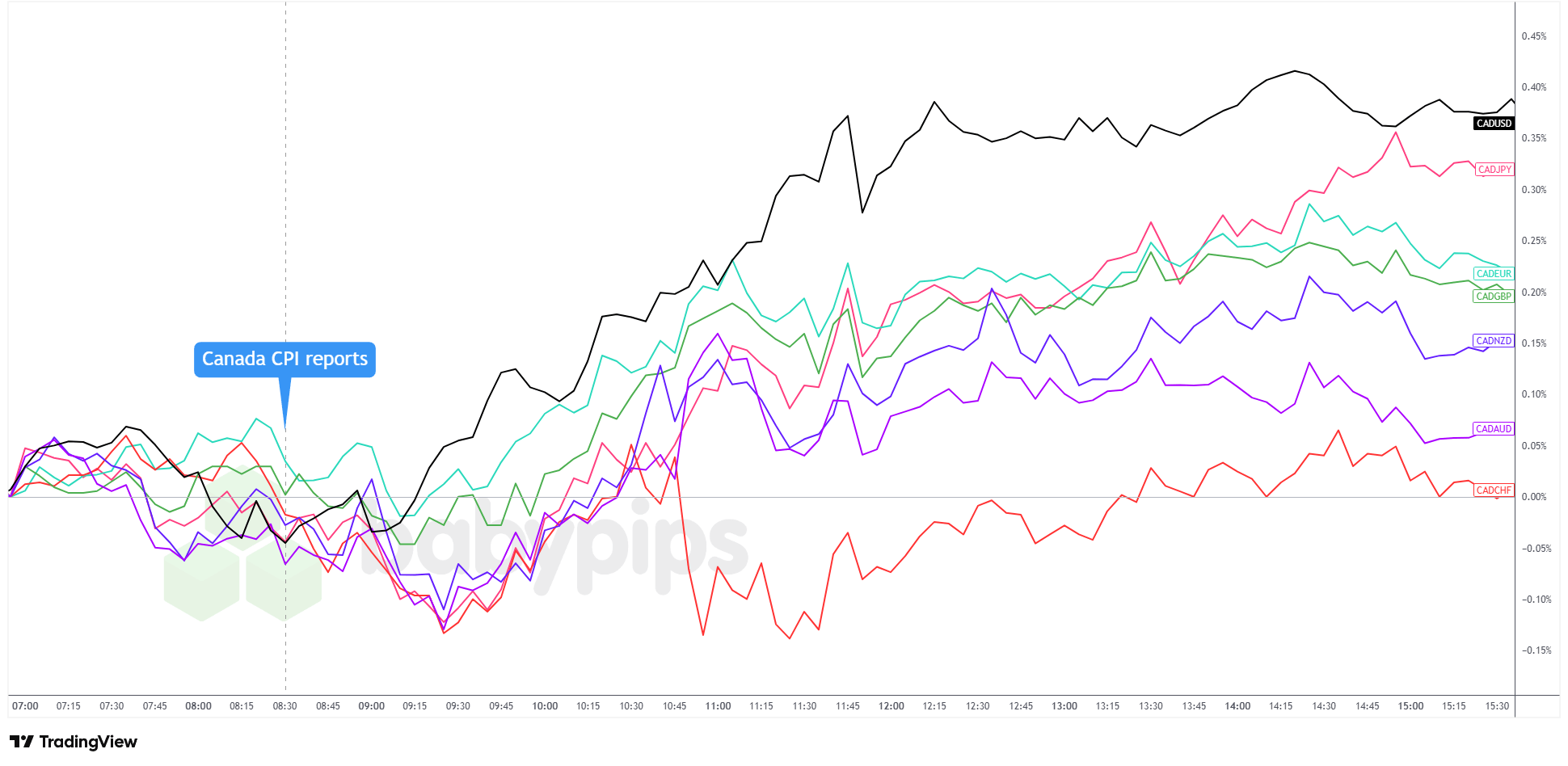
Overlay of CAD vs. Major Currencies – Chart Faster with Tradingview
The Canadian dollar, which was trading near its intraday lows against some major counterparts, initially slipped at the lower-than-expected headline figures.
However, the sticky high inflation prints, a recovery in crude oil prices, and the relative weakness of the U.S. dollar likely improved the Loonie’s demand an hour later. Demand for the Loonie built steadily through the session, lifting it broadly higher, with the clearest strength showing up against the Greenback and the euro.
By the time London markets wrapped up, it was clear traders had taken comfort in the idea that the energy shock was not spilling into broader inflation, allowing CAD to hold onto its gains and close the day stronger across the board, with only the Swiss franc managing to keep pace.
Promoted: CAD didn’t move on the headline; it moved on what was underneath.
Canada’s CPI spiked on energy, but softer core inflation flipped the narrative and sent the Loonie higher after the initial reaction. In markets like this, missing the real story by a few seconds can cost you the move.
Join FinancialJuice for Free to learn more!Disclosure: We may earn a commission from our partners if you sign up through our links, at no extra cost to you.