


Canada’s inflation rate jumped to 3.2% year-over-year in May 2026, beating analyst forecasts of 3.0% and hitting its sharpest annual pace since early 2024. Gasoline prices — up 33.2% year-over-year due to the Strait of Hormuz supply disruption — drove most of the acceleration for a third straight month. But there’s a critical complication: Canada’s economy is in a technical recession, leaving the Bank of Canada (BoC) stuck balancing rising prices against weak growth.
Canada CPI May 2026: Key Takeaways
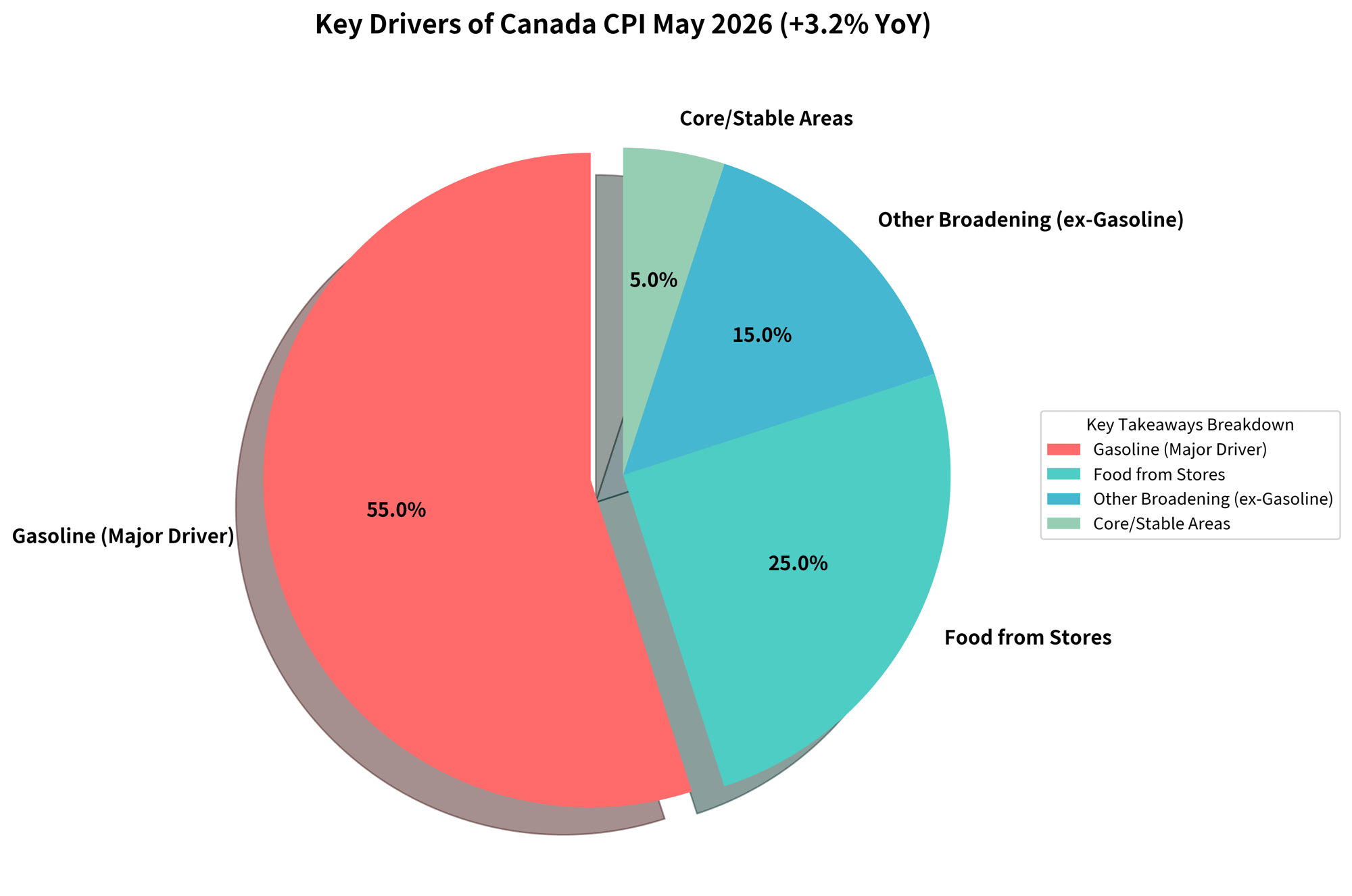
- Headline CPI: +3.2% year-over-year in May 2026 — above the 3.0% forecast and up from 2.8% in April; sharpest annual gain since early 2024
- Monthly change: +1.0% month-over-month in May; on a seasonally adjusted basis, the CPI rose 0.5%, driven by transportation and recreation costs
- Gasoline: +33.2% year-over-year — the highest pump prices since June 2022, when Russia’s invasion of Ukraine caused a similar supply shock; Strait of Hormuz disruption now in its third month
- CPI excluding gasoline: +2.2% year-over-year in May, up from 2.0% in April — a signal that price pressures are beginning to broaden modestly beyond energy
- Food from stores: +4.3% year-over-year — the 16th consecutive month food inflation has outpaced the headline rate; fresh vegetables surged 9.0%, the largest May jump since 2008
- Core inflation (BoC preferred measures): rose modestly in May but remained near the Bank of Canada’s 2% target, per BMO Economics
- Bank of Canada: held its policy rate at 2.25% on June 10 — a fifth consecutive hold; next rate decision is July 15, 2026
What Were Canada’s CPI Results for May 2026?
Statistics Canada’s Consumer Price Index report shows inflation accelerating to 3.2% year-over-year in May, up from 2.8% in April. That beat the Reuters consensus forecast of 3.0% and marks the sharpest annual increase since early 2024. On a monthly basis, the CPI rose 1.0% in May — a significant jump. Seasonally adjusted (meaning the normal seasonal patterns are stripped out), prices rose a more moderate 0.5%, driven by transportation and recreation, education, and reading costs.
Prices accelerated in every single Canadian province in May compared with April. The main driver across all regions was gasoline, which has a larger impact on households in Atlantic Canada due to higher expenditure shares there. Statistics Canada also updated the basket of goods and services used to calculate the CPI with this release, switching to 2025 spending patterns — but the headline number would have been the same under the old basket, confirming the result is not a methodology artifact.
What Drove Canada’s Inflation Higher in May 2026?
Gasoline was, once again, doing most of the heavy lifting. Pump prices rose 33.2% year-over-year in May, accelerating from a 28.6% gain in April. The Strait of Hormuz — a narrow passage through which roughly 20% of the world’s oil normally flows — has remained effectively closed to normal shipping since the escalation of the conflict in the Middle East. That supply squeeze has now pushed gasoline prices to their highest level since June 2022, when the Russian invasion of Ukraine caused a similar shock to global energy markets. Airlines are feeling the same pressure: air transportation costs rose 7.4% year-over-year in May, as carriers pass on higher jet fuel costs. Travel tour prices also reversed sharply, rising 0.7% after falling 11.0% in April.
Food prices are adding a second layer of pressure. Fresh vegetables surged 9.0% year-over-year — the biggest May jump since 2008 — with broccoli, cauliflower, tomatoes, and lettuce all rising sharply. Tomato prices alone climbed 45.2% year-over-year, partly a result of supply contractions in Mexico, where US tariffs reduced planted acreage. Fresh fruit prices rose 5.3% after falling 0.5% in April. The combination of energy costs and grocery bills is putting real pressure on Canadian household budgets.
Promoted: Pay Once. Trade Forever.
Most prop firms quietly drain your account with monthly subscription fees long before you ever see a payout. Tradeify operates differently — evaluations are a one-time purchase with no recurring charges. Pass the eval, get activated instantly, and keep more of what you earn. With ~$200M paid out and growing, the math speaks for itself.
Learn More About Tradeify! Limited Time offer: Code “JUNE” for 35% off!
Disclosure: We may earn a commission from our partners if you sign up through our links, at no extra cost to you.
Is Canada’s Inflation Spreading Beyond Gasoline?
This is the key question the Bank of Canada is watching closely — and the answer is: slightly, but not yet alarming. The CPI excluding gasoline rose 2.2% year-over-year in May, up from 2.0% in April. That modest uptick is a signal that price pressures are beginning to broaden beyond the direct energy shock. Still, the broadening remains limited. Shelter costs — the largest single component of the CPI basket at roughly 30% of total weight — continued to slow, rising just 1.7% year-over-year, down from 1.8% in April. Mortgage interest costs fell year-over-year for the 33rd consecutive month. Rent inflation eased to 3.5% in May from 3.6% in April, the lowest since January 2022.
The Bank of Canada tracks its own preferred “core inflation” measures — CPI-trim and CPI-median — which strip out the most extreme price movements each month, whether up or down, to give a cleaner read on underlying inflation trends. Those core measures remained right around two per cent in May — still at the BoC’s 2% target.
What Does Canada’s May CPI Mean for the Bank of Canada?
The Bank of Canada held its policy rate at 2.25% on June 10, 2026 — a fifth consecutive hold since October 2025 — and signaled it is “looking through” the near-term impact of energy prices on headline inflation. Governor Tiff Macklem was explicit: the BoC “will not let higher energy prices become persistent inflation.” The central bank’s June statement described its stance as one that “balances” two competing risks — energy-driven inflation on one side, and a weakening economy on the other. Canada’s real GDP edged down 0.1% in the first quarter of 2026, following a 1.0% annualized decline in Q4 2025 — a technical recession by most definitions.
The May CPI print lands broadly in line with BoC expectations. The Bank had already forecast inflation hovering near 3% in the near term before gradually returning to 2%. With core measures still anchored near the target, a rate hike at the July 15 meeting looks unlikely. However, some swap markets have begun pricing in the possibility of a hike later in 2026 — the first time that pricing has turned in that direction since last fall — if the broadening of price pressures beyond gasoline continues. Major bank forecasts are split: Scotiabank and CIBC both see the policy rate rising to 3.0% by year-end 2026, while TD Economics and National Bank see it holding at 2.25% well into next year.
Promoted: The Strategy is Half the Battle; Your Mindset is the Rest.
Most trading mistakes aren’t technical—they’re psychological. In the classic “Trading in the Zone” by Mark Douglas (⭐ 4.7★ | 10,000+ reviews on Amazon), you’ll learn how to master the probabilistic thinking and emotional discipline mentioned in today’s article. If you struggle with hesitation or breaking your rules, this is your manual for consistent execution.
Click on the link to learn more about “Trading in the Zone” by Mark Douglas!
Disclosure: To help support our content, we may earn a commission from our partners if you sign up through our links, at no extra cost to you.
What Does Canada’s Inflation Data Potentially Mean for CAD Traders?
The inflation beat — 3.2% vs a 3.0% forecast — was technically CAD-positive, since higher-than-expected inflation can push a central bank toward tighter policy and support the currency. But the market reaction was muted. USD/CAD has been trading near 1.4170, its highest level since April 2025, as broader US dollar strength — driven by Federal Reserve Chair Kevin Warsh’s hawkish tone at his first FOMC meeting — continues to dominate. The US Dollar Index (DXY), which tracks the greenback against a basket of major currencies, hit its highest level in 13 months this week. As long as the Fed looks more hawkish than the BoC, that interest rate differential will keep pressure on the loonie.
There is also a complication specific to Canada’s usual commodity-currency relationship. Normally, rising oil prices support the Canadian dollar because Canada is a net energy exporter. But in the current environment, ongoing US-Iran negotiations and the prospect of Strait of Hormuz re-opening have pushed oil prices lower on peace-deal optimism — removing that traditional CAD tailwind even as gas prices remain elevated for consumers at home. For traders watching USD/CAD, the key signals to monitor are: whether BoC core inflation continues to rise (which could shift BoC language toward tightening), whether the Middle East conflict escalates or de-escalates (which directly affects oil prices and CAD), and whether Canada exits its technical recession in Q2 GDP data. A hawkish BoC pivot would likely be the strongest near-term CAD catalyst.
Frequently Asked Questions About Canada CPI
What does Canada’s Consumer Price Index (CPI) measure?
The Canadian CPI, published monthly by Statistics Canada, measures changes in the price of a fixed basket of goods and services that Canadian households typically buy — things like groceries, rent, gas, clothing, and transportation. The Bank of Canada uses the CPI as its main gauge of inflation. Its target is to keep annual CPI inflation at 2%, within a control range of 1% to 3%.
Why does Canada’s CPI matter for forex traders?
Canada’s CPI directly shapes expectations for the Bank of Canada’s interest rate decisions. When inflation runs above target, traders price in the possibility of rate hikes — which tend to attract capital into Canadian-dollar assets and strengthen CAD. When inflation is low, rate cut expectations take over, weakening the loonie. The CPI report is one of the highest-impact scheduled data releases on the Canadian economic calendar, often moving USD/CAD sharply in the minutes following release.
What happened to Canada’s inflation in May 2026?
Canada’s annual inflation rate rose to 3.2% in May 2026, up from 2.8% in April and above the 3.0% analyst forecast. Gasoline prices surged 33.2% year-over-year, driven by the Strait of Hormuz supply disruption. CPI excluding gasoline rose 2.2%, signalling some modest broadening of price pressures. Food from stores rose 4.3%, with fresh vegetables jumping 9.0% — the biggest May gain since 2008. On a monthly basis, the CPI rose 1.0%.
What does the May 2026 CPI mean for the Bank of Canada’s rate decision?
The Bank of Canada held its policy rate at 2.25% on June 10 and has signalled it is looking through energy-driven inflation for now. With Canada in a technical recession and core inflation still near the 2% target, a rate hike at the July 15 meeting appears unlikely. The BoC’s key watch item going forward is whether energy price inflation passes through into broader goods and services — something that has not yet happened in a significant way.
What is the outlook for Canadian inflation in coming months?
The Bank of Canada expects total inflation to hover near 3% in the near term before gradually returning toward its 2% target. Much depends on how the Middle East conflict evolves. If the Strait of Hormuz reopens to normal shipping, gasoline prices could fall significantly, pulling the headline rate back down quickly. If the disruption persists or worsens, inflation could stay elevated — and the risk of energy prices feeding through into core goods and services would grow, potentially forcing the BoC’s hand on rate hikes later in 2026.
When inflation beats expectations, you’d expect the currency to strengthen—but if the central bank is constrained by recession, the market may price in something very different. Premium members can read our lesson:
📖 Market Expectations: Why Good News Can Tank a Currency
Reading this helps you understand how inflation data shapes central bank expectations, why good news doesn’t always support a currency, and how comparative policy stances affect exchange rates.
And if you’re not a Premium subscriber yet, consider joining today.
With Babypips Premium, you get full access to School of Pipsology lessons that help you understand why the same inflation report can support one currency and weaken another depending on what the central bank actually does with the data.