


Australia’s labor market delivered a stronger-than-expected performance in May 2026, with the economy adding 40,300 jobs and the unemployment rate falling to 4.4% from 4.5% in April, according to data released Thursday by the Australian Bureau of Statistics.
Markets had anticipated roughly 32,000 new positions, meaning the headline print came in well above consensus. The result largely reversed April’s loss of 40,700 jobs, which had pushed unemployment to its highest level since late 2021.
Australia Employment May 2026: Key Takeaways
- Employment rose 40,300 in seasonally adjusted terms to 14,738,800 people — a 0.3% monthly gain and 1.0% higher year-on-year.
- Unemployment fell to 4.4%, down 0.1 percentage points from April. The number of unemployed persons declined by 18,300 to 671,300.
- Full-time employment rose by 5,200 while part-time employment added 35,200 — suggesting the headline beat was driven primarily by part-time hiring.
- Youth unemployment improved, falling 0.6 percentage points to 10.4%.
- Female unemployment dropped 0.2 percentage points to 4.1%, while male unemployment held steady at 4.6%.
- The participation rate ticked up marginally to 66.7%, and the employment-to-population ratio rose 0.1 percentage points to 63.8%.
- Hours worked declined, falling 1.1% to 2,010 million monthly hours — a notable divergence from the employment gain and a potential signal of softer underlying demand for labour.
- Underemployment edged higher, rising 0.1 percentage points to 5.9% in seasonally adjusted terms, adding a note of caution to the otherwise bullish headline.
The headline figures paint an impressively resilient labor market, but some details are worth watching.
The gap between employment growth (+0.3%) and hours worked (-1.1%) is wider than typical, which could indicate businesses are adding workers at reduced hours rather than expanding capacity.
Link to the official ABS May 2026 Australian Labor Force Survey
Similarly, underemployment rising alongside a falling unemployment rate suggests a portion of the workforce remains underutilized — a dynamic that may temper wage pressure over time.
Regionally, results were uneven. Victoria and Queensland posted solid monthly employment gains of around 0.6% each, while Western Australia shed 0.9% of its employed population — the weakest state-level reading in the report. Queensland’s unemployment rate also fell sharply to 3.7%, among the lowest in the country.
It is also worth noting that May marked the second month of the ABS transitioning its Labor Force Survey to modernized collection systems. The bureau’s quality assurance checks indicate the incoming rotation groups showed higher employment numbers, though the ABS reported these differences fell within acceptable statistical ranges. Some month-to-month volatility is expected during this transition period.
Promoted: Pay Once. Trade Forever.
Most prop firms quietly drain your account with monthly subscription fees long before you ever see a payout. Tradeify operates differently — evaluations are a one-time purchase with no recurring charges. Pass the eval, get activated instantly, and keep more of what you earn. With ~$200M paid out and growing, the math speaks for itself.
Learn More About Tradeify! Limited Time offer: Code “JUNE” for 35% off!
Disclosure: We may earn a commission from our partners if you sign up through our links, at no extra cost to you.
Market Reaction
Australian Dollar vs. Major Currencies: 5-min
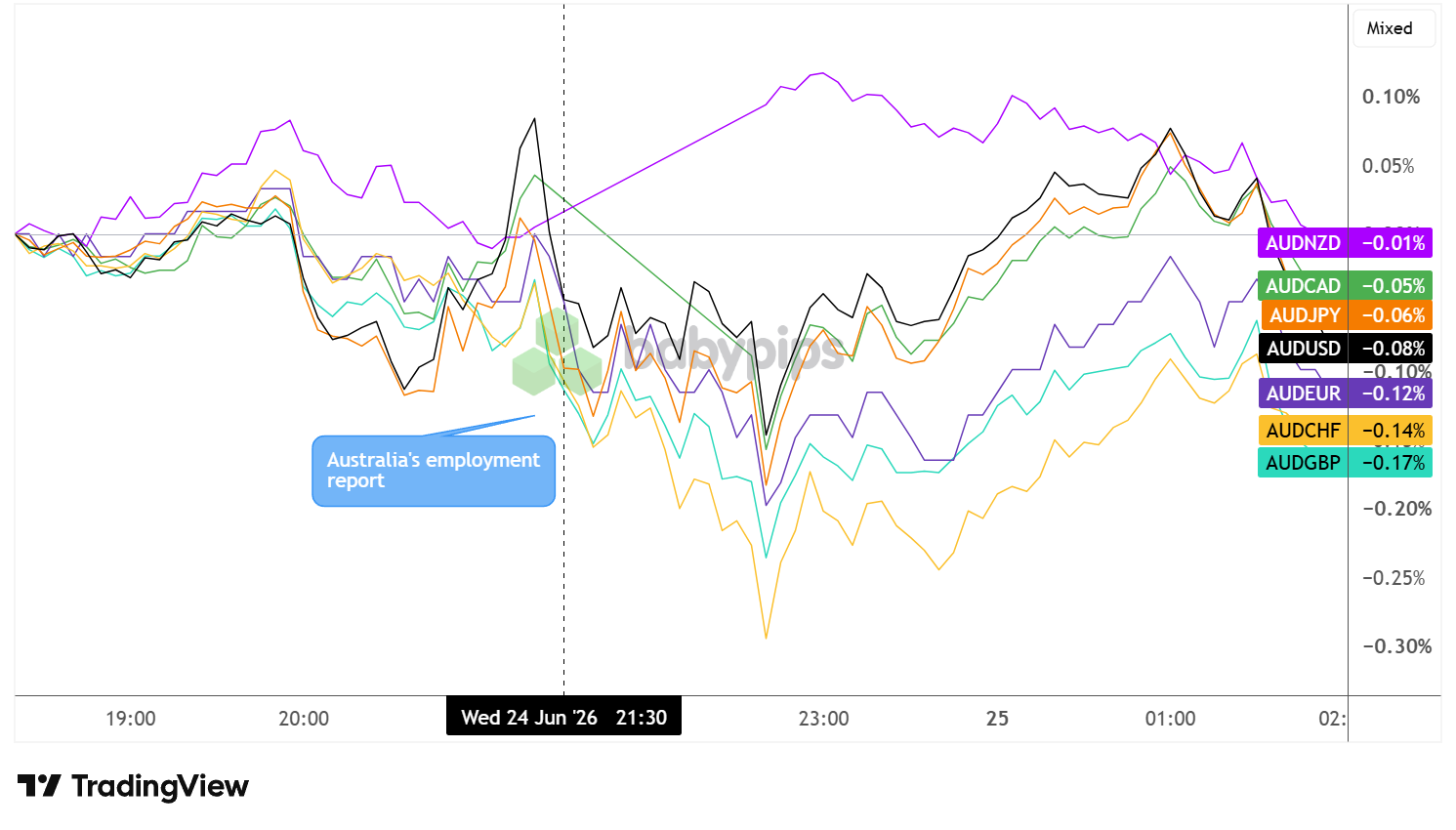
Overlay of AUD vs. Major Currencies: 5-min Forex Chart Faster with TradingView
The initial reaction was volatile — a sharp spike lower at the time of publication, with the AUD falling roughly 0.25–0.30% against several major currencies at the lows in the next hour before partially recovering through the Asian session.
By the time European markets opened, AUD was trading lower against all tracked pairs, down 0.17% against GBP, followed by a 0.14% decline against CHF. AUD/USD settled lower at -0.08% while AUD/NZD was mostly flat.
The muted and ultimately negative AUD reaction likely reflects a few factors. First, while the headline beat expectations, the underlying details, such as gains driven mostly by part-time hiring and fewer hours worked, may have cooled enthusiasm.
Second, markets may have already priced in a resilient labor print following April’s sharp reversal, leaving less room for upside surprise.
Third, ongoing uncertainty around the Reserve Bank of Australia’s rate path may be weighing on sentiment more broadly, with some traders perhaps interpreting the data as insufficient to materially shift the odds of a near-term hike.
Australia’s May jobs report beat expectations, but the AUD sold off anyway. If that reaction seems counterintuitive, you may not be familiar with how the FX market actually processes economic data. Premium members can read our lesson:
📖 From Data to Price Action: What Happens When Big News Hits
Reading this helps you understand why currencies can move against the headline number, how the market’s initial spike differs from the analytical move that follows, and what traps catch unprepared traders in the minutes after a major release.
And if you’re not a Premium subscriber yet, now’s a good time to sign up.
With Babypips Premium, you get full access to School of Pipsology lessons that help you understand not just what the chart is showing after a data release, but the market mechanics driving the move.