


Australia’s March CPI surged to 4.6% annually, the highest since September 2023, as the Iran war drove fuel costs up 32.8% in a single month, the largest monthly jump on record.
The underlying picture was calmer. The quarterly trimmed mean came in at 0.8%, a tenth below forecasts, though the annual pace still ticked up to 3.5%, well above the RBA’s 2–3% target.
Key Takeaways
- Headline CPI rose 4.6% in the 12 months to March 2026, up sharply from 3.7% in February, the highest reading since September 2023
- Monthly CPI jumped 1.1%, the fastest monthly rise since the series began in 2017
- Trimmed mean (core) inflation held at 3.3% annually, unchanged from February; rose 0.3% on the month
- Quarterly CPI rose 1.4% in Q1 2026, the sharpest quarterly rise since late 2023; annual pace accelerated to 4.1% from 3.6%
- Quarterly trimmed mean came in at 0.8% q/q and 3.5% y/y — a tenth below forecasts of 0.9%, offering modest relief
- Largest annual contributors: Transport (+8.9%), Housing (+6.5%), Food and non-alcoholic beverages (+3.1%)
- Automotive fuel surged 32.8% in March alone — the strongest monthly increase since the series began — driven by Middle East conflict disrupting global oil supplies
- Electricity costs rose 25.4% annually as government energy rebates ran out
- Markets trimmed RBA May hike odds to ~75-76% from ~85% before the release; roughly 62 basis points of tightening still priced for the rest of 2026
Link to official ABS Australian Consumer Price Index (March 2026)
On the tradables side, which covers goods affected by global prices, inflation jumped to 4.5% from 1.3% in February as fuel, food, and clothing got more expensive. Non-tradables, or locally driven costs like housing and education, eased slightly to 4.6% from 5.0%.
Goods inflation rose to 5.5% from 3.5%, while services dipped to 3.6% from 3.9%, showing that most of the price pressure is still coming from globally exposed categories for now.
Note that the March data captured only the first wave of the Iran war’s impact. Treasurer Chalmers warned inflation will peak higher, with some economists forecasting it tops 5% in Q2 as energy costs spread more broadly through the economy.
The government’s decision to halve the fuel excise from April 1 should offer some near-term relief, though most expect it to be only a partial offset while the Strait of Hormuz remains closed.
Promoted: Pay Once. Trade Forever.
Most prop firms quietly drain your account with monthly subscription fees long before you ever see a payout. Tradeify operates differently — evaluations are a one-time purchase with no recurring charges. Pass the eval, get activated instantly, and keep more of what you earn. With ~$150M verified payouts and growing, the math speaks for itself.
Learn More About Tradeify!
Disclosure: We may earn a commission from our partners if you sign up through our links, at no extra cost to you.
Market Reactions
Australian Dollar vs. Major Currencies: 5-min
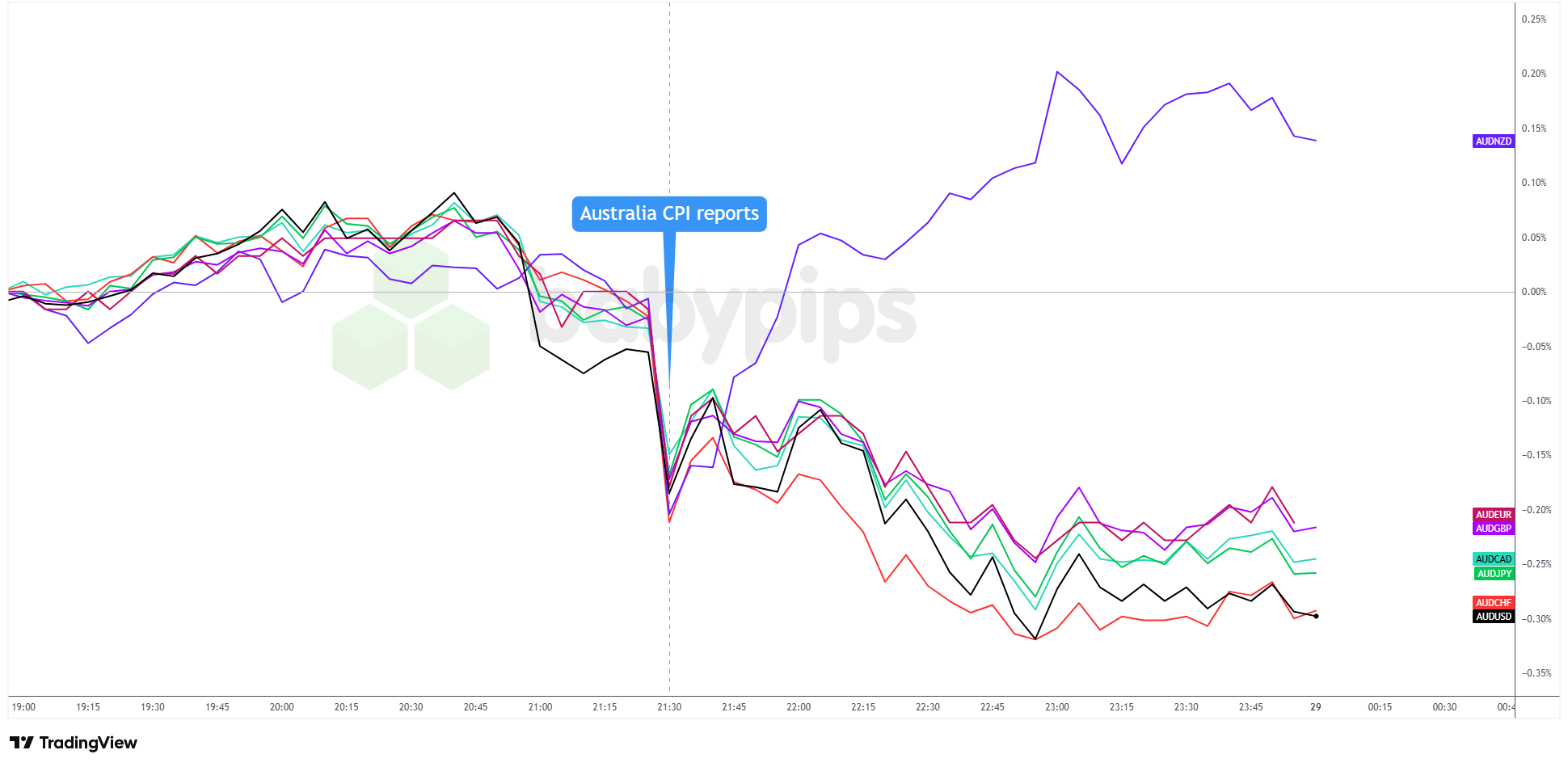
AUD Overlay 5-min – Chart Faster with TradingView
The Aussie was pretty quiet heading into the release, but once the numbers hit, it was off to the races in the wrong direction.
AUD sold off across the board and kept drifting lower over the next couple of hours, with AUD/USD and AUD/CHF taking the heavier hits, while AUD/CAD and AUD/JPY were not far behind, and AUD/EUR and AUD/GBP held up a bit better.
The one exception was AUD/NZD, which managed to push higher before settling back, a sign that Kiwi weakness helped take some of the pressure off that cross.
All in, it’s looking like the market is dialing back some of its more aggressive tightening expectations. A May hike is still very much on the table, but the data suggests the RBA may not need to press as hard, and this may be enough to keep the Aussie on the back foot heading into the London session.
Promoted: Capitalize on AUD Volatility Without Risking Your Own Funds.
Cooler CPI took some heat out of RBA hike expectations, even though the bigger picture hasn’t really changed. When the macroeconomic data shifts this fast, trading the volatility requires deep focus—and enough capital to make your edge count.
If you have the right fundamental bias but a restrictive personal account size, Funded Trading Plus can help. They offer evaluation packages starting at just $89.00. Prove your skills with simple, fair rules, and you can double your account every 10% up to $2,500,000.
Learn more about Funded Trading Plus!
Disclosure: To help support our content, we may earn a commission from our partners if you sign up through our links, at no extra cost to you.