


Every month, the people who actually run the supply chains at major companies — the ones ordering raw materials, managing staff levels, and signing off on shipments — get asked a simple question: Is business better or worse than last month?
Their answers get rolled into a single number called the Purchasing Managers’ Index (PMI), and 50.0 is the line that matters. Above it, the economy is expanding. Below it, it’s contracting.
On Thursday, the “flash” PMI readings — early estimates covering roughly 85% of the final survey — hit the markets for all major economies at once. The results painted a fractured global picture with real consequences for currency pairs.
The Big Flip: Factories Up, Services Down
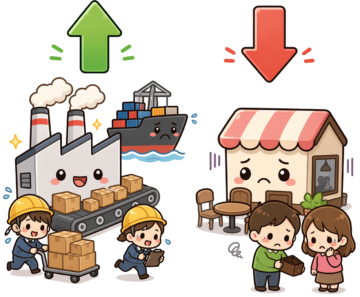 Here’s something you probably wouldn’t have called a year ago. Manufacturing is suddenly the bright spot, while services, the engine that’s been carrying global growth since 2024, is starting to lose steam.
But don’t get too excited about the factory rebound. With the Middle East conflict messing with key shipping routes, companies are rushing to buy supplies now before shortages drive prices even higher. Think less “growth is strong” and more “let’s not run out of stuff.” This kind of front-loading can push manufacturing PMI higher without any real pickup in demand.
Services are dealing with a different problem: energy.
Brent crude oil has pushed past $100 a barrel, a big jump from where it was just a couple of months ago. When fuel prices move like that, it hits fast. Households start cutting back, fewer trips, fewer dinners out, less discretionary spending overall. And that’s a problem for a sector that does most of the heavy lifting in developed economies.
How Each Economy Is Reading
United States: Still Growing But Getting Expensive
The U.S. is the standout this month. Manufacturing climbed to 54.0 from 52.3 in March, and services returned to expansion at 51.3, up from 49.8 the month before. Growth is intact, but look under the hood, and there’s a warning light flashing. Input price inflation hit an 11-month high, with manufacturing costs rising at their second-fastest pace since July 2022. The economy is growing, but businesses are paying significantly more to keep it that way.
Euro Area: The Alarm Is Ringing
The Euro Area Composite PMI crashed to 47.4, its weakest reading in five years. Germany saw business activity fall for the first time in 11 months, while France contracted at its sharpest pace since February 2025. This marks the bloc’s first dip into contraction in 16 months, arriving just days before an ECB policy decision.
United Kingdom: Better Than Expected, But Inflation Isn’t Far Behind
The UK surprised to the upside. The Composite PMI rose to 52.0 from 50.3 in March, comfortably back in expansion territory. The rebound is real, though it came with an uncomfortable side effect: about 69% of businesses surveyed reported rising purchasing costs in April, one of the sharpest cost readings in months. Growth is there, but inflation is riding shotgun.
Japan & Australia: Steady
Japan’s manufacturing output rose at its fastest pace since February 2014, though the broader composite eased slightly to a four-month low. Australia bounced back convincingly, with its Composite PMI jumping from a contractionary 46.6 all the way to 50.1. Neither economy is surging, but both are stabilizing.
Promoted: When the Data Looks Strong but the Story Isn’t, Execution Matters More Than Ever.
April’s PMI divergence shows why surface-level strength can mislead, with manufacturing boosted by stockpiling while services weaken under rising costs. In choppy, mixed environments like this, consistency beats guesswork.
Lux Trading Firm gives serious traders access to real capital, structured evaluations, and the chance to build a verified track record in any market condition.
Learn More at Lux Trading Firm
Disclosure: To help support our free daily content, we may earn a commission from our partners if you sign up through our links, at no extra cost to you.
What Does This Mean for Currencies?
In forex, currencies don’t just move on whether an economy is doing well, they move on whether it’s doing better or worse than expected, and better or worse than somewhere else. That relative comparison is everything, and April’s divergence creates some clear implications.
The dollar holds its ground. When the U.S. is expanding while Europe is contracting, traders gravitate toward the USD. A stronger U.S. economy means the Fed can keep interest rates higher for longer, and higher rates attract global capital. Why take on European risk when U.S. assets are paying well?
The euro is stuck. Slowing Euro Area growth alongside a stubbornly high March inflation print of 2.9% puts the European Central Bank (ECB) in an impossible spot: cutting rates risks stoking inflation, but keeping them high risks deepening the contraction. Markets hate that kind of paralysis, and it’s been weighing on EUR/USD all week.
Sterling faces a difficult balancing act. The UK is outgrowing the Euro Area right now, which is normally positive for a currency, but with inflation running hot, the Bank of England (BOE) faces a tough call. The April 30 BoE decision is the next major catalyst since a rate hike could push GBP/USD higher, but tightening into fragile growth carries its own risks.
Key Lessons for Traders
Divergence drives direction. The growing gap between a resilient U.S. and a contracting Euro Area is the dominant FX theme right now. When growth expectations pull apart across major economies, currencies tend to follow.
Headlines can mislead. Euro Area manufacturing new orders actually rose at their fastest pace in four years but driven by stockpiling ahead of feared shortages, not genuine demand. Context matters as much as the number itself.
Stagflation is every central bank’s nightmare. Weak growth plus rising prices leaves policymakers with no clean options, and when a central bank is trapped, its currency tends to drift.
What’s Next?
The April PMIs are signaling that the soft landing narrative is under real stress. The U.S. is holding, the Euro Area is sinking, and the UK is somewhere in between — growing but squeezed by costs.
The Fed, ECB, and BoE all make policy decisions next week, and if central banks react to what these PMIs are signaling, you’ll likely see the divergence trades play out in a big way.
Keep watching the 50.0 line. If the U.S. stays above it and the Euro Area stays below, the dollar is likely to stay king. The global economy isn’t in freefall, but it’s clearly changing lanes. And in forex, that’s usually when the most interesting moves begin.
BabyPips Premium Annual Members have exclusive access to our highest-tier partnership deal: 30% off your first purchase of a TradeZella annual subscription! To level up the rate of progress towards mastering your performance and psychology, TradeZella’s AI-powered journaling and backtesting tools are the industry gold standard.
This discount effectively covers a large portion of an annual BabyPips Premium subscription!To Claim the Exclusive 30% off, email us at [email protected] to verify membership status and receive the promo code. Please reference “TradeZella Annual Plan Promo Code” in your email subject line.