


The dollar rose against all seven major currencies on Monday as oil climbed above $94 a barrel on Houthi attacks on Saudi Arabia, and the Swiss franc lost the most ground among the major currencies. The S&P 500 slipped as chipmakers fell, gold and Bitcoin fell, and the 10-year Treasury yield held near 5.24% because the cash bond market closed for Columbus Day. Japan’s holiday and the shuttered U.S. bond market left liquidity thin.
Check out the forex news and economic updates you may have missed in the latest trading session!
News Headlines & Data:
- President Trump posted on Sunday that Russia and Ukraine had agreed to an immediate “energy ceasefire.”
- Iran’s security council secretary Mohsen Rezaei called the US reply to Tehran’s conditions for reopening Hormuz inadequate
- Saudi Arabia’s energy minister has vowed a “serious” response after the Houthi strike on Riyadh’s airport
- On Monday, Federal Reserve Bank of Cleveland President Hammack said that she prefers smaller, more frequent adjustments to policy
Broad Market Price Action:
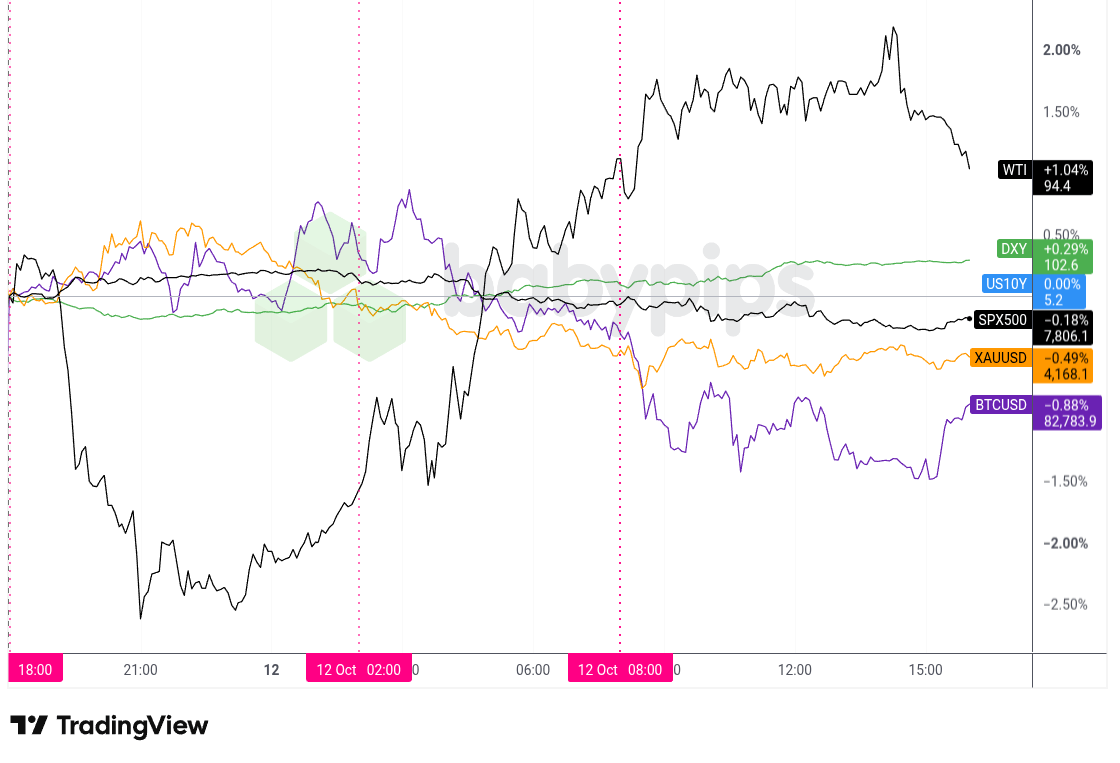
Dollar Index, Gold, Oil, S&P 500, U.S. 10-yr Yield, Bitcoin Overlay – Chart Faster With TradingView
Oil fell on energy-ceasefire hopes overnight and rebounded as Middle East attacks and doubts about the truce took over. Chipmakers pulled stocks lower, gold slipped as the dollar firmed, and Bitcoin moved with equities.
WTI crude oil rose 1.04% to near $94.40 a barrel after a round trip. Oil fell about 2.6% by 9:00 pm ET as President Trump’s energy-ceasefire announcement appeared to revive hopes for more fuel supply, despite the weekend Houthi strikes on Riyadh’s airport. The slide reversed in the European morning. Kyiv said Russia struck power plants within hours of the announcement, and the Kremlin had not confirmed the truce, which may have dimmed hopes of supply relief. A drone struck a tanker near Oman and another vessel took damage in the Strait of Hormuz, and Riyadh’s airport ran near a standstill. Doubts that Russian diesel exports can ease tight fuel markets, given the damage to Russian refineries, may have added support. WTI peaked near $95.50 in the U.S. afternoon and gave back a little into the close.
The 10-year Treasury yield stayed near 5.24% because the cash market closed for Columbus Day. Surging yields have steered trading in recent weeks, so their absence left stocks, gold and the dollar without a key reference, and thin liquidity may have exaggerated moves in other markets.
Cleveland Fed President Beth Hammack said small rate adjustments more often can help keep inflation expectations anchored, but she stopped short of backing a rate increase this month. Markets showed little reaction. Wednesday’s consumer price index is the next inflation reading before the Fed’s October meeting.
The S&P 500 fell 0.18% to near 7,806 and stayed close to its record high. A gauge of large chipmakers extended its longest losing streak since July, while most S&P 500 members rose. Memory-chip stocks fell, with Micron among the decliners as investors weighed competition from China’s CXMT. Oil above $94 and elevated yields may have limited appetite for stocks, and caution ahead of this week’s bank earnings and inflation data may have kept buyers on the sidelines. Estimates call for a 25% jump in third-quarter profits at S&P 500 companies, a backdrop that may explain why the index held near its high despite the chip selloff.
Gold fell 0.49% to near $4,168 an ounce. It climbed above $4,210 overnight as oil sank and gave up those gains as oil recovered and the dollar firmed. Gold has tended to move opposite to oil during the Iran war, because higher energy prices can lift inflation expectations and Fed hike bets, and Monday followed that pattern. The metal stalled near the $4,200 area that has turned it back before.
Bitcoin fell 0.88% to near $82,784. It peaked above $84,000 in the first hours of the London session, slipped through the London and U.S. sessions as oil recovered and the dollar firmed, and bottomed near $82,300 in mid-afternoon, about when the S&P 500 hit its low. No coin-specific headline stood out. The combination of a firmer dollar, higher oil and a chipmaker selloff may have weighed on speculative assets.
FX Market Behavior: U.S. Dollar vs. Majors
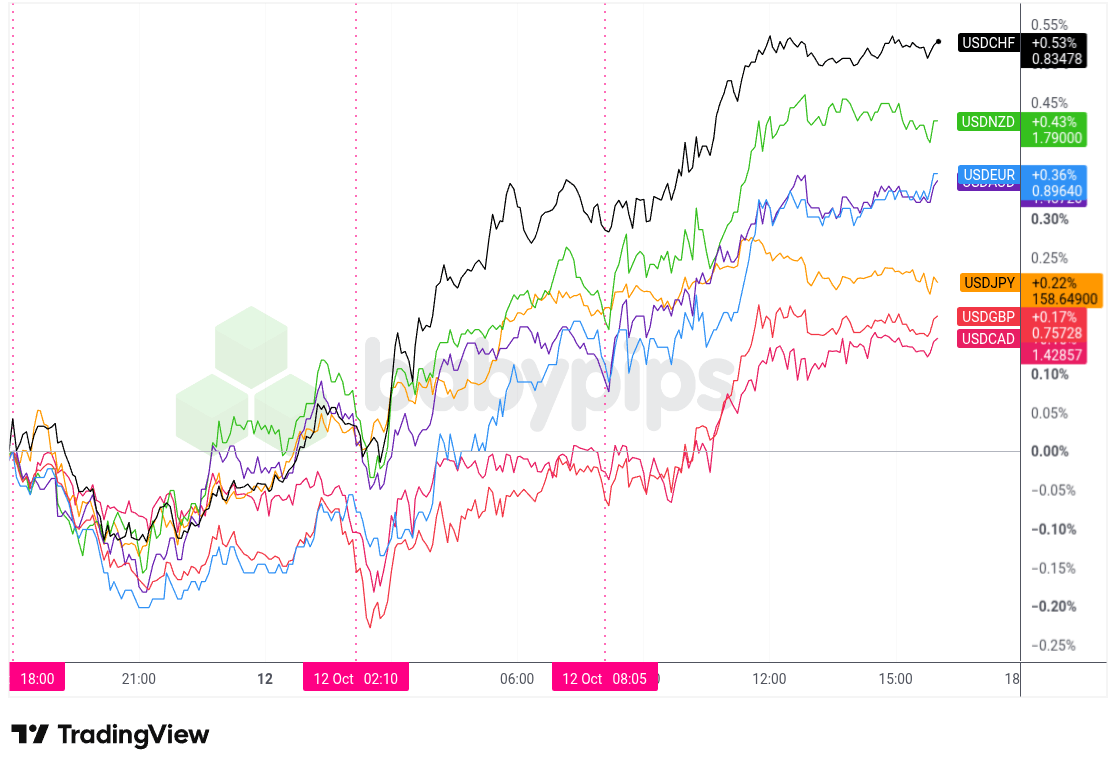
Overlay of USD vs. Major Currencies – Chart Faster With TradingView
The dollar rose against all seven majors on Monday, gaining about 0.5% against the Swiss franc and 0.4% against the New Zealand dollar and the euro. Gains against the Canadian dollar, sterling and yen stayed near 0.2% or less, and the U.S. Dollar Index climbed 0.29% to near 102.6. The dollar appeared to track oil, slipping overnight as crude fell and climbing in Europe and New York as crude recovered.
The dollar index started the week at its Asian-session high near 102.30, a level that may reflect the weekend Houthi attacks on Saudi Arabia, and slipped to near 102.11 by 9:00 pm ET in the Asian session as oil sank. Lower oil may have eased inflation worries and Fed hike bets, which could have weighed on the dollar, and gold hit its overnight high at the same time. The dollar fell about 0.1% against sterling and the euro and edged up against the New Zealand dollar, Australian dollar and yen. The dollar index finished the session little changed near 102.22. Japanese markets closed for a holiday, so the yen traded without Tokyo participation and USD/JPY held in a range of about 30 pips.
The dollar rose against all seven majors in the London session, and the dollar index gained 0.19% to near 102.42. Oil rebounded from near $91 to above $94 as ceasefire doubts and Middle East supply risks returned, and the dollar appeared to follow it higher. The Swiss franc lost the most, down about 0.3%, followed by the euro and yen. Europe imports much of its energy, so higher oil may have weighed on the euro. The franc may have lagged because the Swiss National Bank held its policy rate at 0% in September while the Fed has raised rates, a gap that will likely make the franc relatively less attractive for a while. With no cash Treasury trading, thin conditions may have amplified the moves.
The dollar extended its gains against all seven majors in the U.S. session and closed near the high of the day, with the dollar index up 0.20% to near 102.60. The Australian dollar, New Zealand dollar, Swiss franc and euro each lost about 0.24%, which fits a chipmaker selloff that may have trimmed demand for risk-sensitive currencies. The yen made the smallest move, with USD/JPY holding near 158.65. The Canadian dollar gave up less ground, and oil near $95 may have supported the loonie. The Fed’s September minutes released last week showed that most officials saw another hike as appropriate by year end, which may have kept the dollar supported to start the new week.
Upcoming Potential Catalysts on the Economic Calendar
- U.K. BRC Retail Sales Monitor for September 2026 at 11:01 pm GMT
- Japan PPI for September 2026 at 11:50 pm GMT
- Australia RBA Meeting Minutes at 12:30 am GMT
- Australia NAB Business Confidence for September 2026 at 12:30 am GMT
- BoE Greene Speech at 3:00 am GMT
- Germany Inflation Rate Final for September 2026 at 6:00 am GMT
- Fed Waller Speech at 7:45 am GMT
- U.S. NFIB Business Optimism Index for September 2026 at 10:00 am GMT
- U.S. ADP Employment Change Weekly for September 26, 2026 at 12:15 pm GMT
- U.S. Existing Home Sales for September 2026 at 2:00 pm GMT
- BoE Dhingra Speech at 4:00 pm GMT
- Fed Barkin Speech at 5:00 pm GMT
- ECB Lane Speech at 5:30 pm GMT
- U.S. Monthly Budget Statement for September 2026 at 6:00 pm GMT
- Fed Collins Speech at 8:00 pm GMT
Tuesday brings the first big U.S. bank earnings, with Goldman Sachs, JPMorgan Chase, Citigroup and Wells Fargo reporting ahead of Wednesday’s consumer price index, the key inflation reading before the Fed’s Oct. 27-28 meeting. Strong results could help the S&P 500 hold near its record, and more selling in chipmakers may keep the index in a range.
The cash Treasury market reopens, so yields can return to steering the dollar, gold and stocks, and they may adjust to Monday’s gain in oil. Waller’s speech and the ADP weekly jobs report could shift Fed rate expectations before the CPI data.
Oil traders will watch whether Russia and Ukraine honor the energy truce, how Washington and Riyadh respond to the Houthi attacks, and the International Energy Agency’s Oct. 15 board meeting, where members may discuss further diesel releases. The RBA minutes may move the Australian dollar.
AI disclosure: A Babypips editor researched and directed this article, and AI tools helped analyze the intraday price data, research sources, initiate the draft, before a Babypips editor did the final review and edit. AI tools can misread data, make arithmetic errors, and state wrong information in a confident tone. Prices, levels, and percentage moves here are approximate because the market data was not captured at the exact close, so check the figures against your own data source before you rely on them. The explanations for market moves are possible reasons, not confirmed causes. This article is for education and is not a recommendation to trade.
On Monday, the dollar rose against all seven major currencies as oil climbed, a move that runs against the inverse dollar-oil relationship many traders learned to expect. Premium members can read our lesson:
📖 The Dollar and Oil: Why the Old Rules No Longer Apply
Reading this helps you understand why the dollar and oil can rise together, why the historical inverse correlation has weakened, and what that shift means for trading the dollar when oil prices move.
And if you’re not a Premium subscriber yet, consider joining.
With Babypips Premium, you get full access to School of Pipsology lessons that help you understand not just what the dollar chart shows, but the forces linking it to oil