


The 10-year Treasury yield touched 5.36% on Wednesday, its highest level since 2002, and fell to near 5.28% after a strong auction of 10-year notes. The S&P 500 retreated from Tuesday’s record high, and gold, Bitcoin and oil all fell. The dollar rose against six of the seven major currencies, and the Fed minutes drew little reaction.
Check out the forex news and economic updates you may have missed in the latest trading session!
News Headlines & Data:
- Brent crude rose above $102 a barrel after fresh Iranian attacks on vessels in the Strait of Hormuz
- API Crude Oil Stock Change for October 2, 2026: -2.09M (1.02M previous)
- Australia AIG Manufacturing Index for September 2026: -8.7 (-16.0 forecast; -16.6 previous)
- Japan Reuters Tankan Index for October 2026: 22.0 (23.0 forecast; 21.0 previous)
- Japan Average Cash Earnings for August 2026: 3.8% y/y (4.9% y/y forecast; 4.7% y/y previous)
- Australia Building Permits Final for August 2026: 10.3% y/y (10.3% y/y forecast; 9.0% y/y previous)
- Japan Leading Economic Index Prel for August 2026: 118.0 (117.5 forecast; 117.7 previous)
- Germany Industrial Production for August 2026: 2.0% m/m (0.5% m/m forecast; -1.1% m/m previous)
- France Balance of Trade for August 2026: -6.1B (-6.5B forecast; -6.7B previous)
- U.K. BBA Mortgage Rate for September 2026: 6.58% (6.6% forecast; 6.58% previous)
- U.S. MBA 30-Year Mortgage Rate for October 2, 2026: 7.49% (7.3% previous)
- U.S. MBA Mortgage Applications for October 2, 2026: -4.2% (-6.0% previous)
- EIA Crude Oil Stocks Change for October 2, 2026: -3.19M (0.92M previous)
- U.S. Consumer Inflation Expectations for September 2026: 3.9% (3.7% forecast; 3.6% previous)
- FOMC Meeting Minutes showed all Fed officials supported the September rate hike, and many see another hike as appropriate before year end.
Broad Market Price Action:
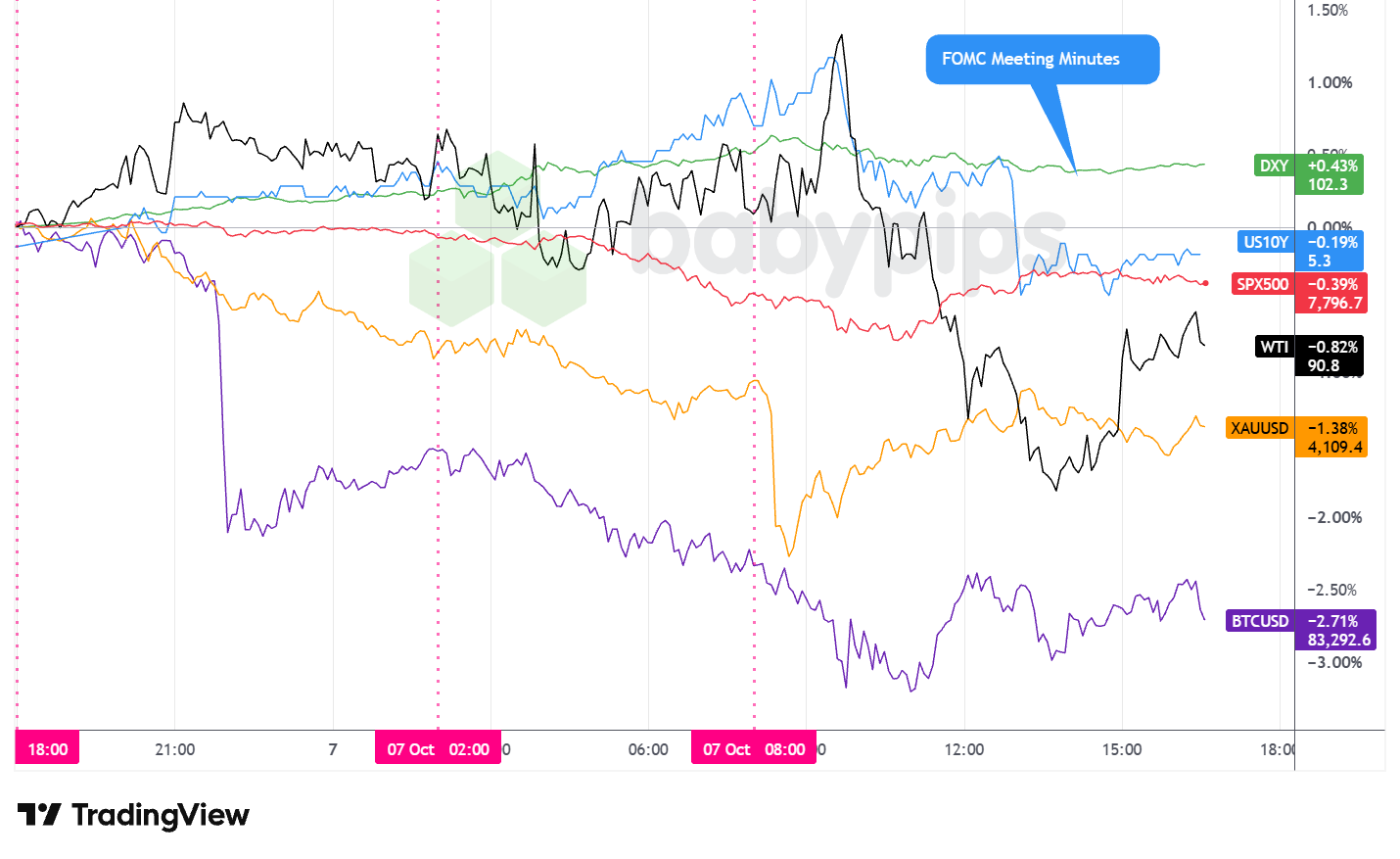
Dollar Index, Gold, Oil, S&P 500, U.S. 10-yr Yield, Bitcoin Overlay – Chart Faster With TradingView
Treasury yields appeared to steer most assets on Wednesday. Stocks, gold and Bitcoin weakened as yields climbed overnight and into the U.S. morning, and they recovered part of their losses after yields fell at the 1:00 pm ET 10-year auction.
WTI crude oil fell 1.4% to near $90 a barrel. Prices rose overnight as Houthi attack claims on Saudi sites, which Saudi authorities had not confirmed, and a storm forming in the Gulf of Mexico stoked supply concerns. WTI peaked near $92.70 at 9:40 am ET. The EIA reported a 3.19 million barrel draw in U.S. crude stocks at 10:30 am ET, but oil kept sliding to a low near $89.90 at 1:45 pm ET. The decline may reflect traders weighing fresh Iranian attacks on vessels in the Strait of Hormuz against resilient Middle East export flows.
The 10-year Treasury yield climbed from near 5.30% to 5.36% at 9:25 am ET and ended near 5.28%. The 30-year yield topped 5.70% during European trading. Oil prices, inflation worries, heavy government spending and corporate borrowing for AI projects, such as a reported $40 billion SpaceX financing to buy Nvidia chips, may have kept pressure on bonds.
At 1:00 pm ET, the Treasury sold $39 billion of 10-year notes at a high yield of 5.3%. The sale drew a bid-to-cover ratio of 2.77, the highest since 2016, and non-dealer buyers took a record 97.5% of the notes. The 10-year yield fell to near 5.27% within minutes. The FOMC minutes at 2:00 pm ET showed all 19 officials backed September’s quarter-point hike, and most saw another increase as appropriate by year end. Markets showed little reaction.
The S&P 500 fell 0.3% to near 7,803 after Tuesday’s record high. Stocks slid through the European morning as yields rose, extended losses at the 9:30 am ET open and hit a low near 7,766 at 10:45 am ET. The index recovered more than half of that decline after the auction and held flat through the minutes. Elevated oil prices and the risk of more Fed rate hikes may have weighed on stocks.
Gold fell 1.3% to near $4,112 an ounce. The metal slid overnight and through the European morning as the dollar and Treasury yields firmed, despite China’s central bank extending its gold purchases for a 23rd straight month in September. At 8:25 am ET, gold dropped $33 in five minutes and bottomed near $4,072 at 8:40 am ET. No single headline stood out as an explanation for the drop, which came as the dollar index and 10-year yield approached their morning highs. Gold regained more than $40 by early afternoon as yields eased from their highs.
Bitcoin fell 2.6% to near $83,400. The price dropped from near $85,300 to near $83,800 in 15 minutes around 10:00 pm ET Tuesday, and a liquidation of more than $400 million in leveraged long positions within one hour may have amplified the decline. Bitcoin hit a low near $82,900 during the U.S. morning and regained little ground. No coin-specific headline stood out. The slide fit a backdrop of firmer Treasury yields and a stronger dollar, a mix that can pressure speculative assets.
FX Market Behavior: U.S. Dollar vs. Majors
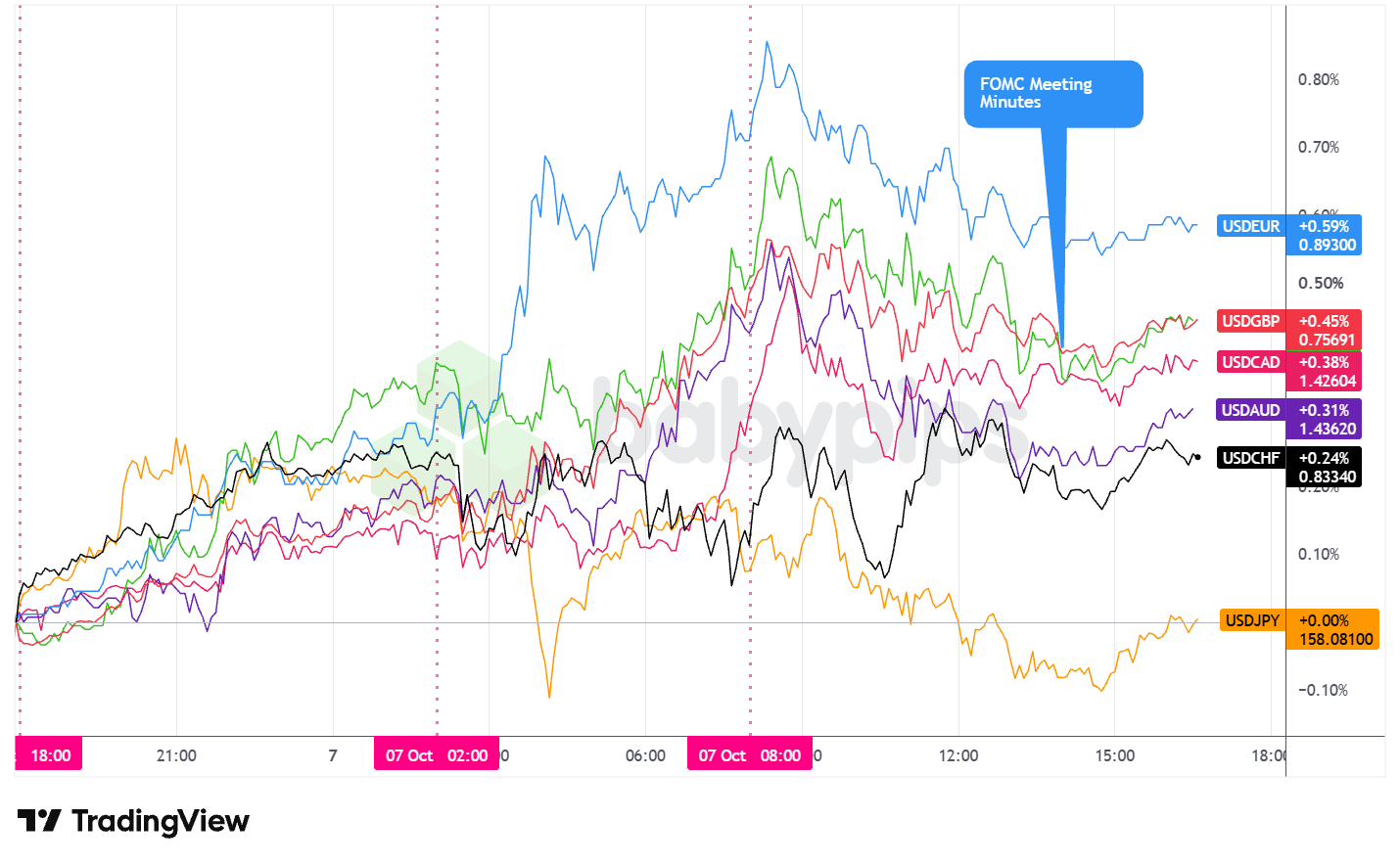
Overlay of USD vs. Major Currencies – Chart Faster With TradingView
Six of the seven major currencies lost ground to the dollar on Wednesday, with the euro the weakest and the yen the only major to gain. The dollar rose 0.57% against the euro, 0.46% against sterling, 0.43% against the New Zealand dollar, 0.36% against the Canadian dollar, 0.27% against the Australian dollar and 0.22% against the Swiss franc, and it fell 0.05% against the yen. The U.S. Dollar Index climbed 0.42% to near 102.3.
The dollar climbed against all seven majors in the Asian session as Treasury yields firmed ahead of the FOMC minutes, and the dollar index rose 0.26% to near 102.1. The kiwi and the euro lost the most ground. USD/JPY reached 158.50 near 9:00 pm ET after Japan reported average cash earnings growth of 3.8% y/y against a 4.9% forecast, a miss that may have weakened the yen.
The dollar extended its gains against five of the seven majors in the London session, and the dollar index added 0.26% to near 102.4 as the 10-year yield rose to 5.34% and the 30-year yield topped 5.70%. The euro took the biggest hit. Germany’s August industrial production jumped 2.0% m/m against a 0.5% forecast, yet the euro showed no lasting gain and fell to near 1.1190 against the dollar around 4:00 am ET. Recent French fiscal worries may have added to the pressure, and France’s finance ministry said it is not changing its bond-issuance strategy. USD/JPY dipped below 158 near 4:10 am ET, a brief gain for the yen.
The dollar peaked near 8:20 am ET at the start of the U.S. session, with the dollar index at 102.49 and the euro near 1.1170. From there it drifted lower as Treasury yields retreated from their highs, and the decline extended after the 10-year auction at 1:00 pm ET. The dollar index held near 102.23 through the 2:00 pm ET FOMC minutes and edged up to near 102.27 by 4:00 pm ET. The yen edged higher after midday and USD/JPY slipped to near 157.90 before climbing back to near 158.04, which trimmed the yen’s gain to 0.05% and left it as the only major to gain against the dollar. Fed funds futures and swaps put the odds of another hike at the Fed’s Oct. 27-28 meeting between 20% and 25% and price in a hike by year end, which may have limited the dollar’s decline.
Upcoming Potential Catalysts on the Economic Calendar
- Japan Current Account for August 2026 at 11:50 pm GMT
- Australia Consumer Inflation Expectations for October 2026 at 12:00 am GMT
- Japan Eco Watchers Survey Outlook for September 2026 at 5:00 am GMT
- Germany Balance of Trade for August 2026 at 6:00 am GMT
- BoE Credit Conditions Survey at 8:30 am GMT
- Fed Waller Speech at 8:30 am GMT
- BoE Greene Speech at 9:15 am GMT
- ECB Lane Speech at 10:00 am GMT
- ECB Monetary Policy Meeting Accounts at 11:30 am GMT
- BoE Gov Bailey Speech at 12:15 pm GMT
- U.S. Initial Jobless Claims for October 3, 2026 at 12:30 pm GMT
- Atlanta Fed GDPNow at 3:00 pm GMT
- Fed Musalem Speech at 5:40 pm GMT
The Treasury’s $22 billion 30-year bond auction on Thursday follows Wednesday’s strong 10-year sale and is on course to offer the highest yield since 2000. A buyback of up to $6 billion of bonds maturing in 20 to 30 years follows it. Weak demand at the long end could revive the bond selloff that lifted the dollar on Wednesday, while firm demand may extend the pullback in yields.Jobless claims offer a read on whether the labor market supports another Fed hike.
In Europe, the ECB’s meeting accounts and speeches from the ECB’s Lane and the BoE’s Bailey may show how policymakers view French fiscal stress and the euro’s slide. Chinese markets return from the Golden Week holiday.
This market recap shows Treasury yields steering stocks, gold, oil, Bitcoin, and the dollar all at once. You’re watching intermarket dynamics in real time, but understanding the mechanism behind the moves takes a framework that most traders never build. Premium members can read our lesson:
📖 What Is Intermarket Analysis?
Reading this helps you understand how bond yields affect currency prices, why gold and Bitcoin fell when the dollar rose, and how to read multiple asset classes together instead of watching your pair in isolation.
And if you’re not a Premium subscriber yet, consider joining to access these lessons whenever you need them.
With Babypips Premium, you get full access to School of Pipsology lessons that help you understand not just what the chart is showing, but the deeper economic and liquidity flows driving the moves
AI disclosure: A Babypips editor researched and directed this article, and AI tools helped analyze the intraday price data, research sources, initiate the draft, before a Babypips editor did the final review and edit. AI tools can misread data, make arithmetic errors, and state wrong information in a confident tone. Prices, levels, and percentage moves here are approximate because the market data was not captured at the exact close, so check the figures against your own data source before you rely on them. The explanations for market moves are possible reasons, not confirmed causes. This article is for education and is not a recommendation to trade.