A softer core PCE print pushed the dollar and Treasury yields lower on Wednesday morning. Both recovered by the afternoon, a move that may reflect stronger growth and hiring data, firmer oil, and quarter-end flows. The S&P 500 surrendered its gains in the last half hour of trading, gold fell, and the dollar ended higher against every major except the pound.
Check out the forex news and economic updates you may have missed in the latest trading session!
News Headlines & Data:
- API Crude Oil Stock Change for September 25, 2026: 1.02M (1.79M previous)
- Japan Retail Sales for August 2026: 2.7% y/y (3.5% y/y forecast; 4.0% y/y previous)
- Japan Industrial Production Prel for August 2026: 3.4% y/y (3.7% y/y forecast; 3.9% y/y previous)
- New Zealand ANZ Business Confidence for September 2026: 51.9 (55.1 forecast; 53.7 previous)
- Australia CPI Growth Rate for August 2026: 4.0% y/y (4.0% y/y forecast; 3.5% y/y previous)
- Australia Building Permits Prel for August 2026: 10.3% y/y (12.5% y/y forecast; 9.0% y/y previous)
- China NBS Manufacturing PMI for September 2026: 50.1 (50.0 forecast; 49.8 previous)
- China NBS Non Manufacturing PMI for September 2026: 50.2 (49.6 forecast; 49.0 previous)
- China RatingDog Manufacturing PMI for September 2026: 52.1 (51.5 forecast; 51.5 previous)
- China RatingDog Services PMI for September 2026: 51.6 (51.7 forecast; 51.4 previous)
- Japan Construction Orders for August 2026: -3.6% y/y (-12.0% y/y forecast; -13.4% y/y previous)
- Japan Housing Starts for August 2026: 6.1% y/y (8.0% y/y forecast; 8.2% y/y previous)
- Germany Import Prices for August 2026: 1.0% m/m (0.4% m/m forecast; 0.2% m/m previous)
- Germany Retail Sales for August 2026: -0.4% y/y (-1.0% y/y forecast; -2.5% y/y previous)
- U.K. GDP Growth Rate Final for Q2 2026: 1.4% y/y (1.2% y/y forecast; 0.9% y/y previous); 0.5% q/q (0.4% q/q forecast; 0.6% q/q previous)
- Germany Unemployment Rate for September 2026: 6.4% (6.4% forecast; 6.4% previous)
- Swiss Economic Sentiment Index for September 2026: 2.6 (13.0 forecast; 12.1 previous)
- U.S. MBA 30-Year Mortgage Rate for September 25, 2026: 7.3% (7.12% previous)
- U.S. MBA Mortgage Applications for September 25, 2026: -6.0% (-1.5% previous)
- Germany CPI Growth Rate Prel for September 2026: 3.3% y/y (3.1% y/y forecast; 2.9% y/y previous)
- U.S. ADP National Employment Report for September 2026: 90.0k (49.0k forecast; 38.0k previous)
- U.S. Core PCE Price Index for August 2026: 0.2% m/m (0.3% m/m forecast; 0.2% m/m previous)
- U.S. GDP Growth Rate Final for Q2 2026: 2.2% q/q (1.5% q/q forecast; 2.1% q/q previous)
Broad Market Price Action:
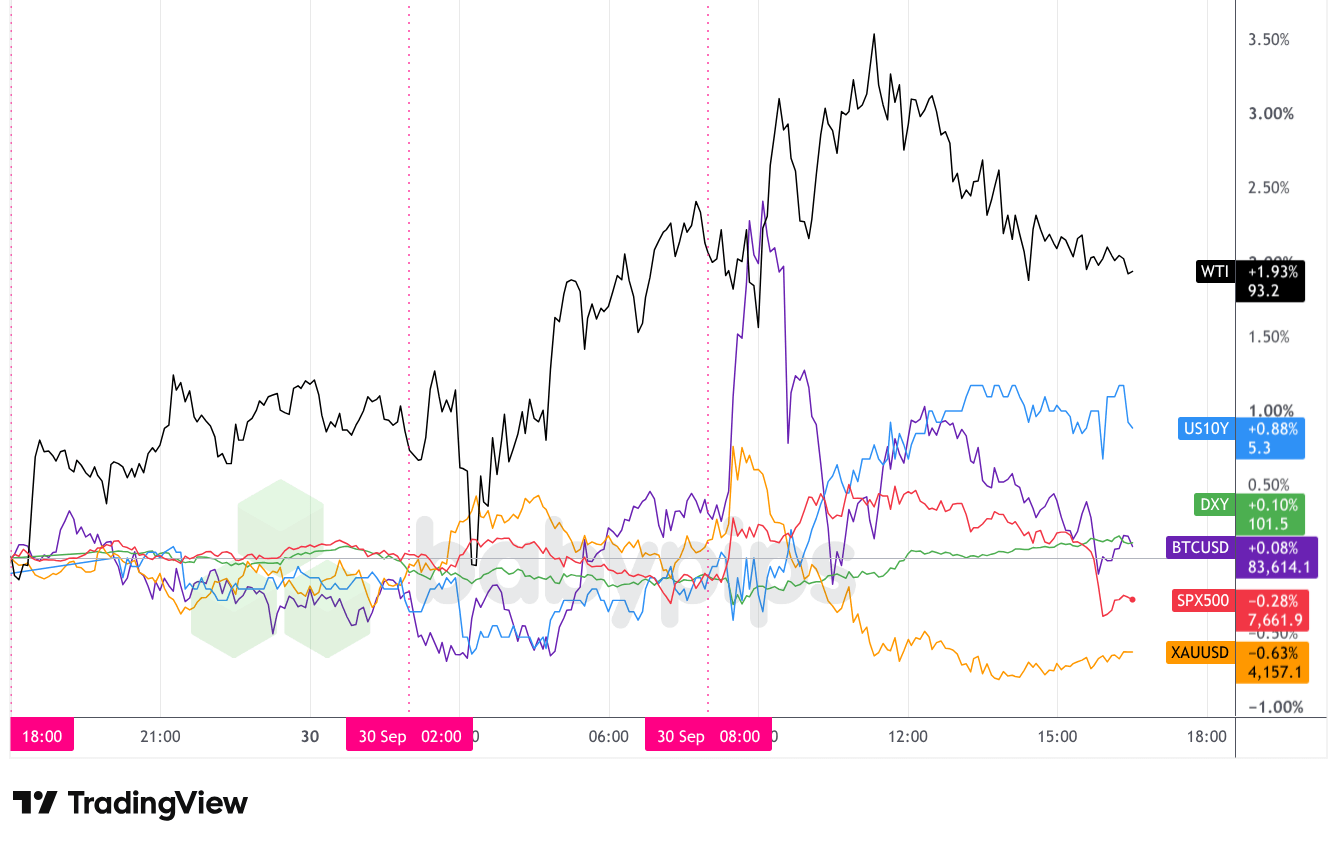
Dollar Index, Gold, Oil, S&P 500, U.S. 10-yr Yield, Bitcoin Overlay – Chart Faster With TradingView
Core PCE inflation rose 0.2% in August against a 0.3% forecast, and the softer reading drove the session’s first big swing across risk assets and the dollar. The CME FedWatch tool now shows a less than a 40% chance of a Fed hike in October after the release. During the U.S. afternoon, most of the initial reaction reversed.
The S&P 500 held a narrow range through Asia and London and climbed about half a percent by mid-morning in New York as the PCE data reinforced bets on an October hold. By 2 pm ET the index had erased its September loss. The gains held until about 3:45 pm ET, when the index sank and ended the chart near 7,660, down about 0.3% on the day. The late slide had no obvious catalyst. Micron’s earnings after the close and quarter-end positioning may have kept buyers on the sidelines.
Oil led the board, with WTI up about 1.9% near $93 after a session high near $94.60 before midday in New York. Crude climbed through Asia after President Trump denied he would ease sanctions on Iran, and buyers kept control through London. Crude shed part of the gain after midday, a fade that may reflect improving Middle East export flows and a planned release of up to 40 million barrels from the U.S. Strategic Petroleum Reserve.
Gold dropped about 0.6% to near $4,157. The metal jumped to near $4,215 when the PCE data hit and the dollar and yields dipped, and it sold off through the afternoon as both recovered. The session low came near $4,150 a little before 2 pm ET.
Bitcoin finished near $83,600, up about 0.1%, after a spike of about 2% to near $85,500 in the hour following the PCE release. The rally faded by mid-morning, and price drifted to flat by the afternoon. No Bitcoin-specific headline surfaced, so the round trip may mirror the swing in Fed hike odds that moved stocks and gold: a bid on softer inflation and a fade as yields climbed.
The 10-year Treasury yield rose about 5 basis points to near 5.30%, with the 30-year yield holding at its highest since 2002. The 10-year dipped toward 5.22% after the PCE release and climbed to a session high near 5.30% around 1:15 pm ET. Second-quarter GDP growth of 2.2% against a 1.5% forecast and a 90,000 gain in ADP payrolls against 49,000 expected may have kept bond buyers away. August PCE predates the September jump in diesel prices, one possible reason the relief faded.
FX Market Behavior: U.S. Dollar vs. Majors
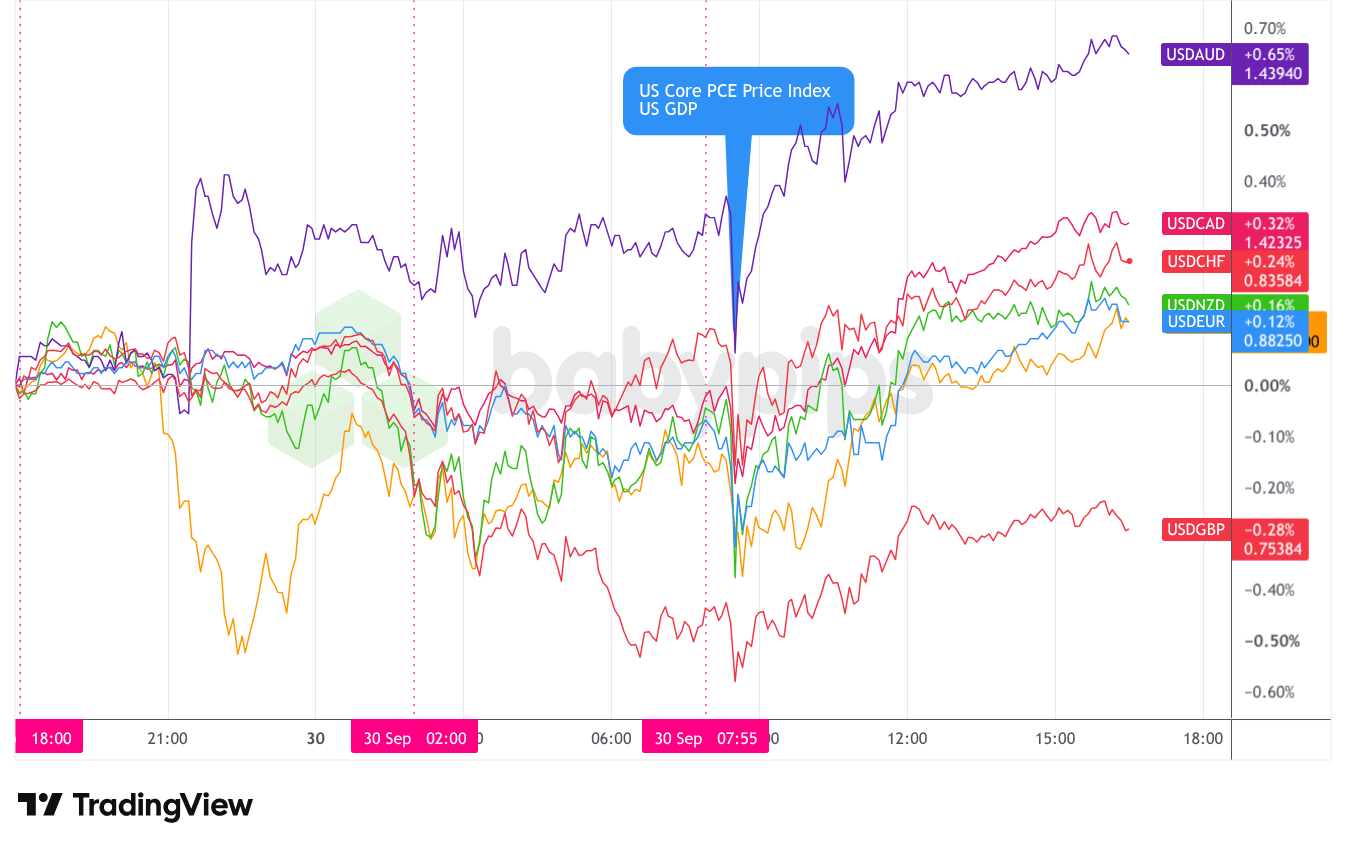
Overlay of USD vs. Major Currencies – Chart Faster With TradingView
The dollar finished higher against most majors after a round trip. The U.S. Dollar Index rose about 0.1% to near 101.5, and the Australian dollar lagged the most. The dollar sat on pace for its best month since June.
The dollar traded mixed in the Asian session, with the Australian dollar and the yen setting the direction. Australian CPI matched the 4.0% y/y forecast, but trimmed mean inflation held at 3.6% y/y against a 3.7% forecast, and USD/AUD jumped about 0.4% after the release. The cooler core reading may have reduced pressure for a near-term RBA hike. USD/JPY slid from near 157.4 to a low around 156.4 despite weak Japanese industrial production and retail sales, a move that may reflect fiscal half-year-end flows from Japanese exporters and investors. USD/NZD ticked higher around the ANZ business confidence miss at 51.9.
The London session favored the pound. USD/GBP fell about 0.4% below its starting level as second-quarter U.K. GDP grew 0.5% q/q against a 0.4% forecast and business investment rose 5.2% y/y against 0.8% expected, two possible drivers of the move. French and German inflation came in hot at 3.0% and 3.3% y/y, but the euro held a narrow range. The Swiss franc softened as economic sentiment sank to 2.6 from 12.1, a drop that may have weighed on it.
The U.S. session opened with a dollar dive. The Dollar Index hit a session low near 101.06 at 8:30 am ET as the softer core PCE reading landed, and USD/GBP touched its lowest level of the day. A reversal followed. The dollar climbed against every major through the afternoon, sterling included, and the Dollar Index gained close to 0.45% from its low. The pound ended ahead on the day. One possible explanation is a shift in attention from core PCE to the stronger GDP and ADP prints, along with rising oil, higher Treasury yields, and month-end flows. The Canadian dollar slipped about 0.3% against the greenback while WTI gained, a sign that broad dollar demand may have outweighed the oil lift.
Upcoming Potential Catalysts on the Economic Calendar
- Australia S&P Global Manufacturing PMI Final for September 2026 at 11:00 pm GMT
- Japan Tankan Large Manufacturers Index for September 30, 2026 at 11:50 pm GMT
- Japan S&P Global Manufacturing PMI Final for September 2026 at 12:30 am GMT
- Australia Balance of Trade for August 2026 at 1:30 am GMT
- U.K. Nationwide Housing Prices for September 2026 at 6:00 am GMT
- Swiss CPI Growth Rate for September 2026 at 6:30 am GMT
- Swiss Retail Sales for August 2026 at 6:30 am GMT
- Swiss procure.ch Manufacturing PMI for September 2026 at 7:30 am GMT
- Euro area S&P Global Manufacturing PMI Final for September 2026 at 8:00 am GMT
- U.K. S&P Global Manufacturing PMI Final for September 2026 at 8:30 am GMT
- Euro area Unemployment Rate for August 2026 at 9:00 am GMT
- U.S. Challenger Job Cuts for September 2026 at 9:30 am GMT
- U.S. Initial Jobless Claims for September 26, 2026 at 12:30 pm GMT
- Speeches from Fed Barkin, Schmid, & Collins at 1:05 pm GMT
- Canada S&P Global Manufacturing PMI for September 2026 at 1:30 pm GMT
- ECB President Lagarde Speech at 1:30 pm GMT
- U.S. S&P Global Manufacturing PMI Final for September 2026 at 1:45 pm GMT
- ISM Manufacturing PMI for September 2026 at 2:00 pm GMT
- U.S. Construction Spending for August 2026 at 2:00 pm GMT
- ECB Schnabel Speech at 3:30 pm GMT
Asia-Pacific traders open Thursday with manufacturing data. Australia’s final PMI arrives first, after the flash reading dropped to 49.3 from 52.0, the first contraction since March. The Tankan headlines at 11:50 pm GMT. Large manufacturers rose to +22 in June from +17, but firms guided to +17 for September, so a lower print would match their outlook. USD/JPY closed the chart near 157.4, above the 152.57 average rate respondents assumed for fiscal 2026, which may keep currency costs in focus. Mainland Chinese markets stay closed through October 7 and Hong Kong shuts Thursday, so liquidity may run thin.
Swiss CPI and retail sales land at 6:30 am GMT. August inflation rose 0.8% y/y, the fastest since September 2024, and topped every forecast in a Bloomberg survey. Final PMIs from France, Germany, the euro area, and the U.K. arrive between 7:50 and 8:30 am GMT, with flash readings at 52.7 for the euro area and 52.0 for the U.K. Lagarde speaks at 1:30 pm GMT and Schnabel at 3:30 pm GMT. The ECB raised its deposit rate to 2.50% on September 17, and Schnabel has said borrowing costs must rise further, so traders may watch both for signals on the next meeting.
Initial jobless claims land at 12:30 pm GMT after a 1,000 drop to 197,000 the week before. Fed’s Barkin, Schmid, and Collins speak at 1:05 pm GMT, with money markets pricing less than a 40% chance of an October hike after the PCE data. Hawkish remarks could lift Treasury yields, with the 30-year yield at its highest since 2002. Williams, who said Tuesday there was no urgency for another rate hike, speaks a second time at 7:30 pm GMT.
The final S&P Global U.S. manufacturing PMI arrives at 1:45 pm GMT after a flash print of 57.0, the strongest since May 2022. ISM follows at 2:00 pm GMT. August’s ISM reading slipped to 54.6, with new orders down 3 points to 53.7 and the prices index at 71.1. The S&P Global flash surged in September while ISM cooled in August, so the print may show whether the surveys converge. A high prices index alongside rising oil may keep inflation worries in play after the softer core PCE reading.
Thursday’s economic calendar is packed with manufacturing surveys, inflation data, and central bank rhetoric. Most traders focus on the numbers themselves, but the real market driver is understanding what traders have already priced in. Premium members can read our lesson:
📖 Market Expectations: Why Good News Can Tank a Currency
Reading this helps you understand what markets have already priced in before data lands, how the market reacts to deviations from consensus forecasts, and why understanding rate expectations matters as much as the economic data itself.
And if you’re not a Premium subscriber yet, this is a perfect time to join.
With Babypips Premium, you get full access to School of Pipsology lessons that help you understand not just what economic data says, but what the market has already priced in and how that creates your actual trading opportunity.