


The U.S. 30-year Treasury yield reached its highest level since 2002 on Tuesday, overshadowing the weakest U.S. consumer confidence reading since 2014 while the dollar firmed against most majors. The Reserve Bank of Australia raised its cash rate to 4.60% and adopted a more cautious tone on further hikes, and the Australian dollar weakened after the press conference. Energy prices fell close to 5% amid signs of recovering Middle East supply.
Check out the forex news and economic updates you may have missed in the latest trading session!
News Headlines & Data:
- Australia Household Spending for August 2026: 6.8% y/y (6.4% y/y forecast; 7.0% y/y previous)
- RBA Interest Rate Decision for September 29, 2026: 4.6% (4.6% forecast; 4.35% previous); further hikes remain possible as policymakers seek to contain inflation.
- Japan Leading Indicators Index for July 2026: 117.7 (117.9 forecast; 116.5 previous)
- Swiss KOF Leading Indicators for September 2026: 109.1 (107.0 forecast; 106.7 previous)
- U.K. Mortgage Approvals for August 2026: 54.92k (57.0k forecast; 56.05k previous)
- U.K. BoE Consumer Credit for August 2026: 2.46B (1.9B forecast; 2.01B previous)
- U.K. Net Lending to Individuals for August 2026: 6.87B (6.4B forecast; 6.3B previous)
- U.K. Mortgage Lending for August 2026: 4.41B (4.5B forecast; 4.29B previous)
- Euro area Economic Sentiment for September 2026: 97.9 (98.5 forecast; 98.4 previous)
- Euro area Consumer Confidence for September 2026: -16.5 (-16.5 forecast; -15.5 previous)
- Euro area Consumer Inflation Expectations for September 2026: 35.2 (40.0 forecast; 33.0 previous)
- France Unemployment Benefit Claims for August 2026: -61.3k (15.0k forecast; 21.5k previous)
- Canada GDP for August 2026: 0.2% m/m (0.2% m/m forecast; 0.0% m/m previous)
- U.S. House Price Index for July 2026: 2.6% y/y (2.2% y/y forecast; 2.3% y/y previous)
- U.S. S&P/Case-Shiller Home Price for July 2026: 2.5% y/y (2.0% y/y forecast; 2.1% y/y previous)
- U.S. JOLTs Job Openings for August 2026: 7.08M (7.24M forecast; 7.27M previous)
- CB U.S. Consumer Confidence for September 2026: 81.9 (89.0 forecast; 89.4 previous)
- Dallas Fed Services Index for September 2026: -1.8 (1.0 forecast; 4.2 previous)
- Federal Reserve Governor Michael Barr said on Tuesday that further interest-rate increases will likely be needed to slow inflation.
- Bank of England rate-setter Alan Taylor said on Tuesday that due to a lack of evidence that higher inflation is spreading widely, the case for interest-rate hikes is “not compelling”
Broad Market Price Action:
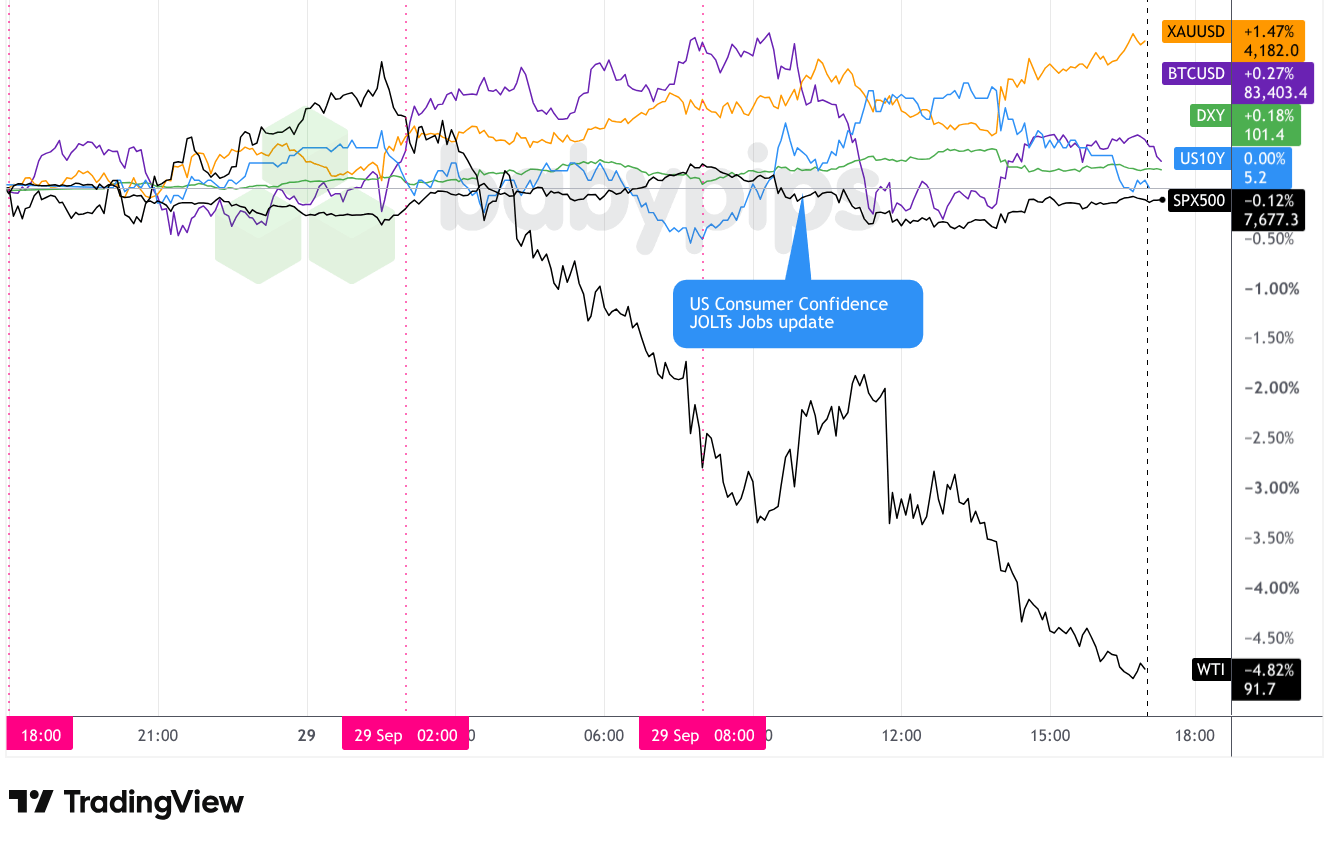
Dollar Index, Gold, Oil, S&P 500, U.S. 10-yr Yield, Bitcoin Overlay – Chart Faster With TradingView
Traders focused on bond yields and energy prices on Tuesday. Long-dated Treasury yields kept climbing into the U.S. session, and the pressure continued after U.S. consumer confidence fell to 81.9 in September, its lowest reading since 2014, and JOLTS job openings slipped to 7.08 million.
S&P 500 ended near 7,677, down 0.12%. The index touched a low near 7,658 around 1:30 a.m. ET, climbed to a high near 7,705 by the end of the London session, and drifted lower through the U.S. session to a low near 7,655 around 1:05 p.m. ET. It held near 7,680 through the 10:00 a.m. ET data releases. The slide in the U.S. session coincided with rising long-dated Treasury yields, which may have weighed on equity valuations.
WTI crude oil fell 4.82% to trade near $91.70, the largest move on the overlay chart above. Prices peaked near $97.60 around 1:30 a.m. ET, and slid through the London session and into the U.S. session, with another leg lower around 11:45 a.m. ET that had no obvious catalyst. The decline may reflect signs that Middle East crude exports are recovering, including Saudi Arabia’s restart of East-West pipeline flows, along with hopes that U.S.-Iran talks could open an off-ramp. Iran’s foreign minister said he expected a formal U.S. answer on Tuesday to Tehran’s proposal to reopen the Strait of Hormuz.
Gold gained 1.47% to trade near $4,182, recovering part of Monday’s slump, when higher yields weighed on the metal. It climbed in steps through the Asia and London sessions and set its session high near the close. Gold rose despite a firm dollar and Treasury yields near multi-year highs, a combination that tends to pressure the metal. One possible explanation is that falling oil eased some inflation worries. A jump of about $19 around 2:00 p.m. ET coincided with a brief dip in yields and the dollar.
Bitcoin rose 0.27% to trade near $83,400 after a round trip. It climbed to a high near $84,500 around 9:20 a.m. ET, in the hour before the 10:00 a.m. ET releases, then fell to lows near $82,900 in the late morning and early afternoon as long-dated yields rose. The slide may reflect sensitivity to higher yields and tighter financial conditions. Bitcoin recovered part of the drop around 2:00 p.m. ET as yields eased.
The 10-year Treasury yield ended near 5.25%, little changed on the overlay after a round trip. It fell to near 5.21% during the London session as oil dropped, then climbed through the U.S. session to a high near 5.29%, its highest level since 2007. The 30-year yield rose above 5.6%, its highest level since 2002. One possible explanation is heavy corporate bond supply, including an investment-grade bond sale from Paramount Skydance that ranks among the largest on record, alongside expectations for more Fed hikes. Fed Governor Michael Barr said further rate increases are likely needed and that he does not yet see a clear trend toward 2% inflation. Fed funds futures show traders expect a hike in October and see a second hike in December as possible.
FX Market Behavior: U.S. Dollar vs. Majors
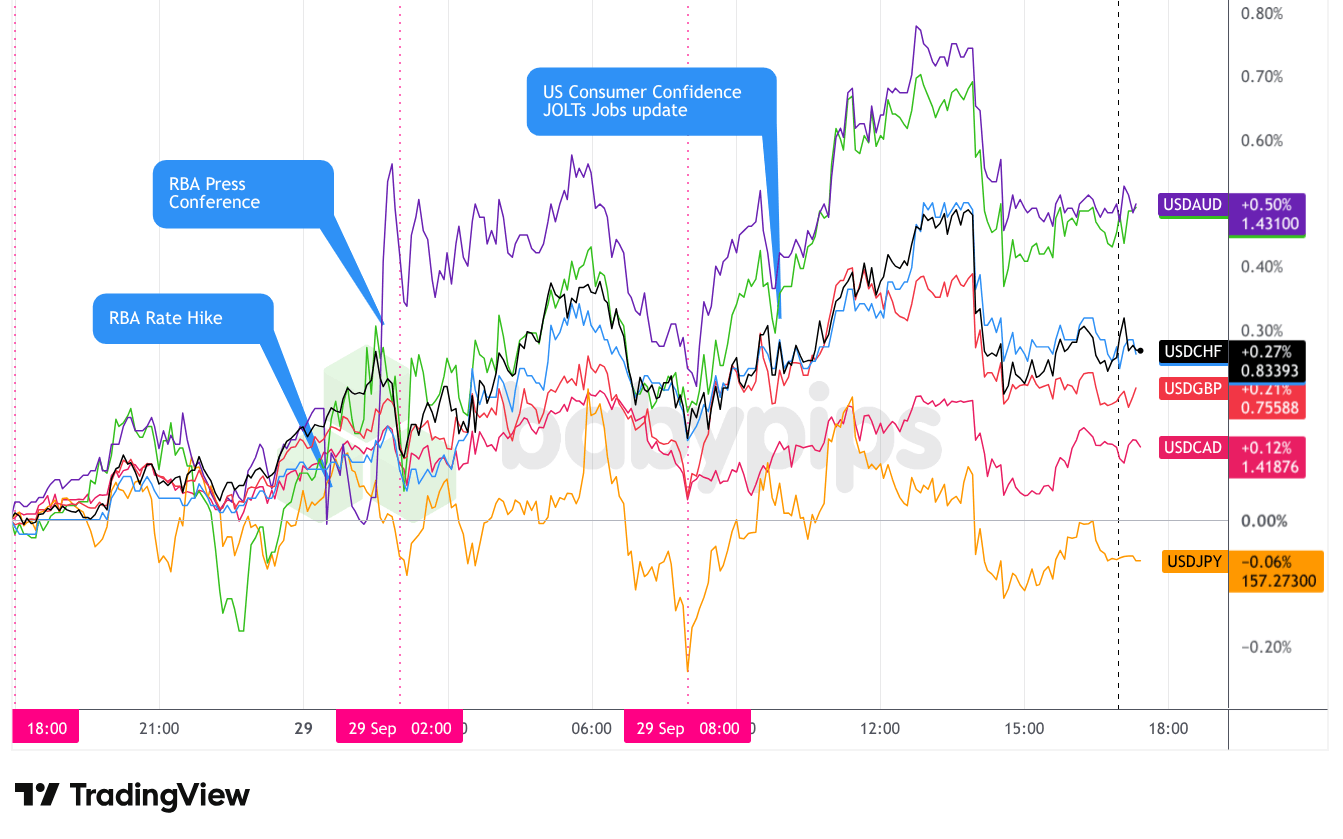
Overlay of USD vs. Major Currencies – Chart Faster With TradingView
The U.S. dollar finished higher against six of the seven majors on Tuesday, and the Dollar Index gained 0.18% to near 101.40. USD/AUD and USD/NZD led with gains near 0.5%, while USD/JPY was the lone decliner, down 0.06%. Rising Treasury yields and Fed rate hike expectations appeared to correlate with the dollar’s strength.
During the Asia session, the dollar traded with a mild bullish lean as the RBA took center stage. The bank raised its cash rate 25 basis points to 4.60% at 12:30 a.m. ET, as traders expected, and USD/AUD dipped to a low near 1.4238 as the Aussie firmed for a moment. The pair reversed higher and jumped after Governor Michele Bullock’s 1:30 a.m. ET press conference, peaking near 1.4319 by 1:50 a.m. ET. The RBA dropped the reference to inflation returning to the midpoint of its target range in late 2027 from its statement and softened its guidance on future hikes, and Bullock said the bank may not need another hike if inflation keeps falling. USD/NZD followed USD/AUD higher, which may reflect spillover from the Australian dollar’s decline. USD/JPY held a narrow range near 157.4 as Japanese Finance Minister Satsuki Katayama repeated that an undervalued yen is a concern.
The dollar traded mixed and choppy in the London session, and the Dollar Index ended it little changed. USD/EUR climbed to a high near 0.8822 around 5:35 a.m. ET, and the euro-area Economic Sentiment miss may have weighed on the single currency. USD/JPY fell to a low near 157.15 by 7:45 a.m. ET as Treasury yields dipped and oil declined.
The dollar rallied through most of the U.S. session. It dipped after the weak 10:00 a.m. ET releases but recovered within an hour and resumed climbing, which may indicate that traders gave more weight to inflation and rate hike expectations than to the soft growth data. The Dollar Index reached a high near 101.60 around 1:50 p.m. ET while the 10-year yield held near its session high. USD/AUD peaked near 1.4350, up close to 0.8%, and USD/NZD and USD/CHF posted session highs in the same window. Barr’s hawkish remarks may have reinforced hike expectations ahead of the Fed’s October 28 decision. Around 2:00 p.m. ET the dollar dropped across the majors as yields dipped, with no clear catalyst at the time of this writing, and it closed off its highs.
Upcoming Potential Catalysts on the Economic Calendar
- Japan Retail Sales for August 2026 at 11:50 pm GMT
- Japan Industrial Production Prel for August 2026 at 11:50 pm GMT
- ANZ NZ Business Confidence for September 2026 at 12:00 am GMT
- Australia Housing & Private Sector Credit for August 2026 at 1:30 am GMT
- Australia CPI Growth Rate for August 2026 at 1:30 am GMT
- Australia Building Permits Prel for August 2026 at 1:30 am GMT
- China NBS General PMI for September 2026 at 1:30 am GMT
- China RatingDog Manufacturing & Services PMI for September 2026 at 1:45 am GMT
- Japan Housing Starts for August 2026 at 5:00 am GMT
- Germany Import Prices for August 2026 at 6:00 am GMT
- Germany Retail Sales for August 2026 at 6:00 am GMT
- U.K. GDP Growth Rate Final for June 30, 2026 at 6:00 am GMT
- Germany Unemployment Rate for September 2026 at 7:55 am GMT
- Swiss Economic Sentiment Index for September 2026 at 8:00 am GMT
- U.S. MBA Mortgage Applications & 30-Year Mortgage Rate for September 25, 2026 at 11:00 am GMT
- Germany CPI Growth Rate Prel for September 2026 at 12:00 pm GMT
- ADP U.S. National Employment Report for September 2026 at 12:15 pm GMT
- U.S. Core PCE Price Index for August 2026 at 12:30 pm GMT
Wednesday’s calendar opens with Australia’s August CPI at 1:30 a.m. GMT. Bullock cautioned against leaning on a single monthly reading, yet the print could shape the debate over another RBA hike. Germany’s preliminary September CPI follows in the European session.
The bigger tests for the dollar arrive in the U.S. morning, when ADP employment and the Core PCE price index land while fed funds futures point to an October hike. A firm inflation print could extend the dollar and yield strength, and a soft one may give the bond selloff room to pause. The September jobs report follows on Friday.
This recap shows how rising Treasury yields and Fed rate hike expectations drove dollar strength across major pairs on Tuesday, overshadowing weaker growth data. But the connection between bond yields and currency movements isn’t always obvious to newer traders. Premium members can read our lesson:
📖 How Bond Yields Affect Currency Movements
Reading this helps you understand why higher yields attract foreign capital to a currency, how yield differentials between countries drive exchange rates, and why bond market moves often precede forex moves.
And if you’re not a Premium subscriber yet, now’s a good time to sign up.
With Babypips Premium, you get full access to School of Pipsology lessons that help you understand why bond yield moves are often predictive of currency moves, so you can get ahead of the price action.