


A deepening global bond selloff set the tone on Thursday, with long-dated Treasury yields pushing to multi-decade highs as a fresh jump in oil revived inflation worries and hardened bets on more Federal Reserve tightening. Higher borrowing costs kept risk appetite in check, leaving equities on the back foot and gold under pressure, while the U.S. dollar firmed against every major. A summit between President Donald Trump and Xi Jinping, paired with a two-month extension of the U.S.-China trade truce, ran in the background without shifting the rates-driven mood.
Check out the forex news and economic updates you may have missed in the latest trading session!
News Headlines & Data:
- The U.S. and China agreed to extend their trade truce by about two months to January 10 as Xi Jinping began a state visit and met Trump at the White House, where the two leaders aired their rivalry over artificial intelligence.
- Australia Employment Change for August 2026: 39.5k (15.1k forecast; -15.8k previous)
- Swiss SNB Interest Rate Decision for September 24, 2026: 0.0% (0.0% forecast; 0.0% previous)
- Germany Ifo Expectations for September 2026: 90.4 (88.7 forecast; 89.1 previous)
- U.K. CBI Distributive Trades for September 2026: -55.0 (-49.0 forecast; -48.0 previous)
- U.S. Building Permits Final for August 2026: -2.1% m/m (-2.7% m/m forecast; 4.3% m/m previous)
- Canada CFIB Business Barometer for September 2026: 47.9 (53.0 forecast; 57.6 previous)
- Canada Average Weekly Earnings for July 2026: 3.2% y/y (3.4% y/y forecast; 3.4% y/y previous)
- Canada Retail Sales Prel for August 2026: 1.3% m/m (0.4% m/m forecast; -0.8% m/m previous)
- Canada Manufacturing Sales Prel for August 2026: 1.1% m/m (-0.1% m/m forecast; -0.4% m/m previous)
- The Federal Reserve unveiled draft rules for stablecoin issuers, proposing full reserve backing and a bank application process, subject to a 60-day comment period.
Broad Market Price Action:
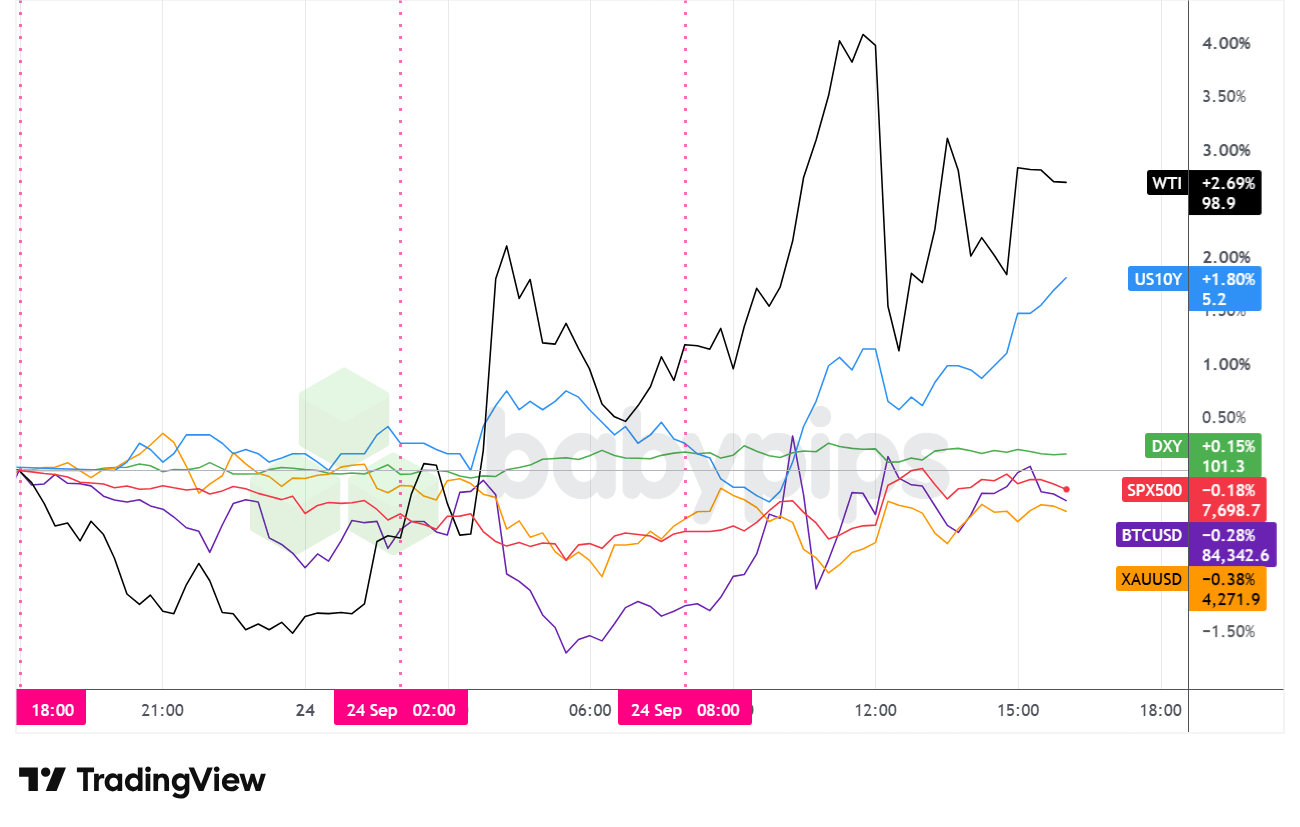
Dollar Index, Gold, Oil, S&P 500, U.S. 10-yr Yield, Bitcoin Overlay – Chart Faster With TradingView
The session belonged to the bond market. The 10-year Treasury yield ground higher through most of the day and finished near 5.2%, close to its highest since 2007, after a soft Treasury buyback operation and a run of firm U.S. data left investors demanding more compensation to hold government debt. Every other asset on the board traded off that move.
Crude did much of the damage to sentiment. WTI crude dropped below $95 in early Asian trade, then reversed hard and added about 2.7% on the day, touching about $100.30 around midday before easing back toward $99. Fading hopes for a U.S.-Iran deal to reopen the Strait of Hormuz kept a bid under energy, and higher oil feeds into the inflation story that has been driving yields.
Equities absorbed the pressure rather than breaking. The S&P 500 spent the Asian and London hours drifting lower, bottomed near 7,648 in the London morning, then clawed back during U.S. hours to close close to flat, off around 0.2%. The index looked resilient on the surface, though breadth was weak, and higher discount rates remain a headwind for valuations while yields stay elevated.
Gold could not shrug off the rate move. The metal touched about $4,303 in early Asia, then slid to about $4,246 in London before steadying near $4,272, a loss of about 0.4%. Rising real yields raise the opportunity cost of holding a non-yielding asset, which offers one plausible read on why gold struggled even with geopolitical risk in the mix.
Bitcoin tracked the broader caution. It sagged to around $83,100 in the London session, recovered above $84,800 by midday, and settled near $84,300 for a decline of about 0.3%. With no fresh crypto-specific catalyst beyond the Fed’s stablecoin proposals, the move looked of a piece with the day’s guarded, yield-sensitive risk tone.
FX Market Behavior: U.S. Dollar vs. Majors
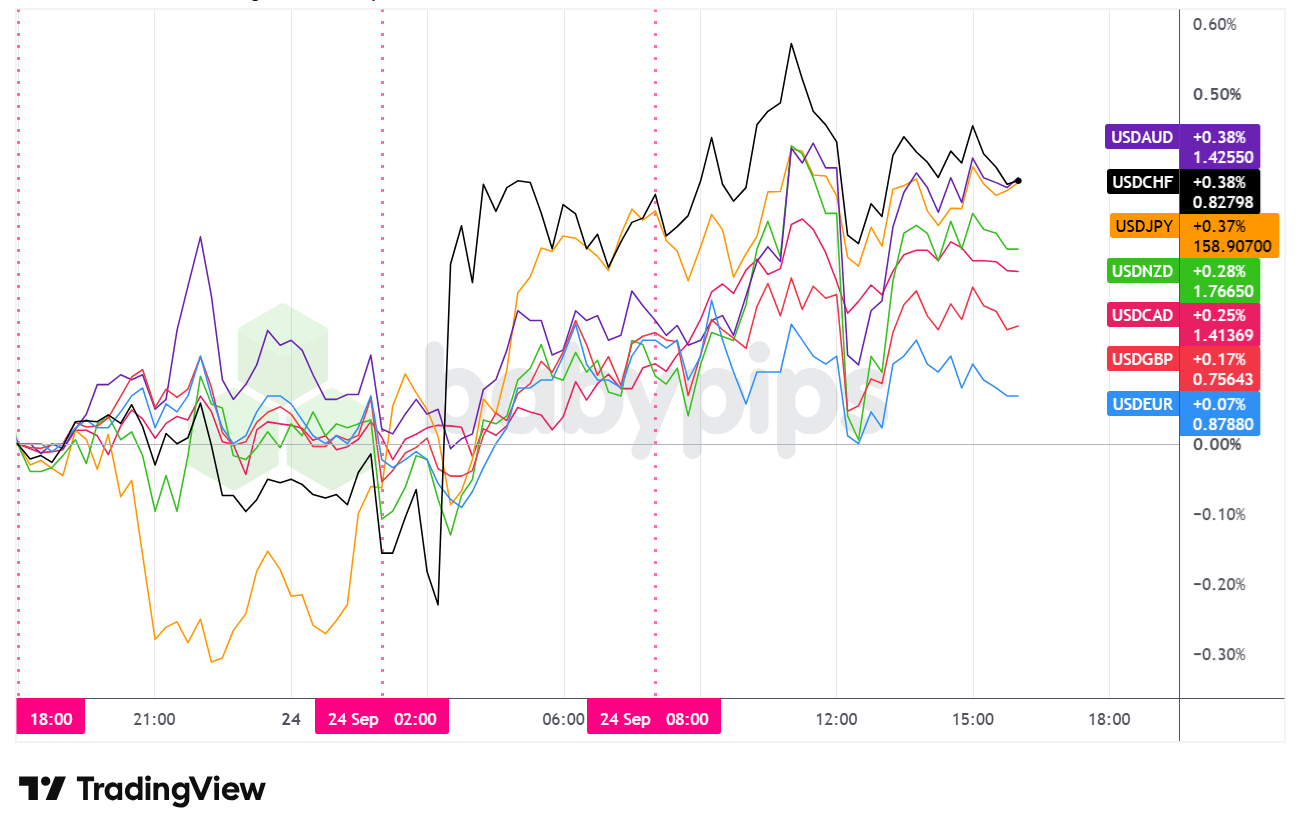
Overlay of USD vs. Major Currencies – Chart Faster With TradingView
The dollar closed higher against all seven majors, and the ranking of winners and losers tracked the rates story more than any single data release. The greenback’s smallest gains came against the euro and the pound, and its largest against the franc, the Aussie, and the yen.
Through the Asia session, the dollar traded choppy, and arguably on the soft side. The yen firmed after Japan’s flash PMIs pointed to an 18th straight month of private-sector expansion with price pressures still elevated, and USD/JPY slipped from above 158.20 toward 157.80 as Japanese government bond futures played catch-up to the global yield jump. The Aussie held steady after a mixed jobs report: employment rose 39.5k, well above forecasts, but the unemployment rate climbed to 4.6% as the participation rate jumped to 67.1%, a mix that left the case for a possible Reserve Bank of Australia move next week intact.
The London session flipped the tone. The Swiss National Bank held rates at 0.0% and eased its intervention stance, and the franc gave way, with USD/CHF lifting off its 0.8230 area low toward 0.8280. Rising Treasury yields did the rest, pulling the dollar higher across the board into the European afternoon even as the euro and pound put up more of a fight than the commodity currencies.
The dollar extended its gains through the U.S. session as yields pressed to their highs. USD/JPY worked back above 158.90, USD/CHF stretched to about 0.8296, and USD/CAD firmed near 1.4147. The Loonie fell less than its peers, and the day’s oil rally likely cushioned it even as broad dollar demand won out. AUD/USD faded into the close, leaving the Aussie among the softer majors despite the earlier jobs beat.
Upcoming Potential Catalysts on the Economic Calendar
- U.K. GfK Consumer Confidence for September 2026 at 11:01 pm GMT
- Euro area Monetary Developments for August 2026 at 8:00 am GMT
- U.S. Fed Williams Speech at 9:15 am GMT
- Canada Wholesale Sales Prel for August 2026 at 12:30 pm GMT
- U.S. Durable Goods Orders for August 2026 at 12:30 pm GMT
- U.S. Fed Schmid Speech at 1:20 pm GMT
- UoM Consumer Sentiment Index for September 2026 at 2:00 pm GMT
- U.S. Michigan Inflation Expectations Final for September 2026 at 2:00 pm GMT
- Canada Budget Balance for July 2026 at 3:00 pm GMT
- Fed Hammack Speech at 6:00 pm GMT
With inflation expectations at the center of this week’s rates story, the Michigan sentiment and inflation-expectations readings carry more weight than usual, and durable goods orders will offer another read on whether the U.S. economy is running hot enough to justify the market’s tightening bets.
The wall of Fed speakers matters too: Williams, Schmid, and Hammack all get microphones, and any hint that the recent hawkish chorus is hardening could add fuel to the yield move. For the dollar, the path of least resistance may stay higher while Treasuries keep selling off, though a pullback in oil or any softening in the inflation data could take some pressure off both yields and risk assets.
When Treasury yields jump to multi-decade highs, every currency trader feels the ripple. What most traders don’t understand is how the bond move itself becomes the main driver of FX price action. Premium members can read our lesson:
📖 How Bond Yields Affect Currency Movements
Reading this helps you understand how rising real yields reprice currencies, why the dollar strengthens when Treasuries sell off, and how to spot when bond moves are driving your pair more than any headline.
And if you’re not a Premium subscriber yet, now’s a good time to sign up.
With Babypips Premium, you get full access to School of Pipsology lessons that help you understand how bond and yield dynamics often move your pairs more than the technical setup you’re staring at.