


Risk appetite ran hot to start the week. A technology and chip-led bid drove U.S. equities to their strongest session in about six weeks, crypto surged to an eight-month peak, and crude buckled close to 5% as talk of U.S.-Iran diplomacy drained some of the Middle East risk premium. The dollar firmed at the margin while Treasury yields eased back under 5%, and the commodity-linked Canadian dollar trailed the majors.
Check out the forex news and economic updates you may have missed in the latest trading session!
News Headlines & Data:
- New Zealand Credit Card Spending for August 2026: 3.5% y/y (5.5% y/y forecast; 5.3% y/y previous)
- Chicago Fed President Austan Goolsbee said on Monday that inflation may be driven by strong demand, signaling a faster pace of rate hikes may be needed
- U.S. Chicago Fed National Activity Index for August 2026: -0.04 (0.2 forecast; -0.08 previous)
- Federal Reserve’s Minneapolis President Kashkari said on Sunday that inflation is “still too high”
- Bank of Canada Governor Macklem warned on Monday that if new U.S. tariffs remain in place, Canadian fourth-quarter growth could be roughly halved to below 1%
Broad Market Price Action:
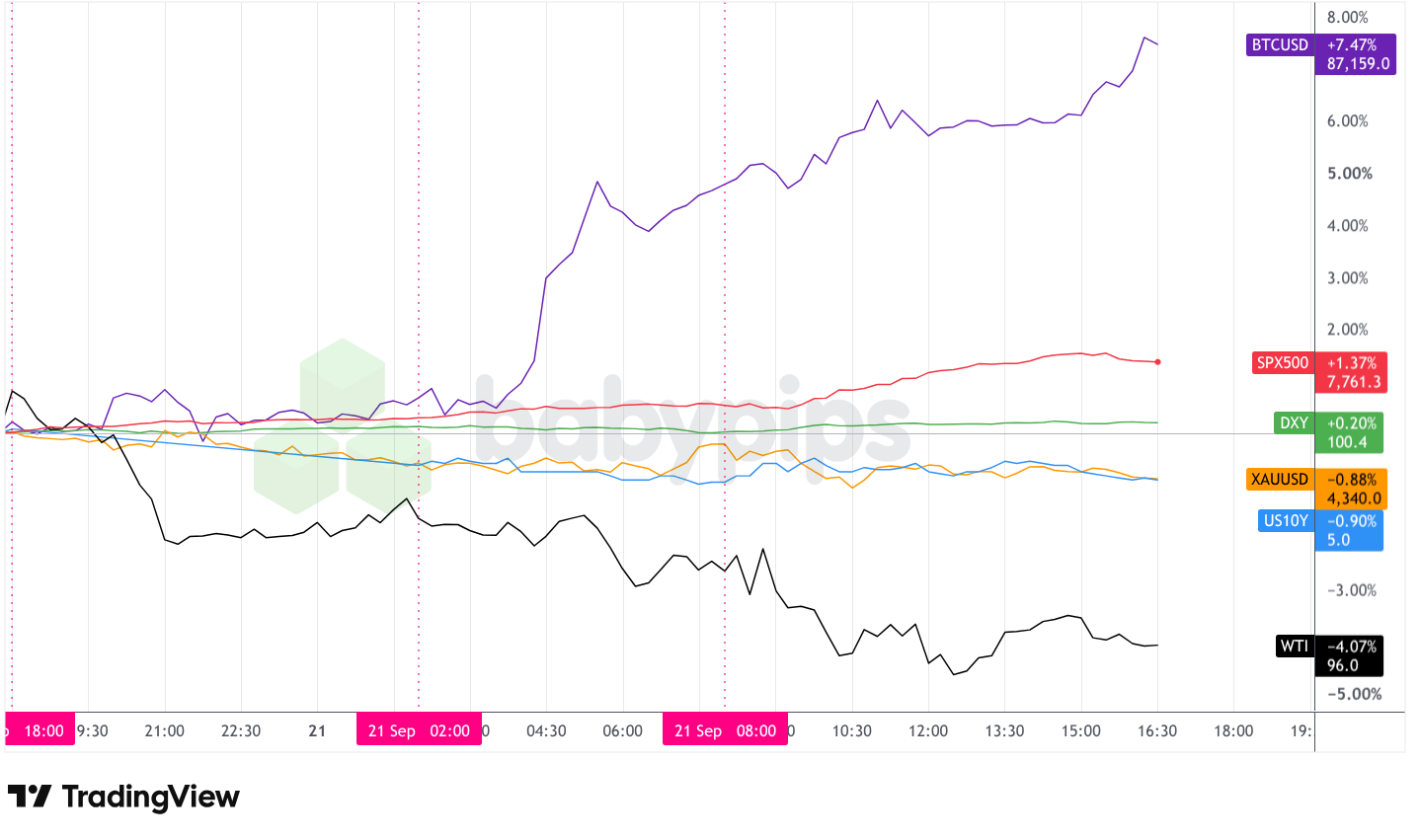
Dollar Index, Gold, Oil, S&P 500, U.S. 10-yr Yield, Bitcoin Overlay – Chart Faster With TradingView
Equities carried a firm tone from the outset and built on it as New York came online. The S&P 500 opened the Asia session near 7,658 and ground higher through thin overnight trade, added little across London hours, then found its stride once the U.S. cash session began, tagging an intraday high around 7,774 in the mid-afternoon before settling near 7,761 for a gain of roughly 1.4%. A rally in chipmakers and megacap technology did most of the lifting, and the broad advance marked the index’s best day in about six weeks.
Bitcoin stole the spotlight. After dipping near $81,000 late in Asian hours, it climbed through the London morning, cleared $85,000, and pressed to roughly $87,200 late in the U.S. afternoon for a move of about 7% and its highest print since late January. The rally tracked the broader risk-on shift and a regulatory bet: with the Clarity Act stalled in the Senate, the SEC granted an exemption letting qualifying venues trade tokenized U.S. stocks onchain, and traders appeared to read regulators pressing ahead as a green light even without new legislation. Rotation out of crowded AI trades and back into crypto may also have added fuel.
WTI crude ran the opposite way. Oil gapped up on Sunday’s Globex open as reports of a Houthi strike on Riyadh circulated, topping $100, then gave it all back through the session as attention turned to U.S. Central Command comments that flows through the Strait of Hormuz had reached a six-month high. President Trump’s remark that he would “probably” meet his Iranian counterpart on the sidelines of the UN General Assembly cooled the war premium further. Crude bottomed near $95.40 around midday and closed near $96, down close to 5%.
Gold struggled against the firmer dollar and lighter haven demand, slipping to a low near $4,332 in late morning before steadying near $4,340, off about 0.9%. The 10-year Treasury yield drifted lower for most of the day and slipped under 5% to around 4.95%, easing from the 5.00% mark it held at the Asian open. Softer yields alongside a green equity tape make for an unusual pairing; last week’s Fed hike to 3.75%-4.00% may have reassured bond investors even as officials kept up hawkish messaging on inflation.
FX Market Behavior: U.S. Dollar vs. Majors
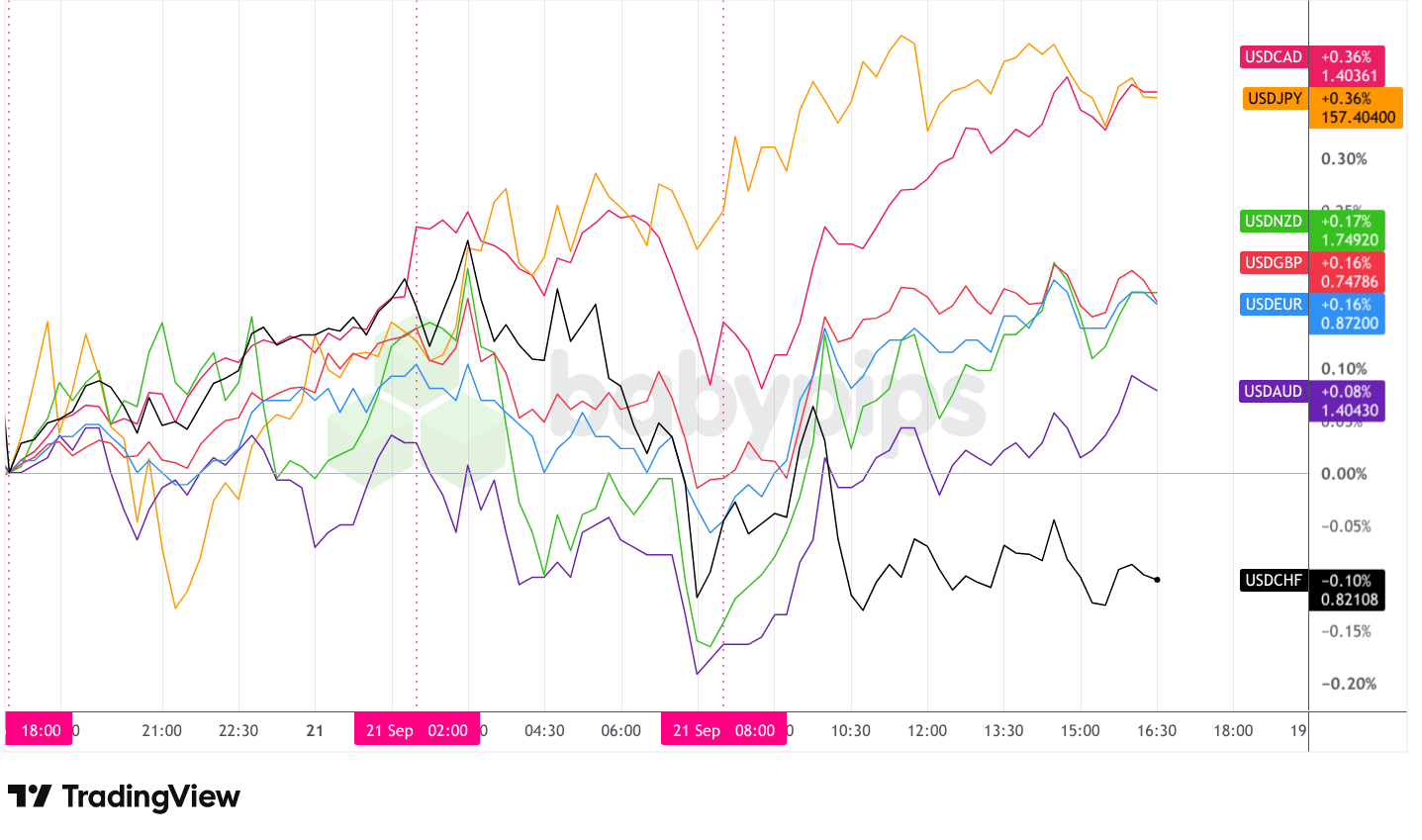
Overlay of USD vs. Major Currencies – Chart Faster With TradingView
The dollar finished with a modest bid, though it took a winding path to get there. The greenback firmed a little through Asian hours, handed the gains back during the London morning as the majors pushed higher, then reasserted itself once U.S. trading began, closing with the Dollar Index up about 0.2% near 100.4.
The Canadian dollar sat at the back of the pack. USD/CAD rose about 0.4% toward 1.4036, possibly pressured by the slide in crude and by Bank of Canada Governor Macklem’s warning that fresh U.S. tariffs could roughly halve fourth-quarter growth to below 1%. The yen was nearly as soft, with USD/JPY up about 0.4% near 157.40. Japanese markets are shut through Wednesday, thinning liquidity and leaving the currency exposed to the day’s risk-on drift.
The Australian dollar held up better than most, little changed against a firmer greenback as markets pulled forward RBA rate-hike bets; several desks now look for a move at the September 29 meeting. The New Zealand dollar lagged after softer-than-expected August credit card spending, sliding toward a two-month low before catching a late bid as the U.S. session wore on.
The euro and the pound each eased around 0.2% against the dollar, following the broader move rather than any home-grown catalyst, though ECB commentary keeping an October hike on the table lent the euro some background support. The Swiss franc was the one major to gain on the dollar, firming a touch even amid the risk-on mood, and lingering Middle East tension may have kept a haven bid under it.
The majors moved together more than apart, following the dollar and the day’s sentiment swings rather than carving out much direction of their own. The franc’s small gain and the loonie’s underperformance stood out as the clearest exceptions.
Upcoming Potential Catalysts on the Economic Calendar
- U.K. CBI Industrial Trends Orders for September 2026 at 10:00 am GMT
- ADP U.S. Employment Change Weekly for September 5, 2026 at 12:15 pm GMT
- Euro area Consumer Confidence Flash for September 2026 at 2:00 pm GMT
- Richmond Fed Manufacturing Index for September 2026 at 2:00 pm GMT
- Fed Williams Speech at 2:05 pm GMT
- Fed Jefferson Speech at 2:20 pm GMT
- U.S. Money Supply for August 2026 at 5:00 pm GMT
- U.S. Fed Barkin Speech at 5:00 pm GMT
The calendar leans on the Fed. A run of speakers, Williams, Jefferson and Barkin, follows last week’s hike and the steady message from Goolsbee and Kashkari that inflation is still running too hot, so any hint on the pace of further tightening could move front-end yields and the dollar.
The weekly ADP employment print offers a fresh, if noisy, read on the U.S. labor market, while Euro area consumer confidence and the RBA’s Hunter give the euro and the Aussie their own threads to watch. With the Trump-Xi summit set for Thursday and a Trump-Zelensky meeting Tuesday, headline risk may matter as much as the data.
While most traders watch the equity rally and the dollar move, they miss the real story: how stock market strength reshapes the playbook for each currency pair. Premium members can read our lesson:
📖 Equities and Currencies: The Big Picture
Reading this helps you understand how equity market moves drive currency pair divergences, which currencies benefit when stocks rally, and why some pairs like USD/CAD and USD/JPY reacted so differently to the same risk-on impulse.
And if you’re not a Premium subscriber yet, now’s a good time to sign up.
With Babypips Premium, you get full access to School of Pipsology lessons that help you understand not just why stocks rally, but which currencies benefit when equities lead and which ones get left behind.