


Markets spent Thursday working through the Federal Reserve’s first rate hike since 2023, and the tone turned constructive. Stocks and bonds climbed together as a second straight drop in oil eased worries about inflation and yields, sending gold up around 2%. The pound lagged its peers after the Bank of England held its bank rate at 3.75% in a split vote, and the dollar closed a touch softer against most of the majors.
Check out the forex news and economic updates you may have missed in the latest trading session!
News Headlines & Data:
- The Bank of England kept its bank rate at 3.75% in a 6-3 vote, with three members pushing for a hike to 4%, and agreed to slow the pace of its gilt sales.
- Saudi Arabia offered extra crude to Asian refiners through ship-to-ship transfers off Oman, easing supply fears and helping oil hold below recent highs.
- President Trump is expected to meet Gulf Cooperation Council leaders at the UN General Assembly next Tuesday to discuss next steps in the Iran war.
- Trump floated cutting trade with Europe or adding tariffs if Canada moves toward associate membership in the EU.
- The U.S. Congress advanced two crypto bills, and Deutsche Bank said it plans BaFin-approved Bitcoin and Ether custody for European clients by the end of 2026.
- The Bank of Japan is widely expected to deliver a quarter-point hike on Friday, its most closely spaced increases since 1990.
- New Zealand GDP Growth Rate for Q2 2026: 2.6% y/y (2.1% y/y forecast; 1.5% y/y previous)
- Swiss Balance of Trade for August 2026: 5.6B (7.5B forecast; 8.1B previous)
- Euro area Inflation Rate Final for August 2026: 3.2% y/y (3.3% y/y forecast; 2.9% y/y previous)
- Canada PPI for August 2026: 13.5% y/y (12.3% y/y forecast; 12.4% y/y previous)
- U.S. Initial Jobless Claims for September 12, 2026: 196.0k (208.0k forecast; 206.0k previous)
- U.S. Housing Starts for August 2026: -2.6% m/m (9.0% m/m forecast; -12.4% m/m previous)
- U.S. Philadelphia Fed Manufacturing Index for September 2026: 37.8 (37.0 forecast; 47.4 previous)
- U.S. Pending Home Sales for August 2026: -4.7% y/y (-0.7% y/y forecast; -2.2% y/y previous)
Broad Market Price Action:
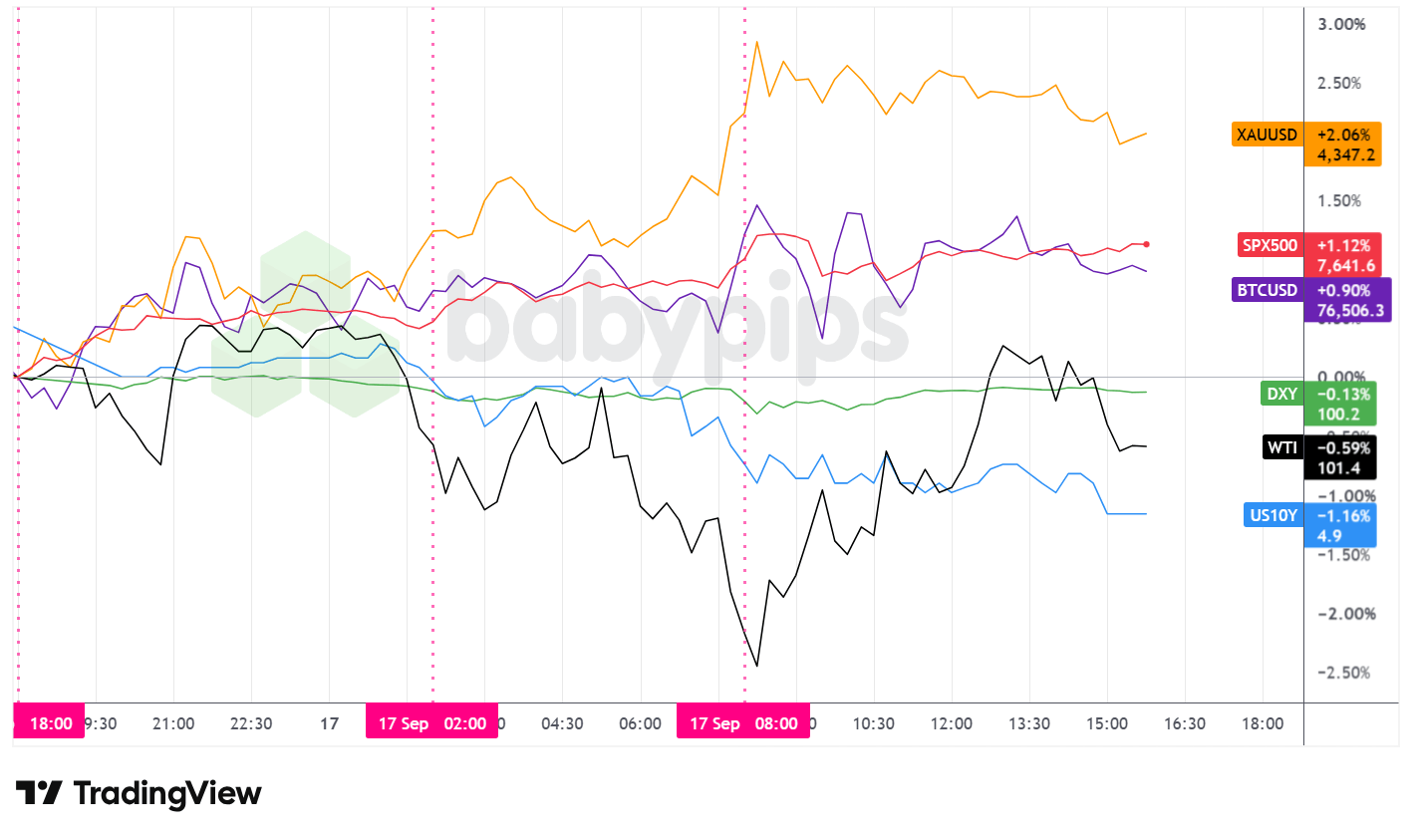
Dollar Index, Gold, Oil, S&P 500, U.S. 10-yr Yield, Bitcoin Overlay – Chart Faster With TradingView
Energy prices led the broad market Thursday. Oil fell for a second day, which eased the pressure on Treasury yields that had built through the Fed’s tightening turn and let stocks and gold push higher.
Oil slipped about 0.6% to settle near $101, though the path there was choppy. Prices dropped toward $99.50 around the US open before recovering into the afternoon. The move marked a second straight down day, likely helped by news that Saudi Arabia is routing extra crude to Asian refiners through ship-to-ship transfers off Oman, which took some heat out of supply fears.
The 10-year Treasury yield eased to around 4.9%, snapping an eight-day climb that had carried it to its highest level since 2007. Yields leaked lower as oil cooled and traders leaned into the view that the Fed’s move was now behind them.
The S&P 500 added roughly 1.1% to finish near 7,640, clawing back the ground it gave up over the prior two sessions. The Nasdaq 100 ran further ahead at about 1.7% as chipmakers led. Micron, AMD and Intel each jumped more than 5%, and Nvidia added about 2.5%, extending a rebound after worries about AI safety had cast doubt on AI spending earlier in the week. The megacap hyperscalers pitched in, with Oracle up around 5%, while financials stayed muted. The move built through the morning and held into the close.
Gold was the day’s standout, climbing about 2.1% to around $4,347. It ran to a session high near $4,380 around the US open before easing back, and the rally likely drew support from the softer dollar and the pullback in yields.
Bitcoin firmed about 0.9% to near $76,500. The move tracked no single crypto-specific catalyst, though the backdrop turned friendlier as the U.S. Congress advanced two crypto bills and Deutsche Bank laid out plans for regulated Bitcoin and Ether custody in Europe. With no fresh driver of its own, the gain may reflect the same risk relief that lifted stocks after the Fed.
FX Market Behavior: U.S. Dollar vs. Majors
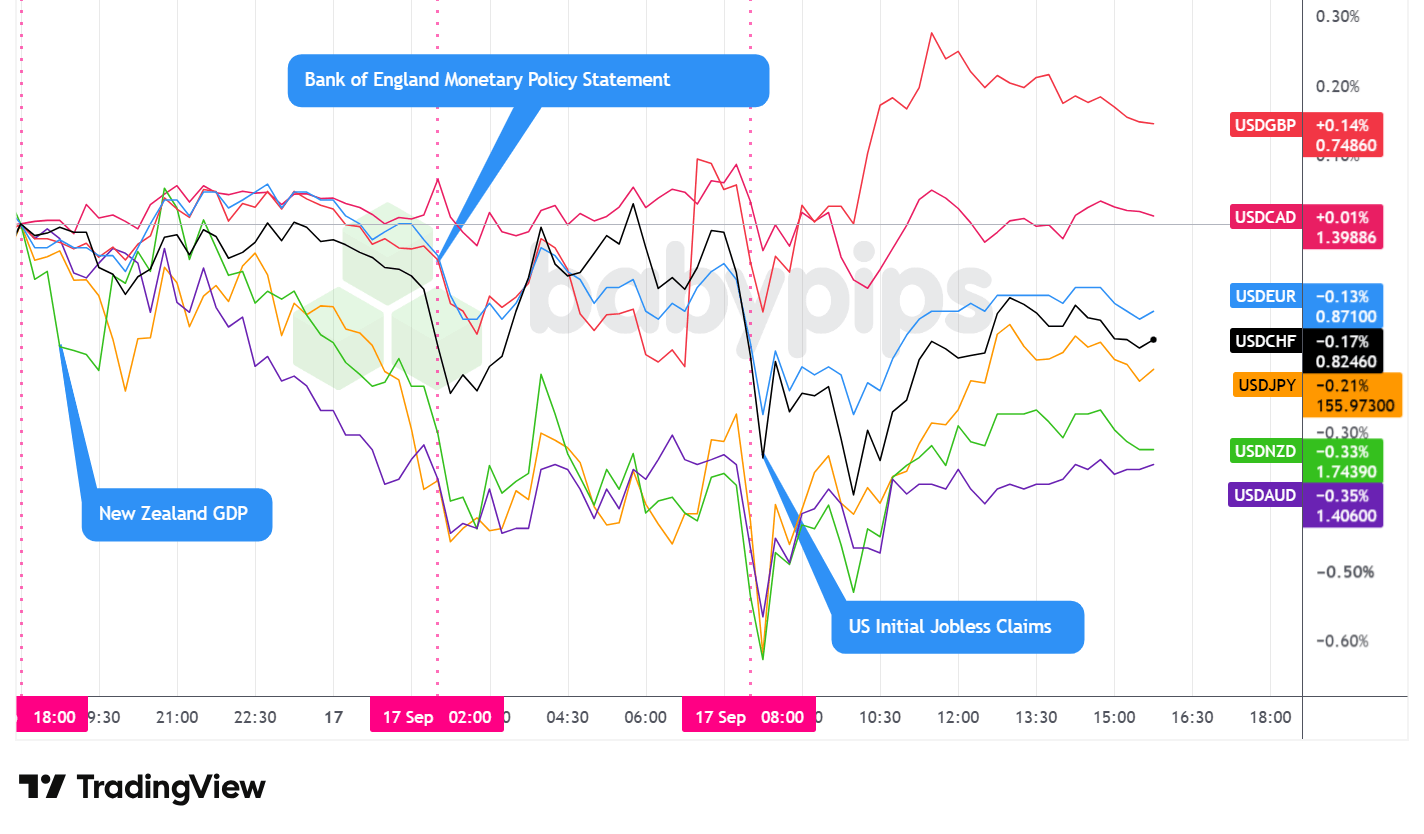
Overlay of USD vs. Major Currencies – Chart Faster With TradingView
The dollar drifted lower against the majors for most of Thursday before clawing back part of the move late, and it still finished as a net underperformer.
Through the Asian session, the dollar leaked lower against its peers. New Zealand’s Q2 GDP came in at 2.6% y/y, above the 2.1% forecast and stronger than the RBNZ’s own flat call, and the Kiwi popped on the release before fading back as the majors settled into a quiet range.
The London session brought the day’s marquee currency event. The Bank of England kept its bank rate at 3.75% in a 6-3 vote, with Pill, Mann and Greene pushing for a hike to 4%. Traders had come in pricing roughly a 30% chance of a hike, so the hold set off repositioning that pulled the pound to the back of the pack. The Bank also agreed to slow the pace of its gilt sales, a move that handed the bond market some relief. The dollar steadied near the middle of the session and began to firm.
The dollar carried that rebound into the US afternoon. U.S. initial jobless claims dropped to 196,000, well under the 208,000 forecast and a sign of a still-firm labor market, which gave the greenback a further nudge higher. Even so, the bounce fell short of a full recovery.
By the close, the dollar sat lower against most majors. It gave up the most ground to the Australian and New Zealand dollars and slipped against the yen, franc and euro, while holding roughly flat against the Canadian dollar. The pound was the one major to lose ground to the dollar, likely weighed down by the BoE hold.
Upcoming Potential Catalysts on the Economic Calendar
- New Zealand Food Price Index for August 2026 at 10:45 pm GMT
- New Zealand Balance of Trade for August 2026 at 10:45 pm GMT
- Japan Inflation Rate for August 2026 at 11:30 pm GMT
- Bank of Japan Interest Rate Decision for September 18, 2026 at 3:00 am GMT
- Germany PPI for August 2026 at 6:00 am GMT
- U.K. Retail Sales for August 2026 at 6:00 am GMT
- ECB Consumer Inflation Expectations for August 2026 at 8:00 am GMT
- ECB President Lagarde Speech at 10:30 am GMT
- Canada CFIB Business Barometer for September 2026
- U.S. Industrial & Manufacturing Production for August 2026 at 1:15 pm GMT
- Fed Bowman Speech at 1:30 pm GMT
- CB U.S. Leading Index MoM for August 2026 at 2:00 pm GMT
Friday belongs to the Bank of Japan. A quarter-point hike is widely expected, which would mark the most closely spaced Japanese rate increases since 1990 and keep the yen in focus after USD/JPY slipped below 156. Japan’s August inflation print lands hours ahead of the decision and could shape expectations.
Later on, U.K. retail sales and a speech from ECB President Lagarde give euro and pound traders something to track, while Fed Bowman’s remarks may add color to the debate Goldman kicked off over the timing of the next U.S. hike.
Thursday’s market had all the hallmarks of a risk-on day: stocks rallied 1.1%, gold popped 2.1%, and the Aussie and Kiwi outperformed while the safe haven currencies lagged. But what connects all those moves is something most traders don’t see until after the fact. Premium members can read our lesson:
📖 Risk-On / Risk-Off: How Global Mood Moves Currencies
Reading this helps you understand how global market mood drives currency flows, why commodity currencies and safe havens move in opposite directions on risk days, and how to check the risk weather before you place any trade.
And if you’re not a Premium subscriber yet, now’s a good time to sign up.
With Babypips Premium, you get full access to School of Pipsology lessons that help you understand not just which currencies move on risk-on days, but why—and how to use that pattern as a confirmation signal before entering a trade.