

The Federal Reserve raised interest rates for the first time since 2023, and the dollar took off while stocks, gold, and oil slid. Chair Kevin Warsh framed the quarter-point move as a direct answer to sticky inflation, and a fresh set of projections pointed to at least one more hike before year-end. A hot U.S. retail sales report and a five-month high in U.K. inflation set a firm tone well before the 2 pm ET decision landed.
Check out the forex news and economic updates you may have missed in the latest trading session!
News Headlines & Data:
- U.S. API Crude Oil Stock Change for September 11, 2026: 7.14M (-0.3M previous)
- Japan Balance of Trade for August 2026: -1,105.6B (-850.0B forecast; -634.5B previous)
- Japan Machinery Orders for July 2026: 11.2% y/y (12.0% y/y forecast; 16.9% y/y previous)
- U.K. Inflation Rate for August 2026: 3.1% y/y (3.1% y/y forecast; 2.9% y/y previous)
- Euro area Wage Growth for Q2 2026: 3.0% y/y (3.2% y/y forecast; 3.4% y/y previous)
- U.S. Retail Sales for August 2026: 6.0% y/y (4.7% y/y forecast; 5.0% y/y previous)
- U.S. Import Prices for August 2026: 7.0% y/y (6.4% y/y forecast; 5.9% y/y previous)
- Canada Building Permits for July 2026: -17.3% m/m (-5.6% m/m forecast; 18.5% m/m previous)
- U.S. MBA 30-Year Mortgage Rate for September 11, 2026: 6.97% (6.85% previous)
- U.S. NAHB Housing Market Index for September 2026: 32.0 (34.0 forecast; 35.0 previous)
- EIA Crude Oil Stocks Change for September 11, 2026: -0.64M (-0.39M previous)
- NY Fed Services Activity Index for September 2026: -8.7 (0.5 previous)
- The FOMC unanimously raised the federal-funds target range by 25 bp to 3.75%–4.00%, citing solid economic activity, resilient domestic spending, strong productivity and investment, a stable labor market, and still-elevated inflation; the statement explicitly framed the move as supporting a “timelier return” to 2% inflation while retaining its ample-reserves operating regime.In the press conference, Chair Kevin Warsh emphasized that inflation remains the Fed’s predominant concern—saying it has been too high for too long—and pointed to the economy’s resilience, but he did not pre-commit to further tightening, preserving data dependence amid geopolitical uncertainty.
Promoted: The Fed Just Moved Markets in Minutes. Could Your Account Handle It?
Today’s FOMC hike and the hot retail sales print sent the dollar, gold, and oil flying inside a single afternoon. Days like this reward traders who can act on news without sweating position size. FundedNext gives disciplined traders simulated accounts up to $200K, with no artificial time limits on challenges and a unique 15% profit share during your evaluation. Once funded, you keep up to a 95% profit split with guaranteed 24-hour payouts, and you can trade CFDs or Futures your way, even during major news events like a rate decision.
Join over 400K traders who have received $300M+ in payouts. Ready to back your edge?
Learn More About FundedNext! Limited time offer: Use code BP for discounts on both CFD & Futures plans! T&C apply.
Disclosure: We may earn a commission from our partners if you sign up through our links, at no extra cost to you.
Broad Market Price Action:
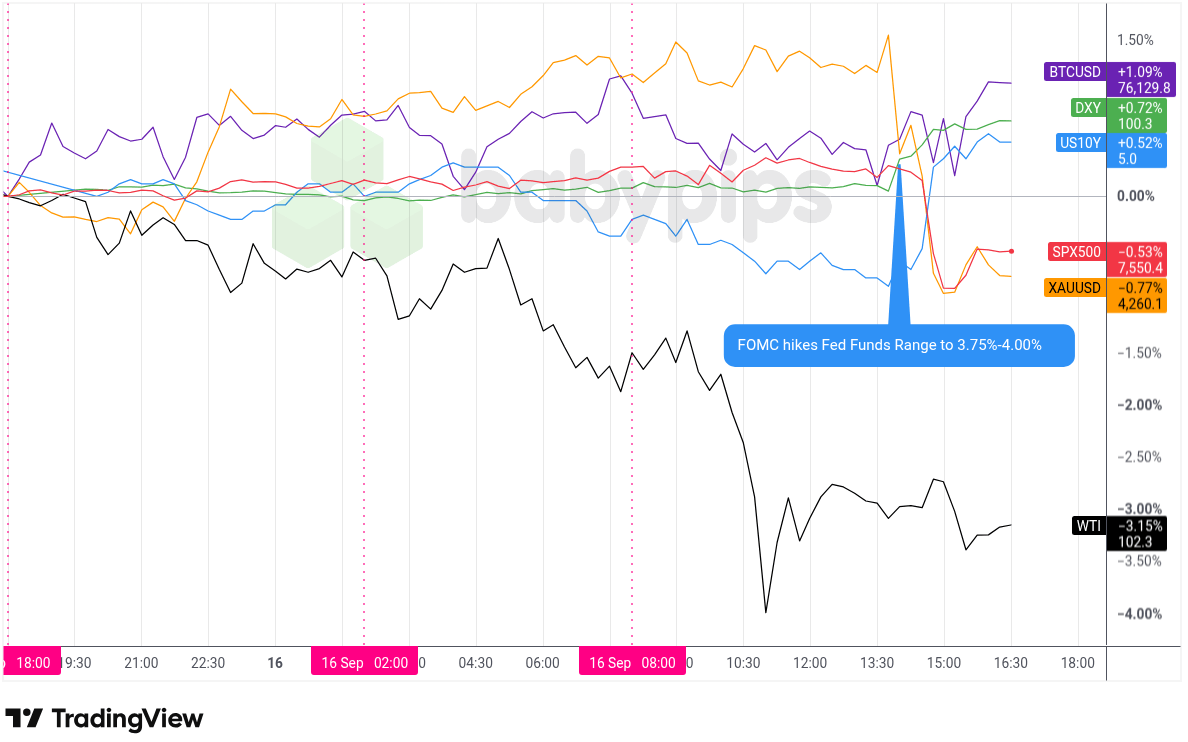
Dollar Index, Gold, Oil, S&P 500, U.S. 10-yr Yield, Bitcoin Overlay – Chart Faster With TradingView
The Fed ran the day. Markets came in leaning toward a hike, and the Federal Open Market Committee delivered, voting unanimously to lift the benchmark rate by a quarter point to a range of 3.75% to 4.00%. The dot plot penciled in at least one more increase this year, and Warsh used his press conference to stress that too many categories still showed price gains above 3%. The reaction hit every asset class within minutes.
The S&P 500 climbed through the morning and touched roughly 7,618 near late morning before the decision turned it. It gave back the gains and then some, sliding to about 7,523 in the afternoon and settling near 7,552, down around 0.5% on the session. Higher-for-longer rate expectations left equity buyers with little to lean on into the close.
Gold traced the same arc in sharper relief. It rallied to roughly $4,359 in the hour before the announcement, then reversed hard as the dollar and front-end yields jumped, dropping toward $4,253 and closing near $4,268, off about 0.6%. A stronger dollar and firmer real yields tend to work against metal that pays no coupon, and that is close to how the tape read.
Oil was the day’s weakest link, with WTI down roughly 3% to near $102 after starting the session above $105. It bottomed around $101 late in the U.S. morning. Private API data earlier in the week had flagged builds across crude, gasoline, and distillates, and while the official EIA print showed only a small draw, the pre-Fed unwind in commodities did the rest. The slide came even with Middle East supply risk still in the background.
The 10-year Treasury yield hovered near the 5% mark for most of the day, dipping toward 4.95% just before the decision and then firming back to about 5.02% by the close. Short-dated yields moved more, consistent with a market repricing the near-term path rather than the long-run destination.
Bitcoin went its own way. It spent the overnight hours choppy, dipped after the U.S. Senate stalled crypto-oversight legislation, then recovered to close up close to 1% near $76,000. On a day when stocks and gold fell, crypto’s resilience stood out, though the move was modest and the range was wide.
FX Market Behavior: U.S. Dollar vs. Majors
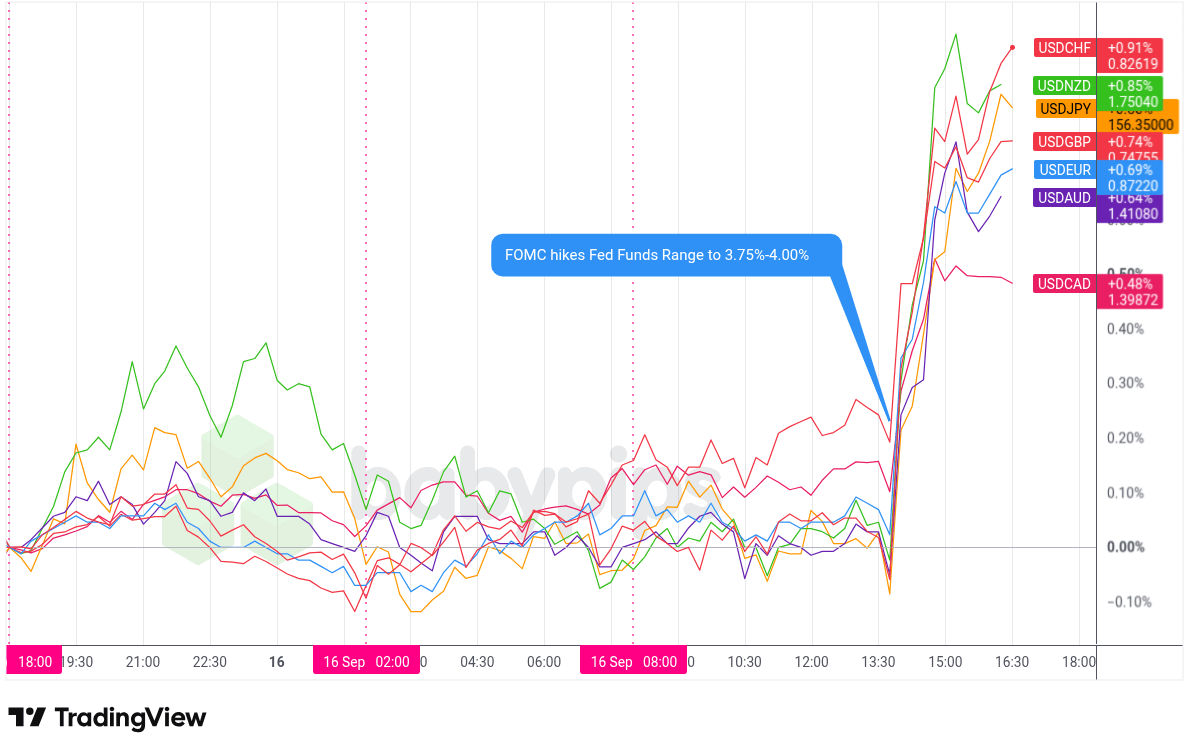
Overlay of USD vs. Major Currencies – Chart Faster With TradingView
The dollar held flat for most of the day, then made its entire move in one afternoon burst. It finished higher against all seven majors, with the Kiwi the weakest and the Canadian dollar the most resilient.
Through the Asia session the greenback drifted sideways and even slipped a touch, with major pairs stuck in tight pre-FOMC ranges. The yen wobbled after Japan posted a wider-than-expected August trade deficit and softer July machinery orders, then steadied and finished the region little changed. Traders held back ahead of the decision.
London added a modest bid. U.K. inflation rose to a five-month high of 3.1%, matching forecasts, while core held at 2.6%, and sterling barely reacted to a print the market had already braced for. The dollar firmed slightly against the bloc as oil and yields eased into the decision, a move that looked more like position-squaring than a fresh view.
The U.S. session split cleanly into before and after. Retail sales came in hot at the open, rising 1.2% on the month against a 0.7% call and 6.0% over the year, which reinforced the case for a firmer Fed and kept the dollar bid into the afternoon.
Then the FOMC hiked, Warsh leaned hawkish, and the greenback surged. The Dollar Index jumped from near 99.7 before the release to roughly 100.3 at the close. USD/JPY pushed to around 156.1, USD/CHF and USD/GBP each firmed by roughly 0.7%, and the euro and Aussie gave ground in step. USD/CAD rose the least of the group, an outcome worth watching given oil’s steep drop, and one that may reflect positioning as much as any fundamental read.
Promoted: The Fed Delivered. The Bank of England Is Next. What Does the Crowd Think Happens?
Today’s session was an expectations day from open to close: retail sales ran hot, the Fed hiked to 3.75%-4.00%, and the dollar surged against every major once Warsh leaned hawkish. With the Bank of England deciding tomorrow and the market leaning toward a hold, FX traders know currencies move on what the crowd has priced in, not just on the headline.
Polymarket is a prediction market where traders buy and sell Yes/No contracts on real-world outcomes like central bank decisions and geopolitics. Prices read like crowd-implied probabilities and shift as headlines land, a useful companion lens when you study how event risk shows up in the pound, in yields, and across FX.
Important: Polymarket is not available in all countries and regions due to regulation and local rules. Eligibility depends on where you are, so always confirm before signing up. Event / prediction-market trading involves a high risk of loss of capital; you can lose your stake. This is not financial advice. Disclosure: We may earn a commission from our partners if you sign up through our links, at no extra cost to you.
Upcoming Potential Catalysts on the Economic Calendar
- New Zealand GDP Growth Rate for Q2 2026 at 10:45 pm GMT
- Swiss Balance of Trade for August 2026 at 6:00 am GMT
- SECO Swiss Economic Forecasts at 7:00 am GMT
- ECB Lane Speech at 7:00 am GMT
- Euro area Inflation Rate Final for August 2026 at 9:00 am GMT
- U.K. Official Bank Rate for September 17, 2026 at 11:00 am GMT
- Canada PPI Growth Rate for August 2026 at 12:30 pm GMT
- U.S. Philadelphia Fed Manufacturing Index for September 2026 at 12:30 pm GMT
- U.S. Building Permits & Housing Starts for August 2026 at 12:30 pm GMT
- U.S. Initial Jobless Claims for September 12, 2026 at 12:30 pm GMT
- U.S. Pending Home Sales for August 2026 at 2:00 pm GMT
The Bank of England takes center stage next. Most economists expect a hold at 3.75%, but a five-month high in inflation lands one day before the vote, so the split among policymakers matters more than the headline decision.
With the Fed now tightening while the BoE likely stays put, that policy gap has capped sterling all week, and any drift toward the hawkish side of the committee could give the pound a short-lived lift. Euro area final inflation and a run of U.S. housing and labor-market data fill in the rest of the picture before the week winds down.
When the Fed hiked rates and Chair Warsh turned hawkish, the dollar surged while stocks, gold, and oil all reversed hard. But this wasn’t one move hitting everything at once—it was a staged sequence that most traders miss. Premium members can read our lesson:
📖 From Data to Price Action: What Happens When Big News Hits
Reading this helps you understand the two-speed market, why the initial algorithmic spike looks nothing like the secondary analytical move, and how to spot the real opportunity after the noise settles.
And if you’re not a Premium subscriber yet, consider joining to access these lessons.
With Babypips Premium, you get full access to School of Pipsology lessons that help you understand not just what moved, but why each asset class reacted the way it did and when the real trading opportunity actually begins.