Markets leaned defensive on Tuesday as a selloff in chipmakers dragged equities lower and long-dated bond yields held near multi-year highs, keeping the focus on inflation and rising government debt. The U.S. dollar recovered from repeated intraday dips to finish arguably the strongest major on the day, while gold slid sharply and oil settled near $85 with the Strait of Hormuz standoff still unresolved.
Check out the forex news and economic updates you may have missed in the latest trading session!
News Headlines & Data:
- Australia Westpac Consumer Confidence Change for August 2026: 6.0% (-2.6% forecast; 4.1% previous)
-
U.K. Employment Change for June 2026: 83.0k (200.0k forecast; 147.0k previous)
- U.K. Claimant Count Change for July 2026: -11.0k (9.0k forecast; 6.7k previous)
- U.K. Unemployment Rate for June 2026: 4.9% (4.9% forecast; 4.9% previous)
- Germany ZEW Economic Sentiment Index for August 2026: 34.2 (28.5 forecast; 26.3 previous)
- Euro area ZEW Economic Sentiment Index for August 2026: 31.4 (24.0 forecast; 23.4 previous)
- Canada Housing Starts for July 2026: 229.1k (240.0k forecast; 239.0k previous)
- U.S. ADP Employment Change Weekly for August 1, 2026: 9.5k (8.25k previous)
- U.S. Building Permits Prel for July 2026: 1.44M (1.39M forecast; 1.37M previous)
- U.S. Pending Home Sales for July 2026: -2.2% y/y (1.4% y/y forecast; -0.3% y/y previous)
- U.S. Import Prices for July 2026: 5.9% y/y (7.2% y/y forecast; 7.1% y/y previous)
- U.S. Export Prices for July 2026: 8.2% y/y (9.6% y/y forecast; 10.2% y/y previous)
- U.S. Industrial Production for July 2026: 0.2% m/m (0.2% m/m forecast; 0.1% m/m previous)
- U.S. Manufacturing Production for July 2026: 0.2% m/m (0.1% m/m forecast; 0.0% m/m previous)
- New Zealand Global Dairy Trade Price Index for August 18, 2026: 2.3% (0.1% previous)
Broad Market Price Action:
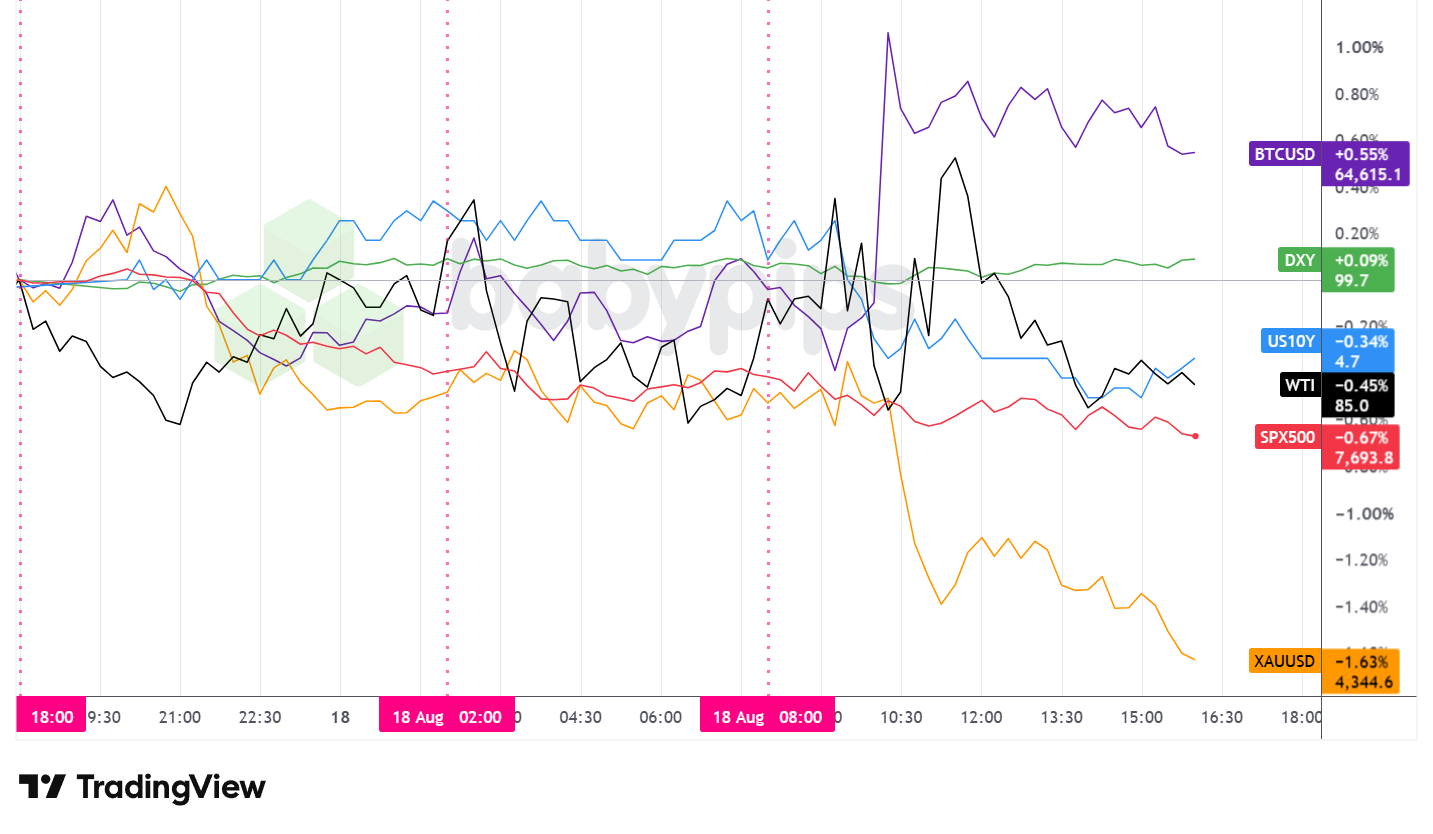
Dollar Index, Gold, Oil, S&P 500, U.S. 10-yr Yield, Bitcoin Overlay – Chart Faster With TradingView
Tuesday’s session ran on a familiar mix. A slide in semiconductor names pulled equities lower, elevated long-end Treasury yields kept a lid on risk appetite, and the Strait of Hormuz deadlock left oil bid near $85. Gold broke from its recent pattern and fell hard as the dollar firmed, while bitcoin drifted higher without a crypto-specific driver.
The S&P 500 opened the Asian and London hours near 7,749 before rolling over through the New York morning, sliding toward a session low near 7,690 in the afternoon and closing near 7,694, down roughly 0.67% on the day. It marked a third straight down session. A closely watched gauge of chipmakers fell about 5.5%, leading the retreat, as investors turned defensive against the backdrop of higher energy and borrowing costs.
Oil held a choppy range through the session, trading near $85.40 in the Asian hours before dipping toward $84.80 and later pushing to a high near $85.97 in the New York morning, then easing back to settle around $85.00, roughly flat to slightly lower on the day. The U.S. and Iran stayed locked in a standoff over control of the Strait of Hormuz, with President Trump saying no talks are scheduled and the naval blockade still in force, while Tehran maintained that the strait remains closed. The U.S. diesel crack hit a record $102.20 a barrel, a sign of how tight refined-product supply has become as war-linked disruptions collide with peak agricultural demand.
Treasury yields stayed elevated near multi-year highs. The U.S. 10-year hovered around 4.7%, down roughly 0.34% on the day after climbing toward 4.75% in the New York morning and then fading back toward 4.70% into the afternoon. Longer-dated debt remains at the center of investor anxiety over inflation, heavy bond supply, and the debt-laden AI boom.
Gold was the standout mover, and not in the direction it followed on Monday. The metal traded near $4,416 early before breaking down through the London and New York sessions, sliding to a low near $4,339 and closing near $4,345, down roughly 1.63% on the day. The firmer dollar and stubbornly high real yields likely did most of the damage, with the retreat tracking the textbook relationship between gold and rising real returns rather than the safe-haven bid that supported it a day earlier.
Bitcoin ground higher through the day, climbing from near $64,030 in the London morning to a spike above $65,000 in the New York morning before easing to close near $64,615, up roughly 0.55% on the day. With no crypto-specific catalyst on the tape, the move may simply reflect pockets of risk appetite rather than a broad risk-on tone, given the slide in equities and gold.
Promoted: As a new trader, the hardest part isn’t learning charts—it’s the psychological pressure of making decisions without all the facts. Markets are dynamic; waiting for absolute certainty means missing the move.
In “Thinking in Bets” (4.3⭐ on 5K reviews on Amazon), former poker champion Annie Duke reveals why great decisions don’t always yield great outcomes. By treating every trade as a “bet” and assessing probabilities rather than guarantees, you’ll eliminate knee-jerk, emotional reactions. Learn to embrace market uncertainty, separate luck from skill, and execute trades with calm confidence.
Develop a probabilistic mindset with “Thinking in Bets” by Annie Duke!
Disclosure: We may earn a commission from our partners if you sign up through our links, at no extra cost to you.
FX Market Behavior: U.S. Dollar vs. Majors
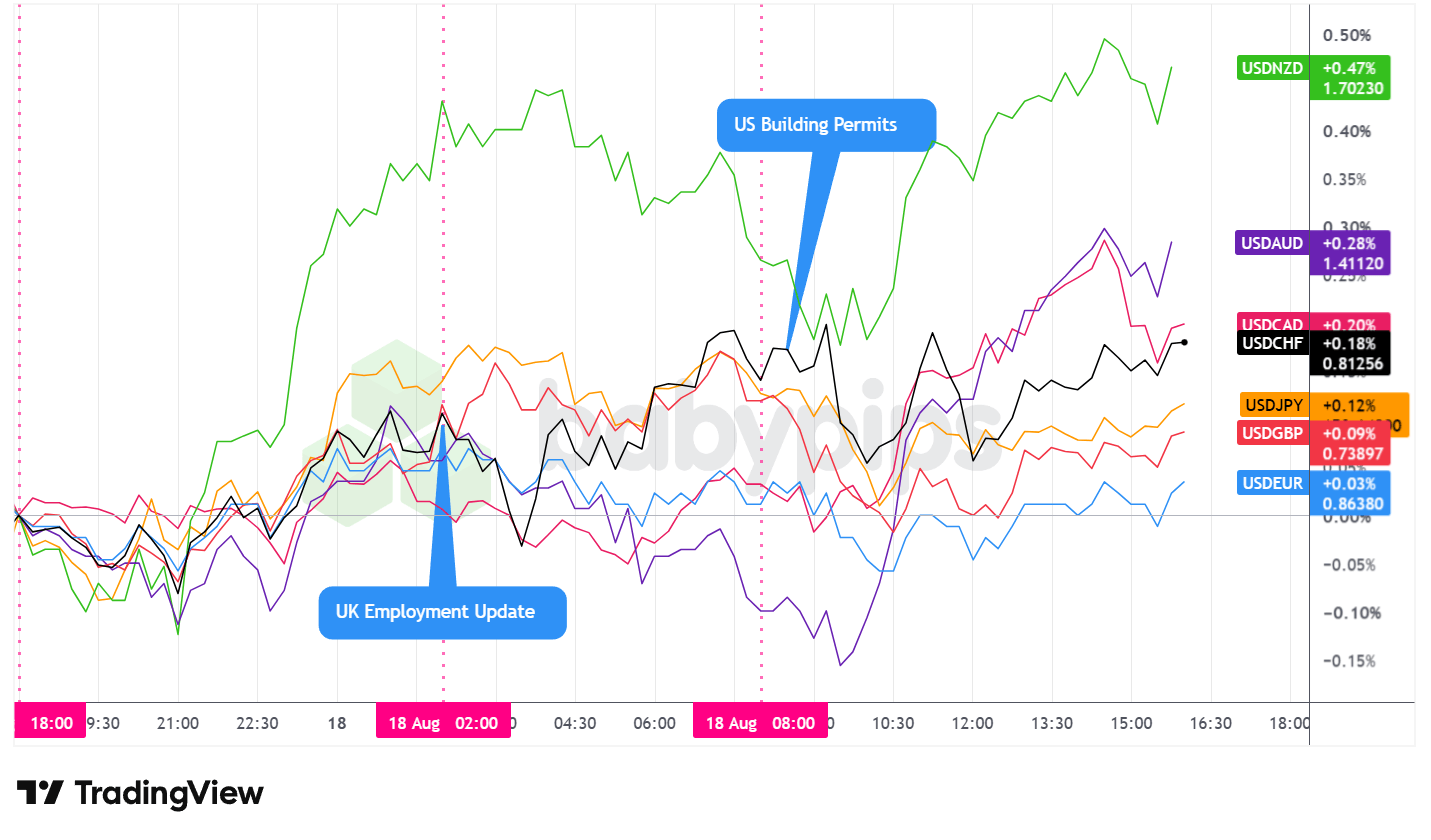
Overlay of USD vs. Major Currencies – Chart Faster With TradingView
The Dollar Index finished a touch firmer, up roughly 0.09% near the 99.66 area, though the flat headline masked a session of repeated dips and rebounds.
From the Tuesday Asia open, the dollar dipped and then rebounded against the majors, leaning net positive heading into the London open. After the London open, the greenback slipped once again before trading mixed against the majors into the U.S. session open. The pattern repeated after the U.S. open, with another dip that stabilized and rebounded not long after the U.S. equity open, and the dollar then traded mixed for the rest of the day.
Sterling drew focus early after the U.K. jobs report split the difference between a miss and a beat. Employment change slowed to 83.0k, well short of the 200.0k forecast, and payrolls fell 13.0k, but wage growth beat expectations and the unemployment rate held at 4.9%. Private-sector wage growth cooled to 2.8%, its weakest pace since 2020, reinforcing the case for a Bank of England hold. The mixed read left the pound with little clear direction, and USD/GBP finished up roughly 0.09% on the day near 0.7390.
The Canadian dollar was in play through the U.S. session as markets priced the risk of U.S. tariffs on Canadian imports scheduled to take effect August 19. The loonie weakened as the deadline loomed, then bounced late after a report suggested Trump was weighing a tariff reprieve, raising hopes the planned 50% duties could be delayed. USD/CAD still finished up around 0.20% on the day near 1.3900.
At Tuesday’s close, the dollar was arguably the best-performing major on a daily basis, firming against every major on net. It gained most against the New Zealand dollar and Australian dollar, added ground against the Swiss franc, Japanese yen, and Canadian dollar, and edged higher against sterling and the euro. The Kiwi’s relative weakness lined up with softer China data cited over the prior session, while the broader move fit a day of defensive positioning and firm U.S. yields.
Upcoming Potential Catalysts on the Economic Calendar
- U.S. API Crude Oil Stock Change for August 14, 2026 at 8:30 pm GMT
- New Zealand PPI for June 30, 2026 at 10:45 pm GMT
- Japan Machinery Orders for June 2026 at 11:50 pm GMT
- Australia Wage Price Index for June 30, 2026 at 1:30 am GMT
- Reserve Bank of Australia Hauser Speech at 2:45 am GMT
- U.K. Inflation Growth Rates for July 2026 at 6:00 am GMT
- Swiss Industrial Production YoY for June 30, 2026 at 6:30 am GMT
- European Central Bank President Lagarde Speech at 7:10 am GMT
- Euro area Inflation Rate Final for July 2026 at 9:00 am GMT
- U.S. MBA Mortgage Applications & 30-year Rate for August 14, 2026 at 11:00 am GMT
- EIA Crude Oil Stocks Change for August 14, 2026 at 2:30 pm GMT
- FOMC Meeting Minutes at 6:00 pm GMT
Wednesday’s calendar hands the microphone to the central banks, which means the FOMC minutes and a run of policy speeches will likely set the tone against the same inflation-versus-debt backdrop that drove Tuesday.
With the U.K. inflation report and the euro area’s final reading both due, along with the ECB’s Lagarde, traders may find fresh cross currents for the dollar, while EIA crude inventory data and the unresolved Hormuz situation keep oil in the frame.
Stay frosty out there, forex friends!
Tuesday’s session packed the textbook risk-off playbook: equities sold off, real yields spiked, gold crashed, and the dollar rallied across every major. But understanding why each piece moved the way it did requires seeing how global mood drives currency flows. Premium members can read our lesson:
📖 Risk-On / Risk-Off: How Global Mood Moves Currencies
Reading this helps you understand which currencies benefit when traders get scared, how to read the risk environment before a trade, and why the dollar’s strength came from fear, not fundamentals.
And if you’re not a Premium subscriber yet, this lesson is a good example of what’s inside.
With Babypips Premium, you get full access to School of Pipsology lessons that help you understand not just what the market is showing you in real time, but the hidden intermarket connections that are actually moving your pairs.