


Oil extended its climb and the S&P 500 fell further from record highs Tuesday as hopes for a Strait of Hormuz deal dimmed and traders positioned for Wednesday’s U.S. inflation report. The Reserve Bank of Australia held its cash rate at 4.35% as expected, and Governor Michele Bullock kept a hawkish tone in place even as the central bank pushed back its inflation timeline. The U.S. dollar chopped through all three sessions and closed little changed against the majors.
Check out the forex news and economic updates you may have missed in the latest trading session!
News Headlines & Data:
- U.K. BRC Retail Sales Monitor for July 2026: 1.0% y/y (1.8% y/y forecast; 1.7% y/y previous)
- Australia NAB Business Confidence for July 2026: -6.0 (-6.0 forecast; -5.0 previous)
- The Reserve Bank of Australia left the cash rate unchanged at 4.35% at its August 11 meeting, judging policy to be somewhat restrictive and reiterating it will do whatever is necessary to return inflation to the 2–3% target, including further hikes if upside risks materialize. In the accompanying statement, the RBA acknowledged a slowing domestic economy and tighter financial conditions but stressed that inflation remains too high and is only expected to return to the midpoint of the target range around late 2027, keeping a hawkish bias firmly in place.
- U.S. NFIB Business Optimism Index for July 2026: 99.8 (96.8 forecast; 97.4 previous)
- U.S. ADP Employment Change Weekly for July 25, 2026: 8.25k (15.0k previous)
- U.S. Existing Home Sales for July 2026: -1.7% m/m (-0.7% m/m forecast; -2.4% m/m previous)
Promoted: Scale Your Strategies
As a weak U.S. jobs report whipsaw traders, navigating the current macro landscape requires more than just a good entry—it requires a partner that has seen it all before.While new firms come and go with the volatility, The5ers (4.7★ rating on 32K+ reviews) has spent the last 10 years perfecting a funding model that works for the trader. It’s why over 1.6 million traders worldwide trust them to provide the capital and scaling needed to turn market analysis into meaningful professional growth.
Learn more about The5ers & available discounts
Disclosure: We may earn a commission from our partners if you sign up through our links, at no extra cost to you.
Broad Market Price Action:
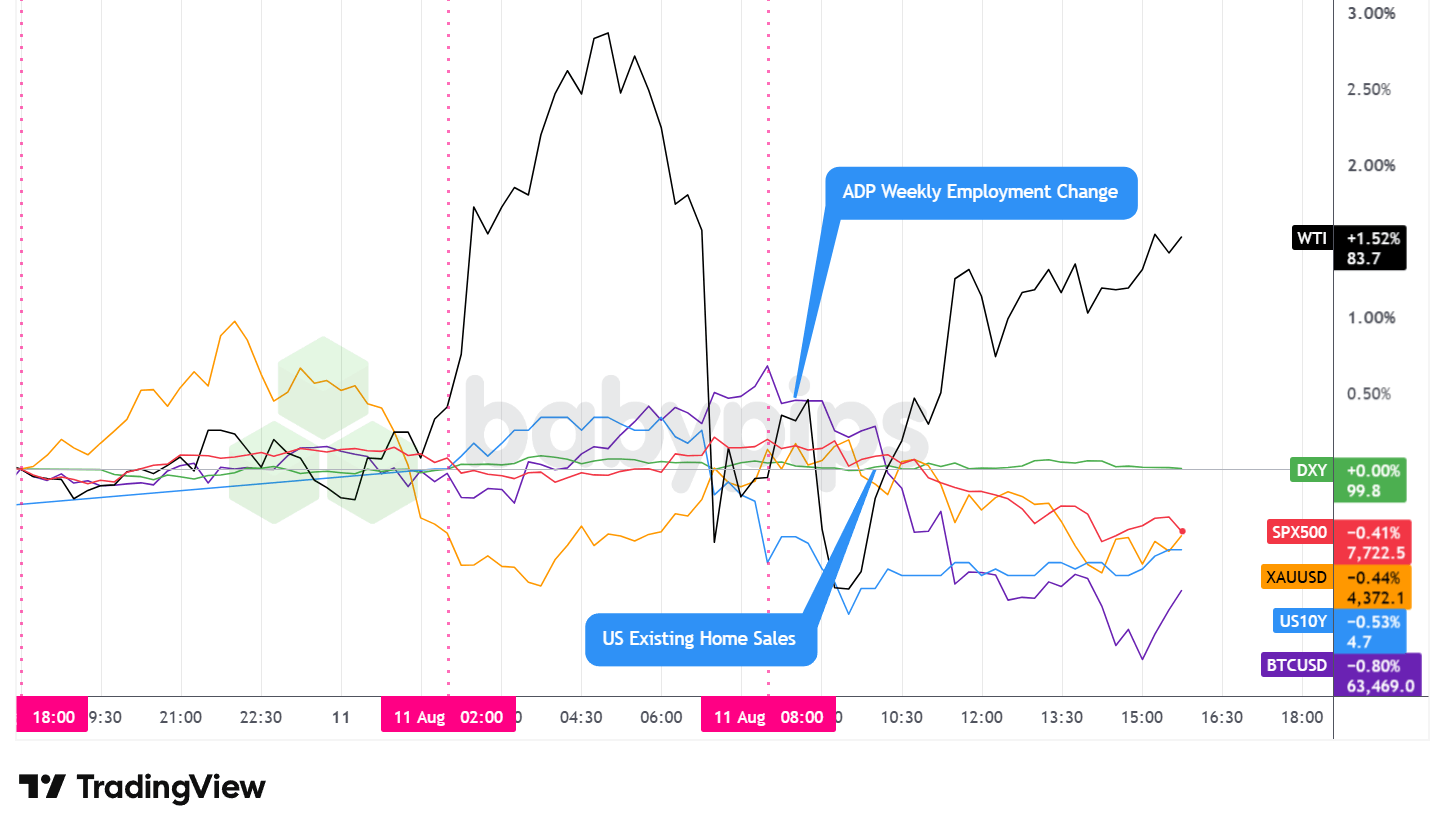
Dollar Index, Gold, Oil, S&P 500, U.S. 10-yr Yield, Bitcoin Overlay – Chart Faster With TradingView
Wall Street stayed quiet but defensive on Tuesday, with traders reluctant to add risk ahead of Wednesday’s inflation report while the stalled Hormuz standoff kept oil bid.
Oil eased in early trade after Pakistan’s defense minister, Khawaja Asif, said the U.S. and Iran are “close to some sort of arrangement” over the Strait of Hormuz, and a Qatari foreign ministry spokesperson signaled that Iran-Oman talks on reopening the waterway to some shipping had reached an advanced stage. The relief proved short-lived. Iran’s newly appointed security council secretary said any agreement with Oman over the strait would remain separate from a full reopening, and President Trump hardened his stance further, demanding Tehran pay reparations for both foreign and domestic unrest. A U.S. Navy helicopter fired on a Panama-flagged cargo ship attempting to run the blockade early Tuesday, and European diesel futures jumped more than 10% after separate strikes damaged Libya’s Zawiya refinery and a Russian refinery in Khabarovsk Krai. WTI crude climbed back above $83 a barrel, up around 1.5% on the session and the strongest performer on the overlay.
The S&P 500 extended its decline from Monday’s near-record levels, trading around 7,725 and down about 0.4% on the session. There were no major headlines from the equity sector for traders to hang on, likely making the rally in oil prices a negative driver for equities, as well as traders possibly repositioning/reducing risk ahead of tomorrow’s U.S. CPI event.
Gold slipped from an overnight high near $4,435 to trade around $4,370, down about 0.45% on the day. No specific catalyst stood out, and the pullback possibly reflected profit-taking after the metal’s recent run, even as the unresolved Hormuz standoff continues to lend some underlying support to havens.
Bitcoin fell to trade near $63,500, down about 0.8% after slipping from an intraday high above $64,400. With no clear crypto-specific catalyst, the decline likely tracked the same risk-off tone weighing on equities through the session.
Treasury yields eased, with the 10-year note trading near 4.70% as traders held positions ahead of Wednesday’s inflation report.
FX Market Behavior: U.S. Dollar vs. Majors
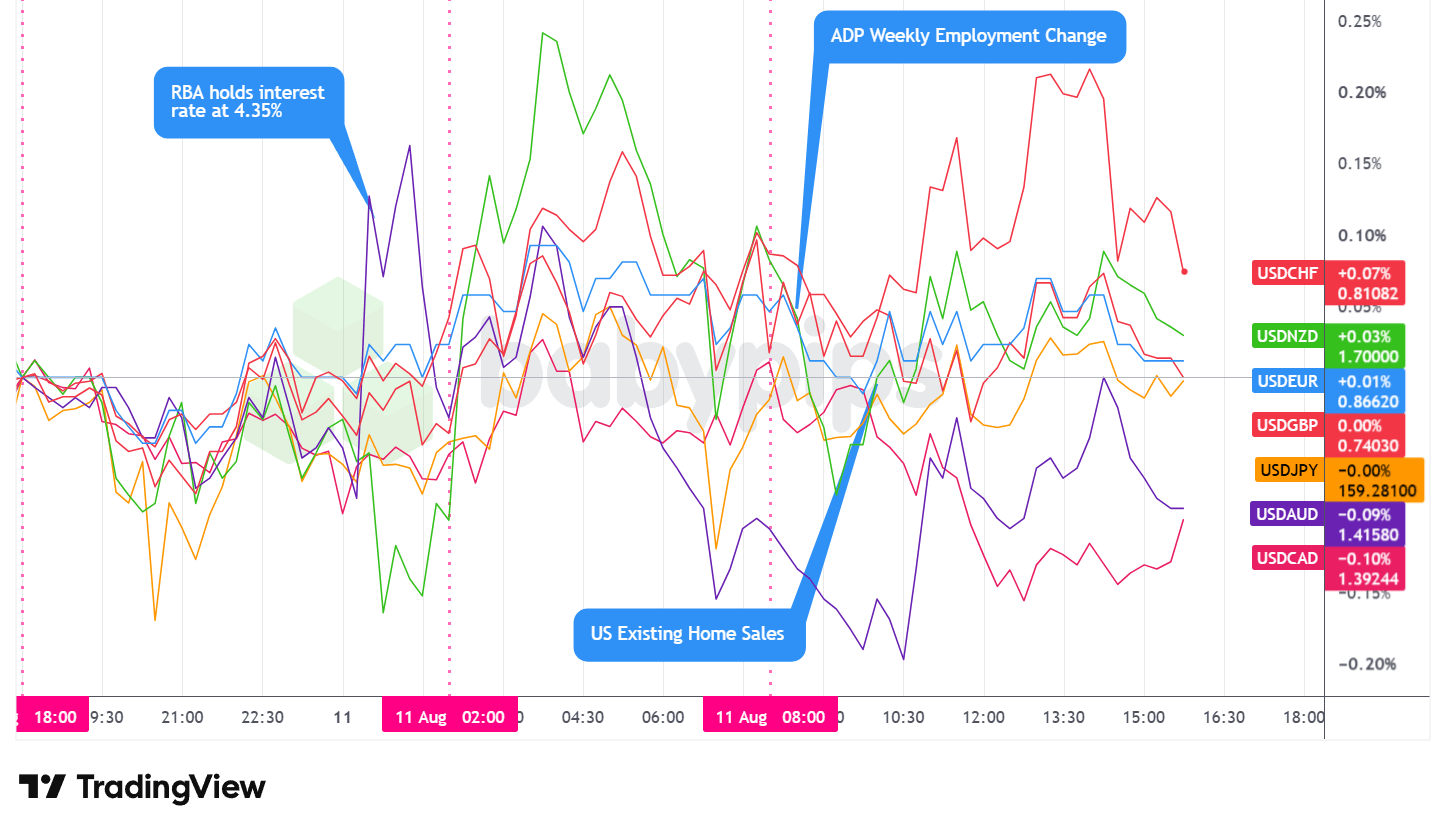
Overlay of USD vs. Major Currencies – Chart Faster With TradingView
During the Asian session, the U.S. dollar traded choppy and sideways, drifting with an arguably net bearish lean against the major currencies. The session’s central event was the Reserve Bank of Australia’s decision to hold its cash rate at 4.35%, a widely expected outcome. Governor Bullock told reporters the board discussed only a hold or a hike, not a cut, and said a further increase remains front of mind, keeping the bar for additional tightening relatively low. The RBA’s updated forecasts revised inflation lower and unemployment higher, while the 2027 cash rate assumption came down to suggest potentially just one more hike ahead. The Australian dollar found some support from that tone even as broader dollar price action stayed choppy across the majors.
The dollar began to rebound against the majors after the London open, but the rebound stalled and gave way to a pullback heading into the U.S. session. London trade ran light on the data front. Reports that Iran-Oman talks on shipping routes had reached an advanced stage offered no clarity on a full reopening of the strait, and traders likely leaned on positioning ahead of Wednesday’s inflation report rather than any single fresh catalyst.
The dollar traded mixed and choppy through the U.S. session, leaning net bearish early before turning neutral to arguably net bullish heading into the close. The session’s data offered no single catalyst. The ADP weekly employment print came in at 8.25k, well below its prior 15.0k reading, while the NFIB small business optimism index climbed to its best reading in about a year and existing home sales dropped to a three-month low.
After a day of choppy price action, the dollar closed arguably neutral against the majors on net. It edged higher against the Swiss franc and New Zealand dollar and posted a marginal gain against the euro, held little changed against sterling and the yen, and slipped against the Australian and Canadian dollars. The Aussie’s relative strength lined up with the RBA’s hawkish hold, and the loonie’s resilience was possibly tied to oil’s rally on the session.
Upcoming Potential Catalysts on the Economic Calendar
- Japan Tankan Index for August 2026 at 11:00 pm GMT
- Germany CPI Growth Rate Final for July 2026 at 6:00 am GMT
- Japan Machine Tool Orders for July 2026 at 6:00 am GMT
- U.S. MBA Mortgage Applications & 30-year rate for August 7, 2026 at 11:00 am GMT
- Canada Building Permits for June 2026 at 12:30 pm GMT
- U.S. CPI Growth Rate for July 2026 at 12:30 pm GMT
- EIA Crude Oil Stocks Change for August 7, 2026 at 2:30 pm GMT
Wednesday’s session likely hinges on the U.S. July inflation report, which should offer a cleaner read on how much of the recent energy spike is feeding into broader prices. Three Fed officials dissented in July in favor of raising rates, and a softer print could ease some of that pressure heading into the next policy meeting. The unresolved Strait of Hormuz standoff remains the dominant wildcard for oil, with API and EIA crude inventory data due to add another layer of context. A lighter international slate, including Germany’s final July inflation reading, Japan’s Tankan survey, and Canadian building permits, rounds out the calendar.
Stay frosty out there, forex friends!
Tuesday’s session showed oil climbing as equities pulled back and the Australian and Canadian dollars responded, a textbook example of how risk sentiment and commodity flows move currencies together. Premium members can read our lesson:
📖 Equities and Currencies: The Big Picture
Reading this helps you understand how equities and commodities shape risk sentiment, which currencies benefit and which suffer when that sentiment shifts, and how to use equity market moves as an early warning system for currency flows.
And if you’re not a Premium subscriber yet, consider joining today.
With Babypips Premium, you get full access to School of Pipsology lessons that help you understand the deeper intermarket connections between equities, commodities, and currencies that drive currency trends before most traders spot them.