


Monday’s session revolved around the widening standoff over the Strait of Hormuz. President Trump’s new demand for war compensation from Iran dimmed hopes for a quick deal to reopen the waterway, and oil jumped in response. Equities finished little changed, bitcoin slipped, and both gold and Treasury yields climbed as the energy spike revived questions about how much room the Fed has left to keep easing. The dollar zigzagged through all three sessions but closed higher against most major currencies, led by an outsized decline in the yen.
Check out the forex news and economic updates you may have missed in the latest trading session!
News Headlines & Data:
- President Trump said Sunday he’s willing to let economic pressure crush Iran’s economy instead of ordering new military strikes over the Strait of Hormuz blockade
- China CPI Growth Rate for July 2026: 0.5% y/y (0.9% y/y forecast; 1.0% y/y previous)
- China PPI Growth Rate for July 2026: 3.5% y/y (4.3% y/y forecast; 4.1% y/y previous)
- Japan Bank Lending for July 2026: 5.4% y/y (5.5% y/y forecast; 5.7% y/y previous)
- Japan Current Account for June 2026: 923.0B (3,430.0B forecast; 3,968.0B previous)
- Japan Eco Watchers Survey Outlook for July 2026: 45.8 (46.0 forecast; 45.7 previous)
Have a solid trading strategy but lack the capital? FundedNext empowers disciplined traders by providing simulated trading accounts up to $200K.
Unlike other prop firms, FundedNext imposes no artificial time limits on challenges. You even earn a unique 15% profit share during your evaluation! Once funded, you keep up to a 95% profit split with guaranteed 24-hour payouts. Trade CFDs or Futures your way—even during major news events.
Join over 400K traders who have received $300M+ in payouts. Ready to back your edge?
Learn More About FundedNext! Limited time offer: Use code BPFN for discounts on both CFD & Futures plans! T&C apply.
Disclosure: We may earn a commission from our partners if you sign up through our links, at no extra cost to you.
Broad Market Price Action:
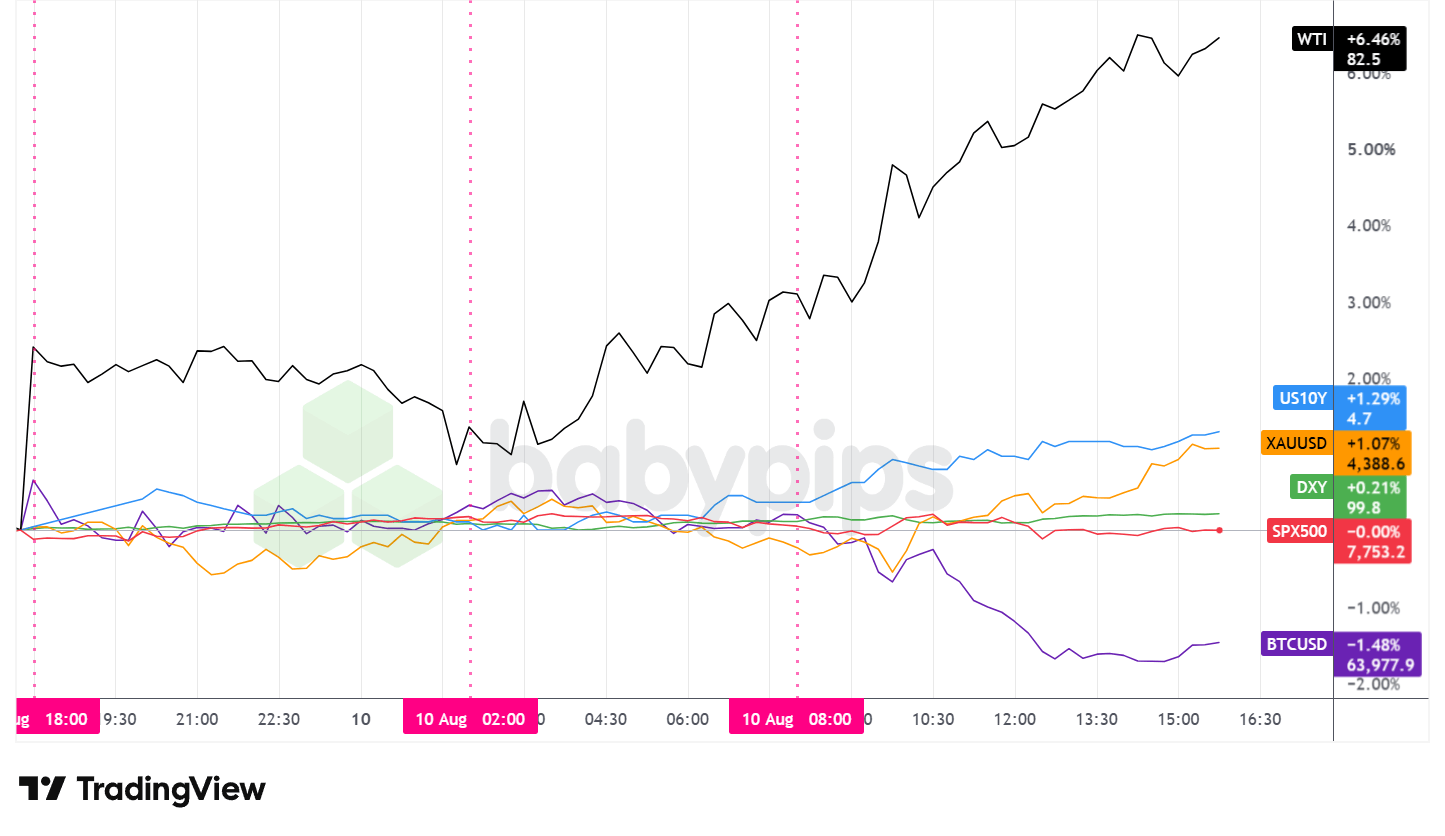
Dollar Index, Gold, Oil, S&P 500, U.S. 10-yr Yield, Bitcoin Overlay – Chart Faster With TradingView
Oil dominated Monday’s price action. WTI crude gapped higher at Sunday evening’s open as shipping through the Strait of Hormuz stayed at a trickle, dipped back toward $78 during the London morning, then extended its climb from there through the New York afternoon to close up roughly 6.5% near $82.50 a barrel. Trump’s hardened compensation demands came on top of a weekend in which Iran named a hardline former Revolutionary Guard commander to its top security post and the UAE reported an Iranian missile strike on an ADNOC-linked vessel in the strait. Yemen’s Houthis also claimed a drone strike on Saudi Aramco’s Jazan refinery, widening the conflict’s front lines beyond Hormuz itself and adding another layer of supply risk into the close.
U.S. equities finished little changed after a wide round trip. The S&P 500 opened near 7,753, climbed toward 7,770 during the Asian equity rally as Korean and Japanese chipmakers extended Friday’s AI-driven momentum, then gave up that advance through the New York morning before a sharp midday slide dragged the index to a session low near 7,740. It recovered only part of the drop into the close, ending the day near where it started. Most individual shares in the index fell, with Nvidia among the laggards after reports that several Wall Street banks are working with the chipmaker on a $500 billion AI funding package, a headline that stoked further unease over AI infrastructure spending.
Gold had a similarly volatile round trip before settling higher. The metal opened near $4,341, dropped toward $4,315 during the Asian evening, rebounded above $4,360 heading into the London session, faded back near $4,317 in the London morning, then rallied from the New York open through the afternoon to close up just over 1% near $4,389. The advance came even as the prospect of a firmer Fed rate path built through the day. An argument could be made that gold’s haven appeal amid the Hormuz standoff outweighed the pressure from higher yields.
Bitcoin moved the opposite direction. The largest cryptocurrency slid from around $65,400 at Sunday’s open to a low near $63,740 in the New York afternoon before a modest bounce left it down roughly 1.5% near $63,980 at the close. No clear crypto-specific catalyst emerged behind the decline, and the drop possibly reflected the same risk-off pressure that weighed on equities and favored havens like gold through the session.
Treasury yields backed up alongside oil. The 10-year yield climbed roughly 6 basis points to trade near 4.70%, extending a recovery from Friday’s slide after the soft July jobs report, as the jump in energy costs revived concerns the Fed may need to stay cautious on further easing even with a softening labor market.
FX Market Behavior: U.S. Dollar vs. Majors
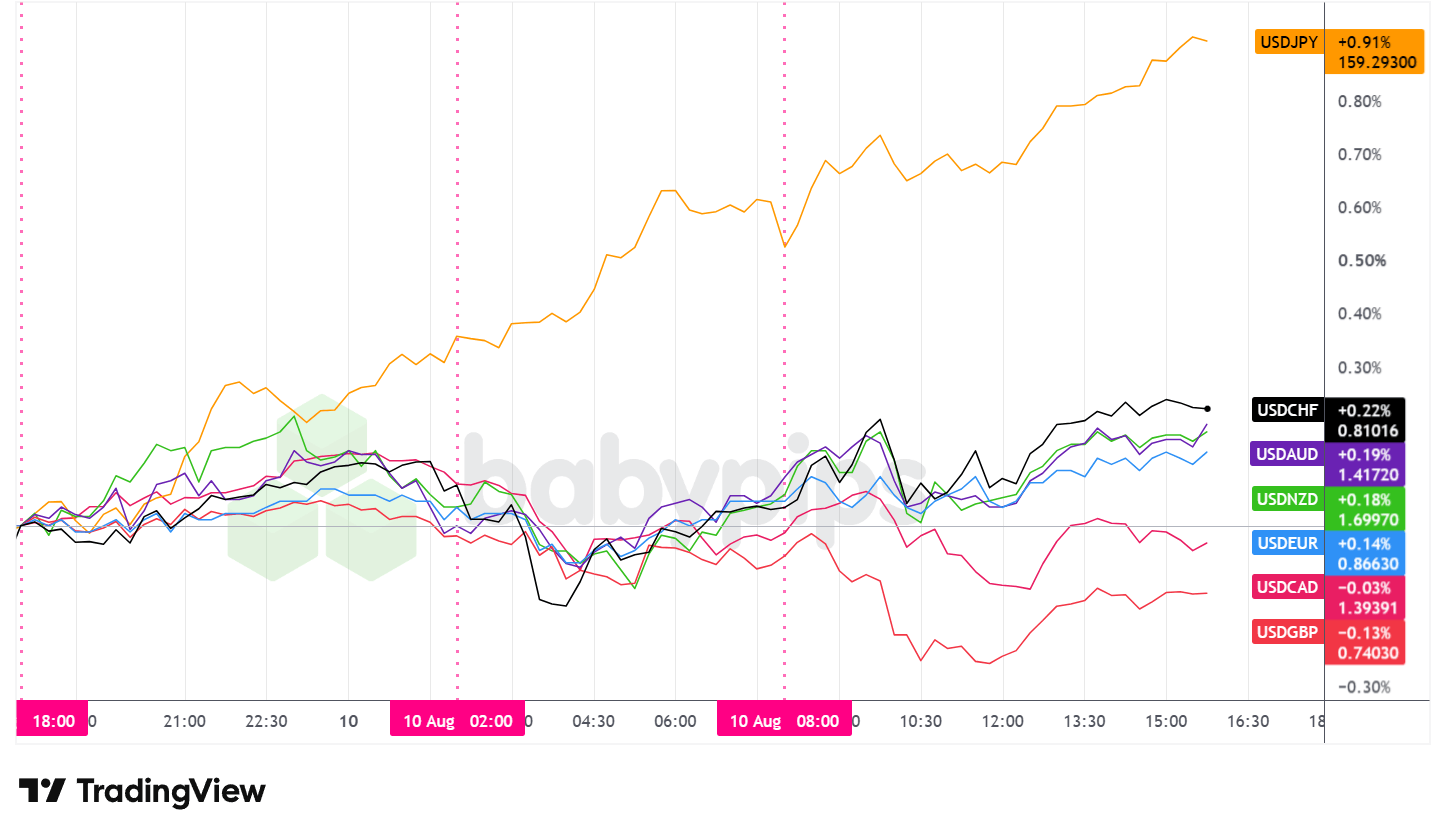
Overlay of USD vs. Major Currencies – Chart Faster With TradingView
The U.S. dollar closed higher against most major currencies on Monday after zigzagging through all three sessions.
During the Asian session, the dollar traded net higher before pulling back into the London open. The Bank of Japan released a summary of opinions from its July meeting on Monday showing policymakers growing more concerned about an inflation overshoot, with one member saying the pace of hikes could end up faster than markets expect. That pushed market pricing further toward a possible September hike. The yen still underperformed through the session, however, possibly as traders continued unwinding part of the sharp gains built up after last month’s joint intervention by Tokyo and Washington. A broad risk-on tone in Asian equities, with Korean and Japanese chipmakers extending Friday’s rally, may have added to the pressure on the yen as a funding currency.
The dollar continued to pull back through the early London session before finding a bottom mid-morning and rebounding into the U.S. open. The European calendar was light, and with oil’s climb still gathering steam, the session lacked a single clear catalyst for the dollar’s moves beyond broader positioning ahead of Wednesday’s U.S. inflation report.
After the U.S. session opened, the dollar extended its rebound before dipping again shortly after equities began trading at 9:30 a.m., a move that lined up with the S&P 500’s push to session highs. It found a bottom soon after and trended higher for the rest of the afternoon as the equity index reversed into its midday slide and oil and Treasury yields kept climbing, a combination that arguably favored the dollar’s haven appeal into the close.
At Monday’s close, the dollar was net bullish against the majors, led by an outsized gain against the Japanese yen, which slid roughly 0.9% to trade near 159.29. The dollar also closed higher against the Swiss franc, Australian dollar, New Zealand dollar and euro, though by far smaller margins than against the yen. Sterling and the Canadian dollar were the session’s only gainers against the greenback, with the loonie’s resilience possibly tied to oil’s rally and sterling’s larger gain lacking any single clear domestic catalyst.
Upcoming Potential Catalysts on the Economic Calendar
- U.K. BRC Retail Sales Monitor for July 2026 at 11:01 pm GMT
- Australia NAB Business Confidence for July 2026 at 1:30 am GMT
- Reserve Bank of Australia Interest Rate Decision for August 11, 2026 at 4:30 am GMT
- U.S. NFIB Business Optimism Index for July 2026 at 10:00 am GMT
- U.S. ADP Employment Change Weekly for July 25, 2026 at 12:15 pm GMT
- U.S. Existing Home Sales for July 2026 at 2:00 pm GMT
- U.S. API Crude Oil Stock Change for August 7, 2026 at 8:30 pm GMT
Tuesday’s session likely hinges on the Reserve Bank of Australia, where all 37 economists polled by Reuters expect a hold at 4.35%, leaving the accompanying language on inflation and the bank’s hiking bias as the bigger driver for the Aussie than the decision itself.
The Hormuz standoff remains the dominant wildcard heading into the new session, with oil capable of overriding the calendar at any point after both sides hardened their positions over the weekend.
Monday’s hawkish BOJ summary could also keep yen positioning volatile ahead of a possible September hike.
A lighter batch of second-tier U.S. data, including business optimism, weekly employment figures and existing home sales, arrives ahead of Wednesday’s higher-profile July inflation report, which should offer a cleaner read on how much of the recent energy spike is feeding through to broader prices.
Stay frosty out there, forex friends!
Monday’s oil spike from the Strait of Hormuz standoff sent ripples through Treasury yields, equities, and currency markets—but only if you know how to read those connections. Premium members can read our lesson:
📖 What Is Intermarket Analysis?
Reading this helps you understand how commodity shocks transmit into bond yields, why yield changes reshape currency flows, and how to spot the real drivers of market moves instead of reading individual markets in isolation.
And if you’re not a Premium subscriber yet, now’s a good time to join.
With Babypips Premium, you get full access to School of Pipsology lessons that help you understand how oil shocks feed through Treasury yields, how yield shifts drive currency flows, and why looking at one market in isolation blinds you to what’s actually moving price.