


Tuesday’s session ran on Hormuz headlines more than anything on the economic calendar. Qatar said it had circulated a draft plan to de-escalate the standoff over the strait, and upbeat comments from U.S. officials sent oil into a steep slide, even as an overnight missile strike on a cargo vessel showed the conflict hadn’t gone anywhere.
Equities pushed to fresh records on the improving mood and a strong batch of earnings, while the dollar traded mixed to lower against most majors through a session light on market-moving data of its own.
Check out the forex news and economic updates you may have missed in the latest trading session!
News Headlines & Data:
- Japan Monetary Base for July 31, 2026: -13.8% y/y (-14.0% y/y forecast; -13.7% y/y previous)
- Australia Household Spending for June 2026: 6.0% y/y (5.1% y/y forecast; 5.5% y/y previous); 0.8% m/m (0.2% m/m forecast; 1.3% m/m previous)
- Australia ANZ-Indeed Job Ads for July 2026: 0.8% m/m (-0.1% m/m forecast; -0.2% m/m previous)
- Australia Commodity Prices for July 2026: 15.4% y/y (15.0% y/y forecast; 16.9% y/y previous)
- Canada Balance of Trade for June 2026: 3.86B (4.8B forecast; 4.24B previous)
- U.S. Balance of Trade for June 2026: -73.3B (-73.0B forecast; -77.6B previous)
- Canada S&P Global Manufacturing PMI for July 2026: 53.5 (51.0 forecast; 53.0 previous)
- U.S. JOLTs Job Openings for June 2026: 7.36M (7.3M forecast; 7.54M previous)
- U.S. Factory Orders for June 2026: -0.3% m/m (0.4% m/m forecast; -1.3% m/m previous)
- U.S. Factory Orders ex Transportation for June 2026: -0.4% m/m (0.5% m/m forecast; 1.9% m/m previous)
- New Zealand Global Dairy Trade Price Index for August 4, 2026: 0.1% (1.5% previous)
Broad Market Price Action:
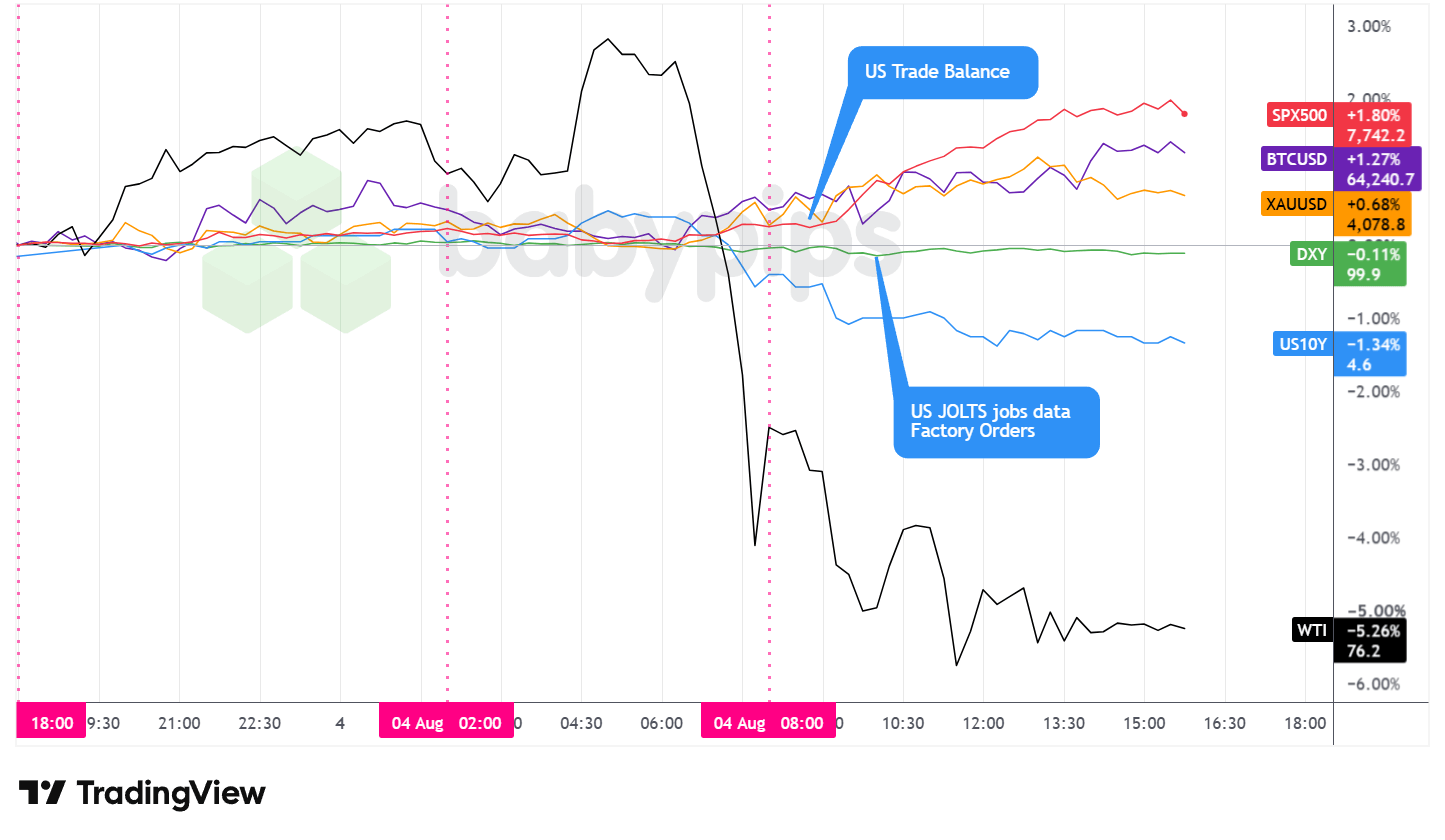
Dollar Index, Gold, Oil, S&P 500, U.S. 10-yr Yield, Bitcoin Overlay – Chart Faster With TradingView
Geopolitics set the tone for a second straight session. Qatar’s foreign ministry said a proposed de-escalation resolution was circulating between Washington and Tehran, and both Secretary of State Marco Rubio and Treasury Secretary Scott Bessent gave optimistic public assessments of the talks to reopen the Strait of Hormuz, according to Bloomberg. That optimism followed an overnight scare in the Gulf. The UK Maritime Trade Operations body reported a cargo vessel disabled by a missile strike near Al Khasab, Oman, and Iranian state-linked media pointed to fresh strikes on U.S. bases in Kuwait, claims that drew no independent confirmation elsewhere.
The S&P 500 climbed roughly 1.8% to close near 7,742, with the index and the Dow Jones Industrial Average both setting fresh records on the session, Bloomberg reported. Price chopped near flat through the Asian and London hours, then turned higher once U.S. trading got underway and built on those gains through the afternoon. The advance likely reflected some mix of the Hormuz optimism and a strong run of earnings, including a 93% year-over-year jump in Palantir’s revenue that arrived alongside raised full-year guidance.
WTI crude absorbed the sharpest reversal among the assets we track, giving back roughly 5% to settle near $76 a barrel after trading as high as the low $83s during the London morning. The early climb tracked the overnight escalation in the Gulf. The slide then gathered pace once Bessent said a deal to reopen the strait could come within a day or two, and once Qatar confirmed a draft proposal was already circulating between the two sides. Brent crude, the global benchmark, settled below $80 a barrel for the first time in more than three weeks, extending Monday’s decline into a second session, Bloomberg reported.
Gold added about 0.7% to trade near $4,079 an ounce, a gain that sits a little awkwardly next to the day’s broader risk-on tone. Price chopped in a narrow range through the Asian session and dipped further into the London morning. It extended higher once U.S. trading began, tested levels above $4,100 in the early afternoon, then eased back into the close. Equities and oil both moved on the same Hormuz headlines but in the opposite direction from gold, so the metal’s strength this session may owe more to the day’s pullback in Treasury yields and USD weakness than to any renewed safe-haven bid.
Bitcoin gained roughly 1.3% to trade near $64,240, tracking the broader improvement in risk appetite. The token dipped toward the low $63,000s during the Asian session on no apparent catalyst, then rallied through the London morning. It pulled back again ahead of the U.S. open, then climbed through the afternoon alongside equities. As on sessions with no crypto-specific news, the move likely reflected the same swings in broad risk sentiment that lifted stocks rather than anything unique to bitcoin.
The 10-year Treasury yield fell to around 4.6%, part of a broader bond rally that Bloomberg tied to easing geopolitical risk alongside a mixed JOLTS report. Job openings for June came in at 7.36 million, below the 7.3 million forecast and down from a downwardly revised 7.54 million in May, even as hires improved to 5.35 million on the month. Fed officials have left the door open to a possible rate hike in recent weeks despite softer growth data. Tuesday’s move in yields suggests traders leaned toward the softer side of that debate for now as oil prices fall, though Friday’s more closely watched July jobs report should carry more weight for the rate path.
Promoted: A 5% Oil Reversal and Record Highs in the Same Session Call for a Risk-Managed Approach.
Tuesday’s whipsaw between crude’s Hormuz-driven slide and the S&P 500’s record close is exactly the kind of day that punishes oversized positions. FundedNext empowers disciplined traders by providing simulated trading accounts up to $200K.
Unlike other prop firms, FundedNext imposes no artificial time limits on challenges. You even earn a unique 15% profit share during your evaluation! Once funded, you keep up to a 95% profit split with guaranteed 24-hour payouts. Trade CFDs or Futures your way, even during major news events.
Join over 400K traders who have received $300M+ in payouts. Ready to back your edge?
Learn More About FundedNext! Limited time offer: use code BPFN for discounts on both CFD & Futures plans. T&C apply.
Disclosure: We may earn a commission from our partners if you sign up through our links, at no extra cost to you.
FX Market Behavior: U.S. Dollar vs. Majors
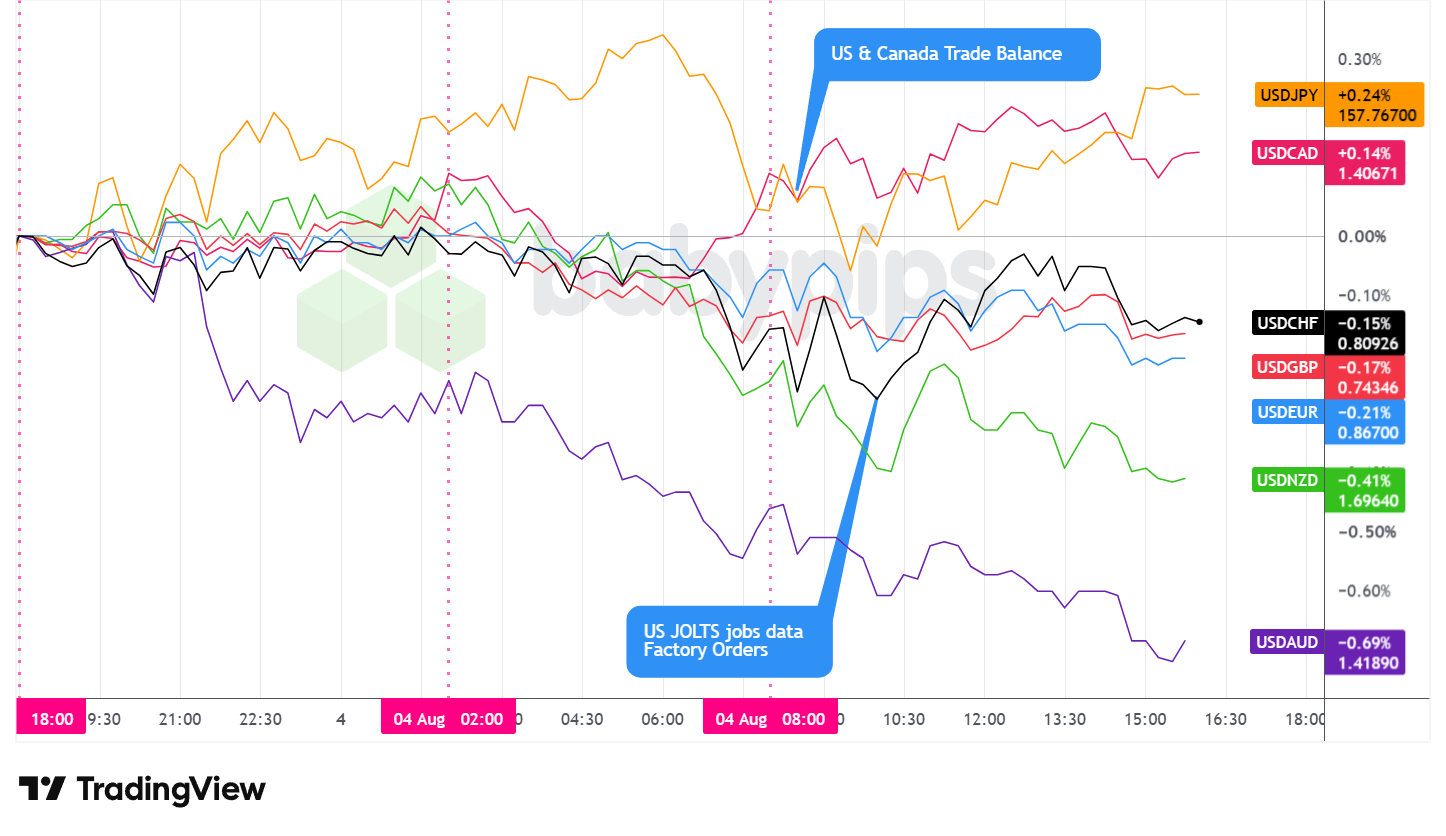
Overlay of USD vs. Majors – Chart Faster With TradingView
The U.S. dollar spent Tuesday mostly on the defensive, closing mixed but arguably net bearish against the majors in a session where geopolitics and a scattered batch of U.S. data did more to move currencies than any single dollar-specific catalyst.
During the Asian session, the dollar traded with low volatility and mostly sideways, though the yen and the Australian dollar both saw more action than the rest of the pack. USD/JPY pushed toward the mid-157.00s. The move may reflect Japan’s ruling party backing a temporary cut to the food consumption tax, alongside roughly ¥600 billion a year in household cash transfers, adding to existing worries over Japan’s fiscal position. The Australian dollar moved the other way. June household spending beat forecasts, reinforcing bets that the Reserve Bank of Australia holds rates steady at next week’s meeting, and AUD ended the day as the strongest major against the dollar.
The London session brought a net lower dollar against the majors, and the greenback had stabilized by the time U.S. trading got underway. No single London data point stood out as the driver, and the drift lower likely reflected some mix of positioning ahead of the day’s U.S. releases and the broader improvement in risk appetite building on Hormuz hopes.
The U.S. session opened with the dollar choppy: it dipped further against the majors, found a floor and rebounded around the London close, then traded mixed for the rest of the afternoon. The U.S. trade balance for June came in at negative $73.3 billion, close to the $73.0 billion forecast, while the mixed JOLTS report and a soft Factory Orders print (down 0.3% on the month, with the ex-transportation read even weaker at negative 0.4%) gave the dollar little clear direction. It’s possible the afternoon rebound owed more to the broader risk-on shift in equities than to anything specific on Tuesday’s calendar.
At Tuesday’s close, the dollar finished mixed: modestly firmer against the yen and the Canadian dollar, but softer against the euro, sterling, the Swiss franc, the New Zealand dollar, and, most of all, the Australian dollar. Taken together, the session leaned net bearish for the greenback, and Wednesday’s ADP employment report and ISM Services PMI look likely to matter more for the dollar’s next move than anything on Tuesday’s calendar.
Upcoming Potential Catalysts on the Economic Calendar
- New Zealand Employment Situation Update for June 30, 2026 at 10:45 pm GMT
- Australia S&P Global Services PMI Final for July 2026 at 11:00 pm GMT
- Bank of Japan Monetary Policy Meeting Minutes at 11:50 pm GMT
- Japan S&P Global Services PMI Final for July 2026 at 12:30 am GMT
- China RatingDog Services PMI for July 2026 at 1:45 am GMT
- France Industrial Production for June 2026 at 6:45 am GMT
- Germany S&P Global Services PMI Final for July 2026 at 7:55 am GMT
- Euro area S&P Global Services PMI Final for July 2026 at 8:00 am GMT
- U.K. S&P Global Services PMI Final for July 2026 at 8:30 am GMT
- Euro area PPI for June 2026 at 9:00 am GMT
- U.S. MBA 30-Year Mortgage Rate & Mortgage Applications for July 31, 2026 at 11:00 am GMT
- ADP National Employment Report for July 2026 at 12:15 pm GMT
- U.S. S&P Global Services PMI Final for July 2026 at 1:45 pm GMT
- U.S. ISM Services PMI for July 2026 at 2:00 pm GMT
- EIA Crude Oil Stocks Change for July 31, 2026 at 2:30 pm GMT
- U.S. Fed Cook Speech at 8:05 pm GMT
Wednesday builds toward Friday’s more closely watched July jobs report, with the ADP National Employment Report and the ISM Services PMI standing out as the session’s key U.S. releases. A strong ADP print would likely feed the case some Fed officials have made for a possible rate hike, coming on the heels of three regional presidents dissenting in that direction at last week’s meeting. A soft number would give the central bank more room to sit still.
The Hormuz track deserves just as much attention: Tuesday’s early spike in oil reversed into a slide of more than 5% within hours, and any confirmation, or breakdown, of Qatar’s draft proposal could move oil and the currencies most tied to it well before Friday’s headline number lands. Fed Governor Cook rounds out Wednesday’s calendar with an evening speech, though she will be speaking into a policy debate the Fed has already aired at length since last week’s hold.
Stay frosty out there, forex friends!
Tuesday’s Hormuz headlines moved oil, equities, bonds, and currencies in one coordinated session. You may not realize those moves aren’t isolated, they’re all connected. Premium members can read our lesson:
📖 What Is Intermarket Analysis?
Reading this helps you understand how oil, equity, and bond market moves transmit to currency pairs, why those asset classes move together on risk sentiment shifts, and how to read what’s actually driving the forex market instead of just reacting to price.
And if you’re not a Premium subscriber yet, now’s a good time to explore what’s available.
With Babypips Premium, you get full access to School of Pipsology lessons that help you understand not just individual currency pairs, but how they connect to stocks, bonds, commodities, and broader market conditions