


Tuesday’s session split the market in two. Investors piled into value and cyclical shares, pushing the equal-weighted S&P 500 to a record high, while a rout in semiconductor stocks left the Nasdaq 100 flirting with a technical correction.
Crude oil tumbled for a third straight day as easing U.S.-Iran tensions pulled the geopolitical premium out of the barrel, dragging Treasury yields lower with it. The dollar made a wide round trip and finished close to where it started, with the Fed’s Wednesday decision keeping a lid on conviction.
Check out the forex news and economic updates you may have missed in the latest trading session!
News Headlines & Data:
- U.K. BRC Shop Price Inflation for July 2026: 0.9% (1.3% forecast; 1.2% previous)
- RBA Governor Bullock said on Tuesday that recent supply shocks, including higher oil prices and Middle East disruption, are complicating the inflation outlook. She said the RBA remains focused on bringing inflation sustainably back to target and is prepared to raise rates further if needed.
- ADP U.S. Employment Change Weekly for July 11, 2026: 15.0k (16.5k previous)
- U.S. Goods Trade Balance Adv for June 2026: -101.5B (-99.0B forecast; -105.9B previous)
- U.S. Wholesale Inventories Adv for June 2026: 0.3% m/m (0.2% m/m forecast; 0.1% m/m previous)
- U.S. S&P/Case-Shiller Home Price for May 2026: 1.6% y/y (1.3% y/y forecast; 1.1% y/y previous)
- U.S. House Price Index for May 2026: 2.2% y/y (1.8% y/y forecast; 2.0% y/y previous)
- Richmond Fed Manufacturing Index for July 2026: 5.0 (7.0 forecast; 4.0 previous)
- Richmond Fed Services Revenues Index for July 2026: -3.0 (-2.0 forecast; -1.0 previous)
- CB U.S. Consumer Confidence for July 2026: 90.8 (92.0 forecast; 91.2 previous)
- Dallas Fed Services Index for July 2026: 6.6 (2.0 forecast; 2.9 previous)
- Dallas Fed Services Revenues Index for July 2026: 9.5 (8.0 forecast; 9.8 previous)
Broad Market Price Action:
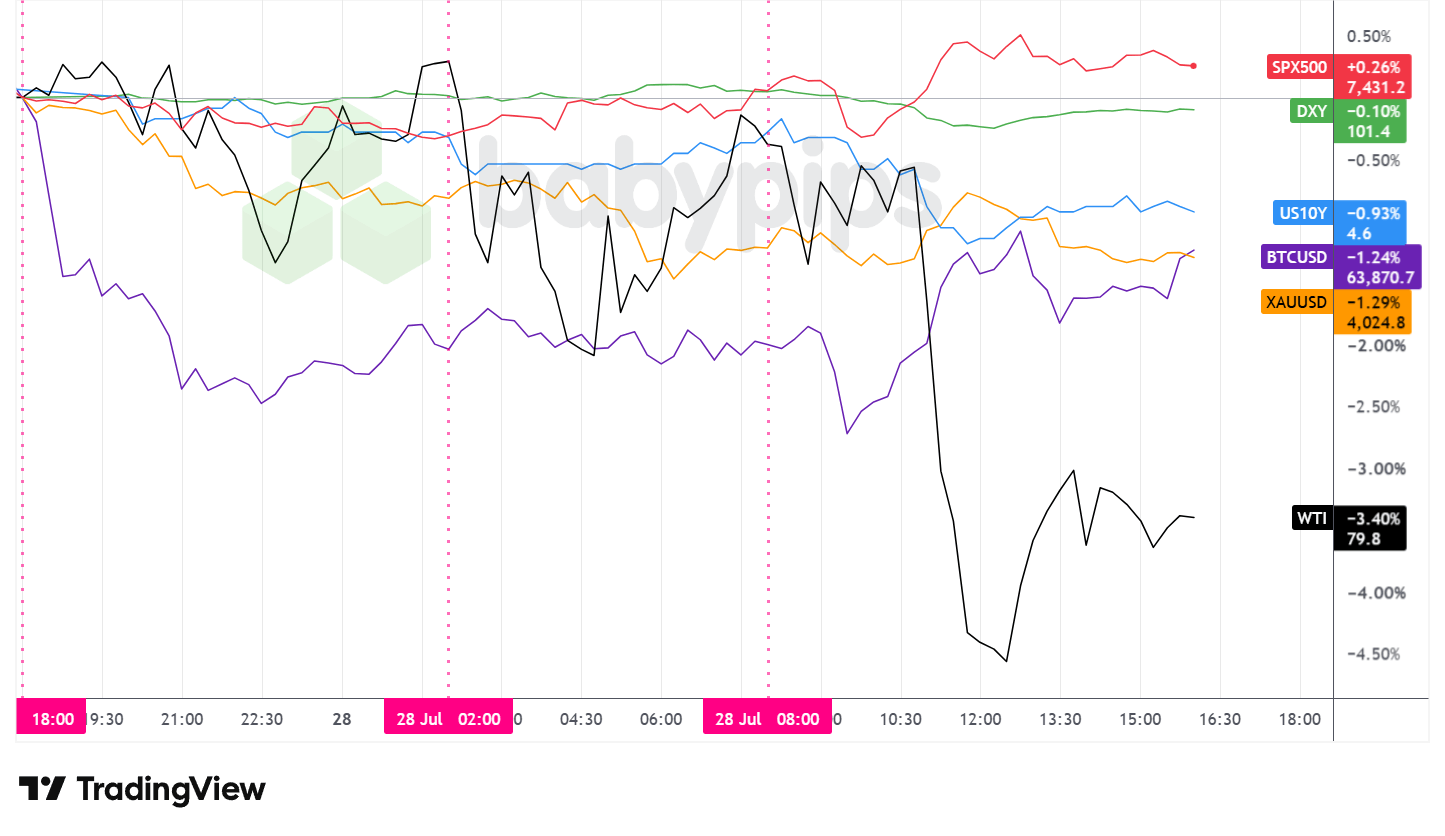
Dollar Index, Gold, Oil, S&P 500, U.S. 10-yr Yield, Bitcoin Overlay – Chart Faster With TradingView
Tuesday’s rotation ran deep. The Dow Jones Industrial Average added roughly 1% and the equal-weighted version of the S&P 500 hit a record, while the cap-weighted S&P 500 managed only a modest gain as chipmakers weighed on the index. The S&P 500 closed near 7,431, up about 0.26% on the day. An early dip gave way to a strong midday rally that lifted the index above 7,450, before it gave back some of the advance into the close.
The Nasdaq 100 told a rougher story. Chipmakers headed toward their worst month since 2002, with skepticism growing over whether spending on artificial intelligence infrastructure will justify the money pouring into it. The same pressure showed up even more sharply overseas. South Korea’s Samsung and SK Hynix each fell by double digits, and the broader Korean market dropped more than 10% on the day. The slide has erased roughly 30% of the market’s value in six weeks, a stunning reversal after its best quarter on record.
Several arguments are made for the broader stock market resilience, including positive earnings expectations, an improving U.S. growth outlook and lower valuations elsewhere in the market. Investors may be starting to realize that they have more ways to play the AI theme than a narrow list of chip stocks, even while keeping a constructive view on the semiconductor group itself.
Tuesday’s trade figures added a wrinkle to the same debate. The U.S. goods trade deficit narrowed 4.2% from May to $101.5 billion, a touch wider than economists had forecast. Capital goods imports, a category that includes computers and semiconductors, fell for the first time since September, though they remained 37.4% higher than a year earlier.
WTI crude led the day’s moves, sliding 3.40% to settle near $79.80 a barrel, its worst three-day stretch since 2020 alongside Brent. Oil had chopped between roughly $82 and $83 through the Asian and early European sessions. A Reuters report that Oman had presented Iran with a proposal for a regional mechanism to manage the Strait of Hormuz, with voluntary fees rather than sole Iranian control, helped send prices lower from there. Regional backing for the plan, if it holds, would remove a significant obstacle to a broader de-escalation. Crude extended its slide through the U.S. morning session, touching a low near $78.50 before stabilizing.
Gold slipped 1.29% to trade near $4,025 an ounce. The metal ground lower overnight to a low near $4,012, attempted a recovery through the U.S. morning, then faded back into the close. The decline arguably reflected fading safe haven demand as Middle East risk eased, even though falling Treasury yields would typically be expected to work in gold’s favor.
Bitcoin fell 1.24% to around $63,871, with no clear asset-specific catalyst behind the move. The cryptocurrency slid to a low near $62,634 overnight before rebounding to a session high above $64,000 during the U.S. morning, a path that tracked the broader swings in risk appetite running through equities and oil more than anything crypto-specific.
The 10-year Treasury yield eased about 0.9% on the day to trade near 4.60%, extending a third straight day of gains for bonds. Yields drifted lower through the session as crude’s slide eased inflation expectations, and positioning ahead of Wednesday’s Fed decision likely added to the move.
Promoted: Scale Your Strategies
As persistent inflation and shifting central bank policies whipsaw traders, navigating the current macro landscape requires more than just a good entry—it requires a partner that has seen it all before.While new firms come and go with the volatility, The5ers (4.7★ rating on 32K+ reviews) has spent the last 10 years perfecting a funding model that works for the trader. It’s why over 1.6 million traders worldwide trust them to provide the capital and scaling needed to turn market analysis into meaningful professional growth.
Learn more about The5ers & available discounts
Disclosure: We may earn a commission from our partners if you sign up through our links, at no extra cost to you.
FX Market Behavior: U.S. Dollar vs. Majors
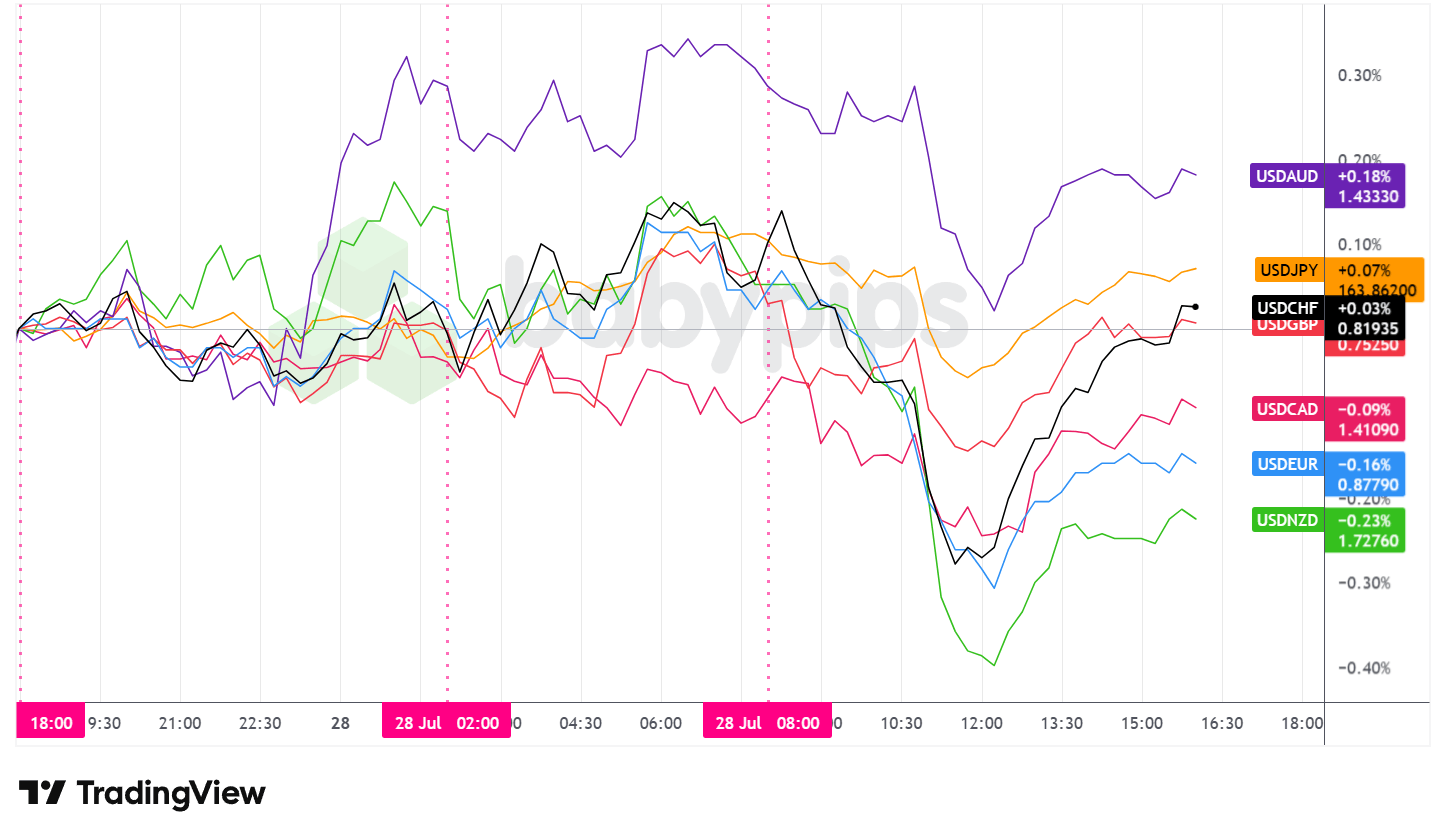
Overlay of USD vs. Majors – Chart Faster With TradingView
The dollar spent Tuesday on a round trip that left it little changed against most majors by the close, even though the path there was far from calm.
During the Asian session, the dollar traded mostly sideways and choppy against the majors, arguably balancing out to a neutral lean overall. RBA Governor Bullock’s hawkish tone on the inflation outlook left AUD/USD largely unmoved right after her comments, though the Aussie drifted a few pips lower against the dollar as the session wore on.
Choppy trading continued through the London session. The dollar traded with an initial net bearish lean before staging a rebound through the mid-morning that lifted the Dollar Index toward an intraday high above 101.60 ahead of the U.S. open.
Just ahead of the U.S. session, the dollar’s rebound stalled and reversed. An argument that aside of Oman’s proposal to Iran, this dip could be owed to a wider than forecast U.S. goods trade deficit and a softer than expected consumer confidence read, which showed present conditions at their weakest since 2021. The Dollar Index slid to a session low near 101.26 as the morning wore on.
The dollar rebounded through the afternoon U.S. session, clawing back most of the morning’s losses. An argument could be made that given the lack of major catalysts to end the day, Tuesday’s broader price swings owed more to hedging and deleveraging ahead of Wednesday’s FOMC decision than to fresh developments out of the Middle East, a dynamic that may help explain the afternoon recovery too.
At Tuesday’s close, the dollar traded mixed against the majors, arguably leaning neutral to slightly net bullish on the day. The greenback posted gains against the Australian dollar, Japanese yen and Swiss franc, held little changed against the British pound, and lost ground to the Canadian dollar, euro and New Zealand dollar.
Promoted: Profitable Trading Isn’t Reserved for Wall Street.
Most traders quietly wonder if consistent profitability is actually achievable for someone like them—or if it’s just a story people tell. Jack Schwager’s newest book, “Market Wizards: The Next Generation,” answers that question directly. The legendary author behind the original Market Wizards series interviews a new generation of successful traders—many self-taught—who built real wealth and income through the markets. Their common thread isn’t genius or insider access. It’s a deliberate process, disciplined risk management, and the conviction to take trading seriously as a pursuit worth mastering.
If that sounds like something worth exploring, this is a good place to start.
Get Market Wizards: The Next Generation on Amazon!
Disclosure: We may earn a commission from our partners if you sign up through our links, at no extra cost to you.
Upcoming Potential Catalysts on the Economic Calendar
- Australia CPI Growth Rate for June 2026 at 1:30 am GMT
- Germany Import & Export Price Index for June 2026 at 6:00 am GMT
- Swiss Economic Sentiment Index for July 2026 at 8:00 am GMT
- U.K. Monetary Developments for June 2026 at 8:30 am GMT
- U.S. MBA Mortgage Applications & 30-year rate for July 24, 2026 at 11:00 am GMT
- EIA Crude Oil Stocks Change for July 24, 2026 at 2:30 pm GMT
-
FOMC Federal Funds Rate Decision for July 29, 2026 at 6:00 pm GMT
- FOMC Press Conference at 6:30 pm GMT
- RBA Hunter Speech at 10:40 pm GMT
- Canada Budget Balance for April 2026
Wednesday’s session hinges on the Federal Reserve. Chair Kevin Warsh delivers his second policy decision since taking the role, with the statement due at 6:00 pm GMT and a press conference to follow at 6:30 pm GMT. The meeting carries no fresh economic projections, and a hold remains the widely expected outcome.
Positioning for a hawkish surprise looks to have crept up over the past week, though, a shift that lines up with the same oil-driven inflation concerns Governor Bullock raised on the RBA side Tuesday.
A further slide in crude on Wednesday could also color the tone heading into the decision, since a cooling in Middle East risk would arguably take some of the pressure off the inflation side of the Fed’s mandate. Traders should also watch for read-through from Wednesday’s earnings out of Microsoft and Meta, following Tuesday’s semiconductor rout, with Apple and Amazon still to report Thursday.
Stay frosty out there, forex friends!
Tuesday’s market centered on easing geopolitical tensions in the Middle East and their ripple effects through oil, Treasury yields, and global risk sentiment, a pattern most traders fail to connect until it moves their charts. Premium members can read our lesson:
📖 Geopolitical Risk, Trade Policy, and Safe Haven Flows
Reading this helps you understand how geopolitical events move currency pairs, safe haven flows during periods of shifting risk, and which assets and currency pairs react most when regional stability changes.
And if you’re not a Premium subscriber yet, consider joining.
With Babypips Premium, you get full access to School of Pipsology lessons that help you understand how geopolitical shocks become specific currency pair moves before they show up on your chart.