


A rebound in chipmakers powered risk assets higher on Tuesday, with the S&P 500 clawing back recent losses even as the U.S.-Iran conflict kept oil firm near one-month highs. The U.S. dollar finished as one of the stronger majors, while a hot New Zealand inflation print briefly lifted the kiwi before a softer core reading took some of the heat out of the move.
Check out the forex news and economic updates you may have missed in the latest trading session!
Forex News Headlines & Data:
- New Zealand CPI Growth Rate for June 30, 2026: 1.5% q/q (1.4% q/q forecast; 0.9% q/q previous); 4.1% y/y (4.0% y/y forecast; 3.1% y/y previous)
- Swiss Balance of Trade for June 2026: 3.8B (3.9B forecast; 5.6B previous)
-
U.K. Employment Change for May 2026: 147.0k (70.0k forecast; 100.0k previous)
- U.K. Unemployment Rate for May 2026: 4.9% (4.9% forecast; 4.9% previous)
- U.K. Average Earnings excl. Bonus (3Mo/Yr) for May 2026: 3.4% (3.4% forecast; 3.4% previous)
- U.K. HMRC Payrolls Change for June 2026: -4.0k (20.0k forecast; 2.0k previous)
- U.K. Claimant Count Change for June 2026: 6.7k (25.0k forecast; 31.2k previous)
- Germany ZEW Economic Sentiment Index for July 2026: 26.3 (15.0 forecast; 10.5 previous)
- Euro area ZEW Economic Sentiment Index for July 2026: 23.4 (12.0 forecast; 9.5 previous)
- U.S. ADP Employment Change Weekly for July 4, 2026: 16.5k (19.75k previous)
- New Zealand Global Dairy Trade Price Index for July 21, 2026: 1.5% (-4.9% previous)
Have a solid trading strategy but lack the capital? FundedNext empowers disciplined traders by providing simulated trading accounts up to $200K.
Unlike other prop firms, FundedNext imposes no artificial time limits on challenges. You even earn a unique 15% profit share during your evaluation! Once funded, you keep up to a 95% profit split with guaranteed 24-hour payouts. Trade CFDs or Futures your way—even during major news events.
Join over 400K traders who have received $300M+ in payouts. Ready to back your edge?
Learn More About FundedNext! Limited time offer: Use code BPFN for discounts on both CFD & Futures plans! T&C apply.Disclosure: We may earn a commission from our partners if you sign up through our links, at no extra cost to you.
Broad Market Price Action:
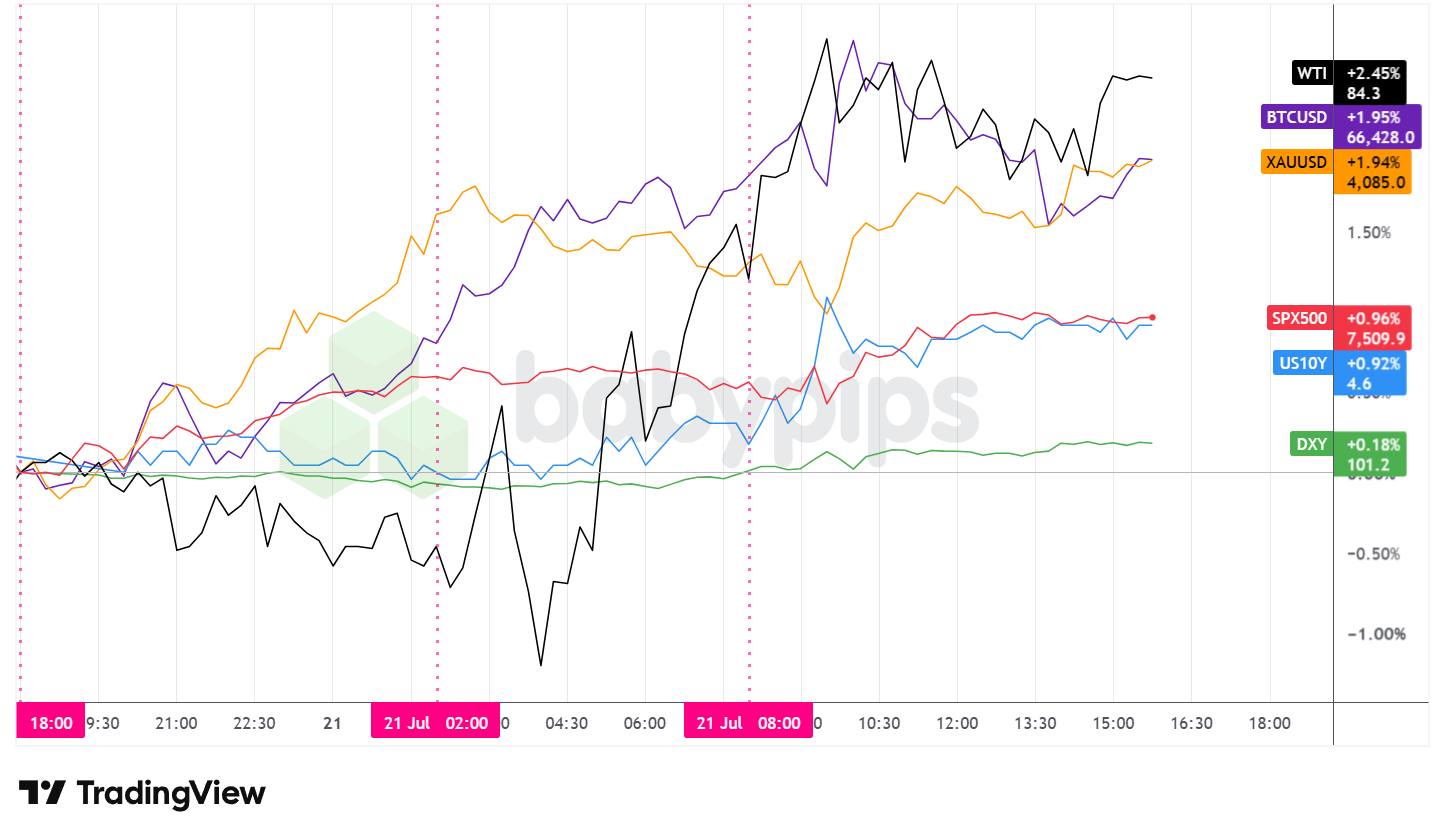
Dollar Index, Gold, Oil, S&P 500, U.S. 10-yr Yield, Bitcoin Overlay – Chart Faster With TradingView
Tuesday leaned firmly risk-on as beaten-down semiconductor shares drew buyers back in, lifting equities and pulling most major asset classes higher alongside a still-elevated oil price tied to the ongoing conflict in the Middle East.
The S&P 500 climbed roughly 0.96% to close near 7,510. The index spent the overnight and early European hours grinding higher, dipped back toward the 7,467 area into the London morning, then accelerated after the U.S. open to reach around 7,516 before easing into a choppy, mostly sideways afternoon just below that high. The rebound appeared to correlate with renewed appetite for chipmakers at the center of the artificial-intelligence trade, with a rally in memory names and strong Asian tech exports helping the broader benchmark shrug off the geopolitical backdrop.
WTI crude oil was the session’s strongest performer, rising roughly 2.45% to trade near $84.30 per barrel. Oil firmed near one-month highs as the U.S. pressed on with its campaign against Iran and the Saudi-led coalition warned it would respond to a Houthi naval blockade threat, with reported tanker attacks in the Strait of Hormuz adding a fresh supply-risk premium. Prices dipped briefly overnight as attention turned to reports that mediators were pushing Washington and Tehran toward a ceasefire, before recovering as the strait was declared closed and strikes continued.
Gold posted a strong session as well, adding roughly 1.94% to trade around $4,085. The metal pushed up to about $4,088 in the Asian session, drifted back toward $4,044 into the London morning, then rebuilt through the U.S. session to close near its highs. With no direct gold-specific catalyst, the advance likely reflected a mix of safe-haven demand tied to the Iran conflict and the inflationary pull of higher oil prices, even as firmer Treasury yields worked against it.
Bitcoin traded higher, gaining roughly 1.95% to trade near $66,428. The cryptocurrency rallied steadily through the Asian and London sessions to a peak around $66,917, then pulled back toward $66,023 before stabilizing in a choppier range into the close. With no crypto-specific driver apparent, the move likely tracked the day’s broad risk-on tone as equities and other risk assets pushed higher.
The 10-year Treasury yield rose roughly 0.92% to around 4.63%. Yields traded quietly through the Asian and early London hours before stepping up sharply around the U.S. open and holding those gains for the rest of the day. The move higher fit the session’s risk-on backdrop and the upward pressure on inflation expectations from firmer oil, both of which argue against aggressive near-term Fed easing.
Promoted: Keep Your Automated Edge Running 24/7.
Your algorithmic strategy shouldn’t rely on your home Wi-Fi. In high-volatility events, execution speed and uptime are what separate a winning backtest from a live market success. ForexVPS provides ultra-low latency, dedicated trading servers that keep your algos executing trades around the clock without interruption. Stop letting connectivity issues erode your edge.
Explore VPS plans at ForexVPS!
Disclosure: To help support our free daily content, we may earn a commission from our partners if you sign up through our links, at no extra cost to you.
FX Market Behavior: U.S. Dollar vs. Majors
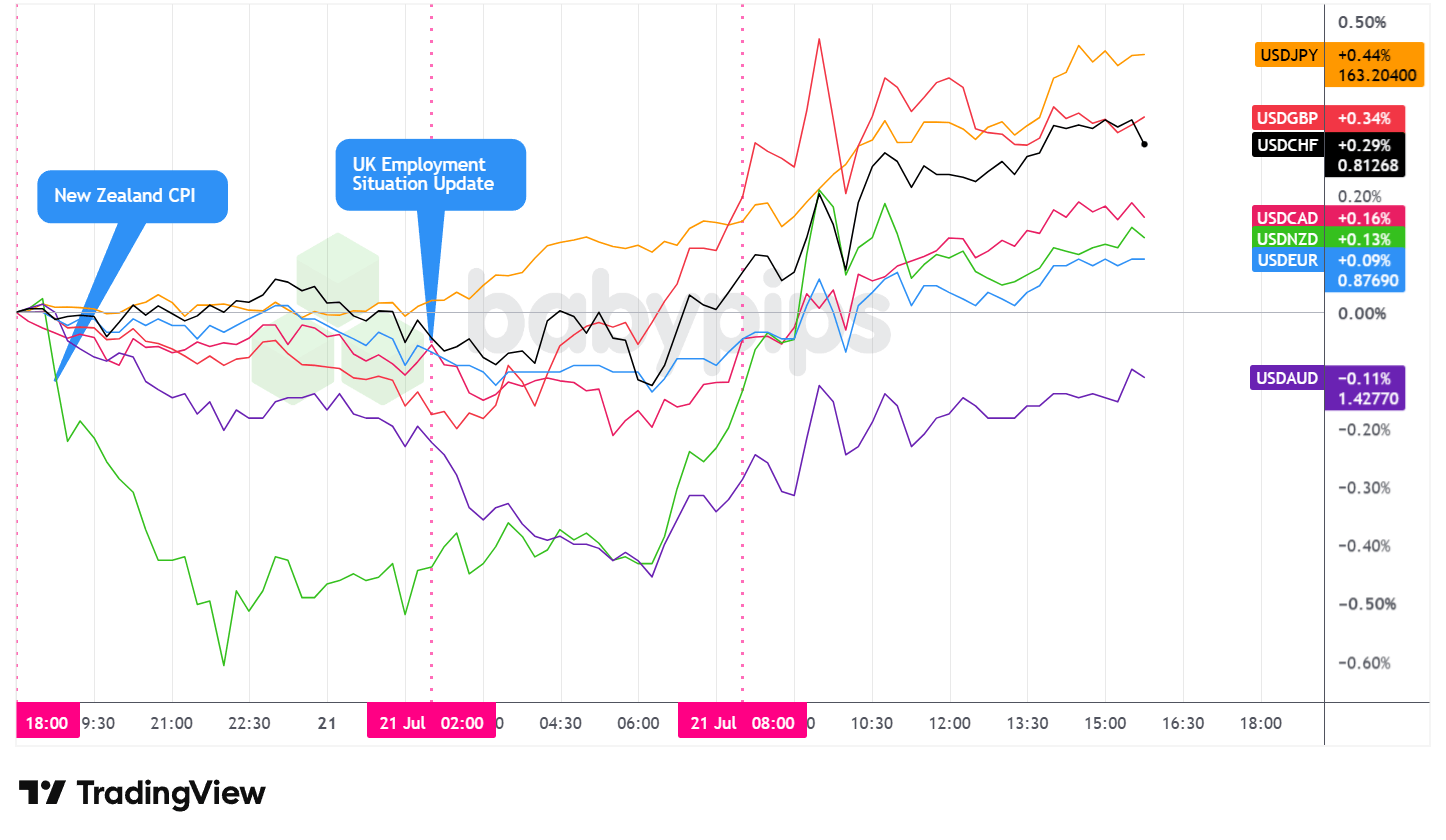
Overlay of USD vs. Majors – Chart Faster With TradingView
The U.S. dollar traded choppy early before firming through the U.S. session, finishing as one of the best-performing majors on the day. It posted gains against every major currency except the Australian dollar.
During the Asian session, the dollar traded with a net bearish lean against the majors, and that softness carried into the London open. There was no single obvious catalyst, though the standout regional event was New Zealand’s Q2 inflation report, which accelerated to a two-and-a-half-year high at 4.1% y/y and briefly lifted the kiwi on firmer RBNZ rate-hike expectations. Those gains faded after the RBNZ’s own sectoral factor model came in more subdued, taking some heat out of both the currency and the rate-hike speculation.
The London session brought a turn in the dollar’s fortunes. The greenback stabilized and began to rebound against the majors heading into the U.S. open. The main data point was the UK employment report, which showed some resilience in the three months to May, with the unemployment rate holding at 4.9% and employment rising by 147,000. Total pay growth eased, pointing to gradually moderating wage pressure. The market reaction was muted, as the mixed report did little to shift Bank of England rate expectations, and sterling drifted lower against a firming dollar rather than on any UK-specific trigger.
After the U.S. session open, the dollar continued to rebound against the majors until roughly the London close, then stabilized and traded mostly sideways for the remainder of the session. The dollar’s firmness lined up with the jump in Treasury yields and the broad risk-on tone, and an argument could be made that safe-haven flows tied to the Iran conflict provided an additional underlying bid. It’s worth noting that the German and euro-area ZEW sentiment surveys both surprised strongly to the upside, yet the euro still slipped against the dollar, suggesting broad dollar strength was the dominant force.
At Tuesday’s close, the dollar sat among the day’s stronger majors, with its firmest gains against the Japanese yen and the pound. Its only loss came against the Australian dollar, which likely benefited from the day’s risk-on mood given its status as a higher-beta, growth-sensitive currency. For traders trying to read the day, this was largely a session where a risk-on backdrop and rising yields, rather than domestic data, set the tone for the greenback.
Promoted: Profitable Trading Isn’t Reserved for Wall Street.
Most traders quietly wonder if consistent profitability is actually achievable for someone like them—or if it’s just a story people tell. Jack Schwager’s newest book, “Market Wizards: The Next Generation,” answers that question directly. The legendary author behind the original Market Wizards series interviews a new generation of successful traders—many self-taught—who built real wealth and income through the markets. Their common thread isn’t genius or insider access. It’s a deliberate process, disciplined risk management, and the conviction to take trading seriously as a pursuit worth mastering.
If that sounds like something worth exploring, this is a good place to start.
Get Market Wizards: The Next Generation on Amazon!
Disclosure: We may earn a commission from our partners if you sign up through our links, at no extra cost to you.
Upcoming Potential Catalysts on the Economic Calendar
- U.S. API Crude Oil Stock Change for July 17, 2026 at 8:30 pm GMT
- Japan Balance of Trade for June 2026 at 11:50 pm GMT
- Australia Westpac Leading Index for June 2026 at 1:00 am GMT
- New Zealand Credit Card Spending for June 2026 at 3:00 am GMT
- U.K. Inflation Updates for June 2026 at 6:00 am GMT
- Canada CFIB Business Barometer for July 2026
- U.S. MBA 30-Year Mortgage Rate & Applications for July 17, 2026 at 11:00 am GMT
- U.S. EIA Crude Oil Stocks Change for July 17, 2026 at 2:30 pm GMT
The next session hinges on whether the chip-led equity rebound can hold and whether oil keeps its geopolitical premium as the U.S.-Iran conflict and the Strait of Hormuz situation remain live risks. With megacap earnings season kicking off after the close, risk sentiment could shift quickly, and the single most notable scheduled release for FX traders is the UK inflation update, which lands into a market already parsing a resilient but non-alarming UK jobs report. Expect oil headlines and any fresh ceasefire signals to keep influencing the safe-haven and inflation narratives.
Stay frosty out there, forex friends!
Tuesday’s session showed equities, oil, gold, bonds, and currencies all moving higher together, but the connections between them might not be obvious. Premium members can read our lesson:
📖 What Is Intermarket Analysis?
Reading this helps you understand how equities drive FX flows, why oil and gold moved alongside the stock rally, and how Treasury yields anchor the entire system so you’re not caught reading one asset class in isolation.
And if you’re not a Premium subscriber yet, consider joining.
With Babypips Premium, you get full access to School of Pipsology lessons that help you understand the hidden market connections most traders miss, from how stock indices move currencies to why commodity flows reshape forex trends.