A resurgence in large chipmakers powered a rebound across U.S. equities on Thursday, lifting risk appetite even as the U.S. and Iran traded airstrikes for a second straight day. The dollar drifted lower against most majors, gold and Bitcoin firmed, and oil fell hard despite the Gulf escalation.
Check out the forex news and economic updates you may have missed in the latest trading session!
Forex News Headlines & Data:
- The US and Iran have traded airstrikes for a second consecutive day, with American forces targeting Iranian military sites and Tehran retaliating against US allies in the Persian Gulf, raising fears of a return to all-out war.
- U.S. Consumer Credit Change for May 2026: -0.18B (19.0B forecast; 20.73B previous)
- New Zealand Business NZ PMI for June 2026: 59.7 (49.0 forecast; 49.9 previous)
- U.K. RICS House Price Balance for June 2026: -33.0% (-22.0% forecast; -34.0% previous)
- China CPI Growth Rate for June 2026: 1.0% y/y (1.3% y/y forecast; 1.2% y/y previous); -0.3% m/m (0.0% m/m forecast; -0.1% m/m previous)
- China PPI Growth Rate for June 2026: 4.1% y/y (3.5% y/y forecast; 3.9% y/y previous)
- Germany Balance of Trade for May 2026: 19.1B (16.0B forecast; 14.5B previous)
- Japan Machine Tool Orders for June 2026: 52.8% y/y (38.0% y/y forecast; 37.4% y/y previous)
- U.S. Initial Jobless Claims for July 4, 2026: 215.0k (220.0k forecast; 215.0k previous)
- U.S. Existing Home Sales for June 2026: -2.4% m/m (0.7% m/m forecast; 3.2% m/m previous)
Broad Market Price Action:
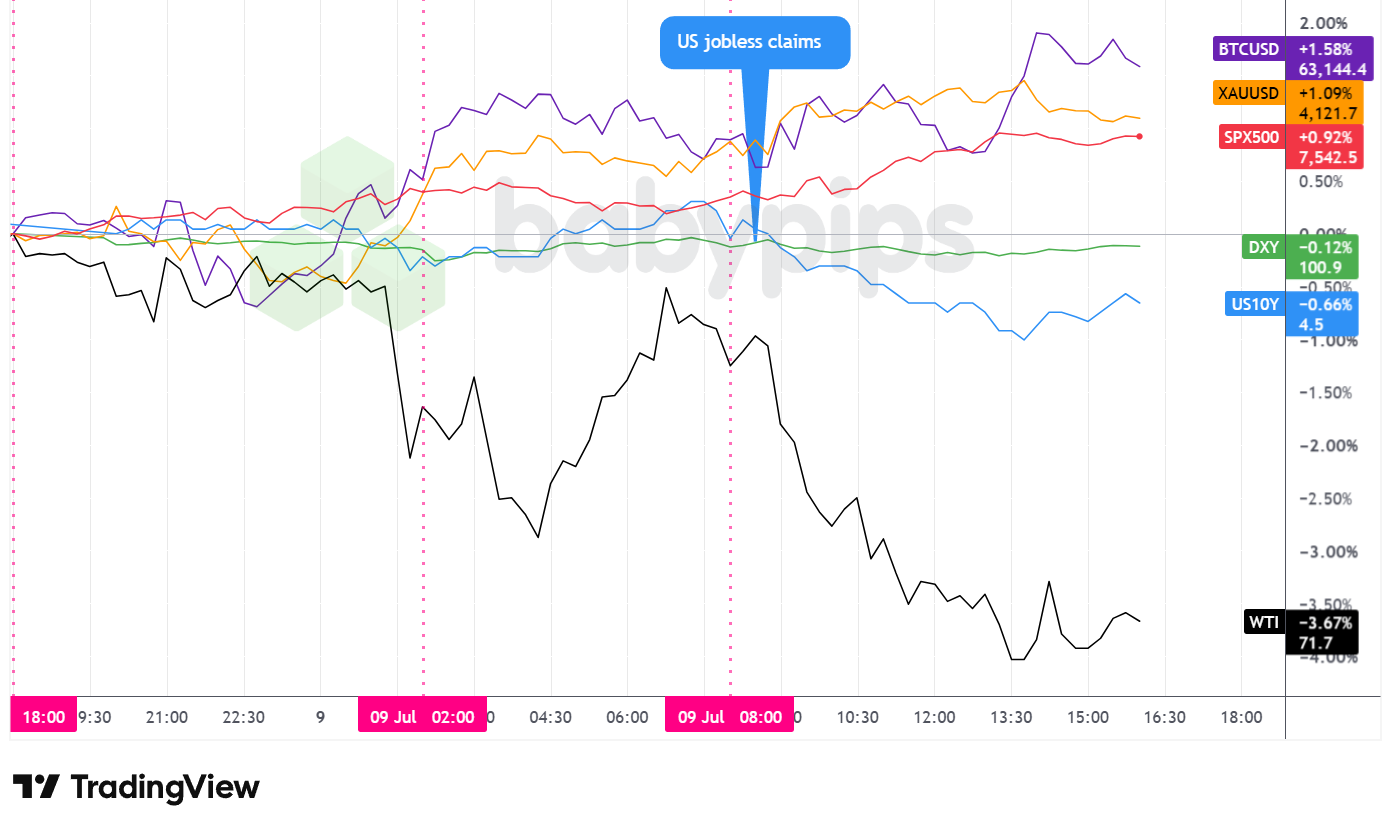
Dollar Index, Gold, Oil, S&P 500, U.S. 10-yr Yield, Bitcoin Overlay – Chart Faster With TradingView
Thursday sorted assets along a clear line. Anything tied to the artificial-intelligence buildout rallied, oil sank, and the geopolitical risk premium that traders might have braced for never really arrived.
The S&P 500 closed near 7,540, up roughly 0.9%, grinding higher through the U.S. afternoon to finish close to its session peak. Semiconductor names led the way. Micron said it would lift U.S. plant spending to $250 billion through 2035 to meet AI-driven memory demand, and SK Hynix’s U.S. listing drew heavy oversubscription. With earnings season approaching, Matt Maley at Miller Tabak said investors are “much more focused on the upcoming earnings season” than on the geopolitical front.
WTI crude was the day’s clear laggard, sliding about 3.7% to trade near $71.70. That drop stands out against the overnight escalation between the U.S. and Iran. One possible explanation is that markets treated the strikes as managed escalation the economy can absorb, and it’s also worth noting that Iran’s leverage over the Strait of Hormuz may be eroding as vessels reroute through a southern corridor near Oman, which could cap the risk premium buyers are willing to pay.
Gold pushed higher, adding roughly 1.1% to trade near $4,122. The metal climbed from its overnight low through the London morning before easing off an intraday peak near $4,138. With no gold-specific catalyst on the tape, the advance likely reflected softer dollar and safe-haven demand tied to the Gulf headlines.
Bitcoin gained around 1.6% to trade near $63,150, firming into the U.S. afternoon after a choppy overnight range. With no crypto-specific driver apparent, the move likely tracked the day’s broader risk-on tone and dollar softness.
The 10-year Treasury yield eased to around 4.50%, slipping on the day after dipping intraday. At the long end, an auction of 30-year Treasuries drew the highest yield in nearly two decades, a reminder that swelling government supply keeps pressure on longer maturities even when front-end yields drift lower.
Promoted: Profitable Trading Isn’t Reserved for Wall Street.
Most traders quietly wonder if consistent profitability is actually achievable for someone like them—or if it’s just a story people tell. Jack Schwager’s newest book, “Market Wizards: The Next Generation,” answers that question directly. The legendary author behind the original Market Wizards series interviews a new generation of successful traders—many self-taught—who built real wealth and income through the markets. Their common thread isn’t genius or insider access. It’s a deliberate process, disciplined risk management, and the conviction to take trading seriously as a pursuit worth mastering.
If that sounds like something worth exploring, this is a good place to start.
Get Market Wizards: The Next Generation on Amazon!
Disclosure: We may earn a commission from our partners if you sign up through our links, at no extra cost to you.
FX Market Behavior: U.S. Dollar vs. Majors
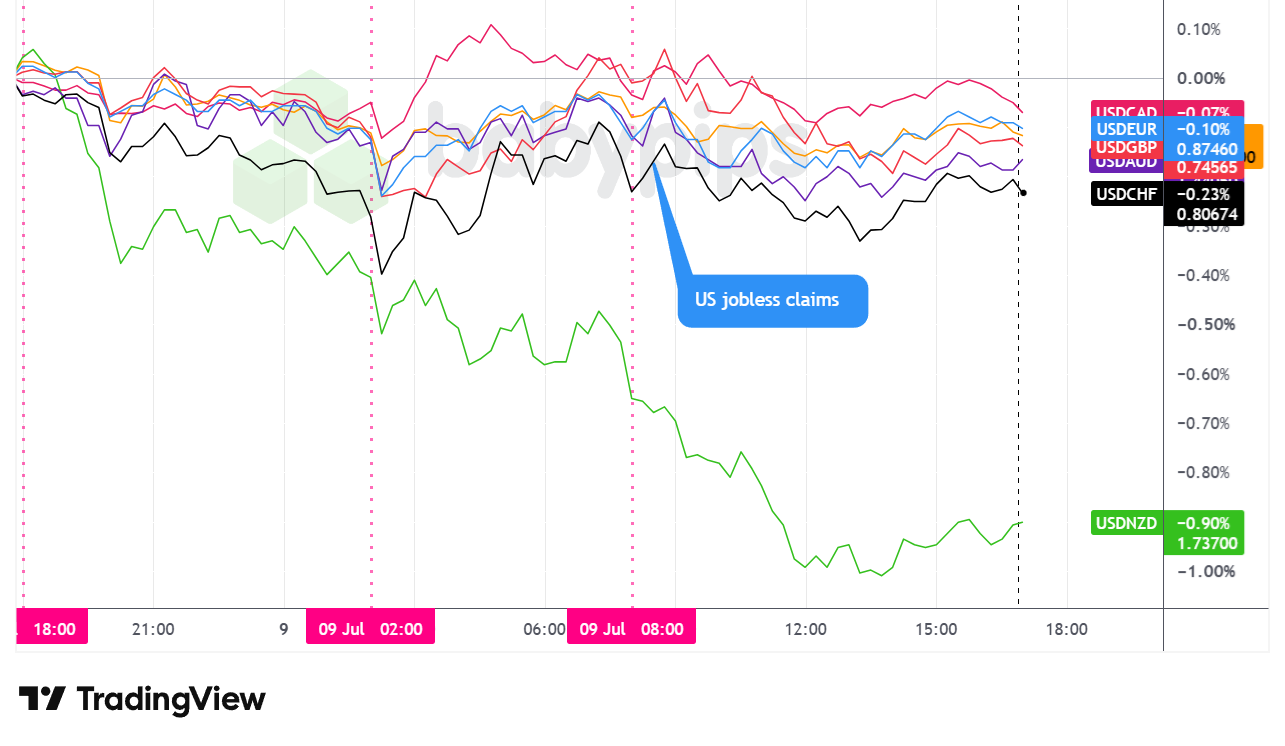
Overlay of USD vs. Majors – Chart Faster With TradingView
The U.S. dollar finished Thursday with a net lower lean against the majors, reversing an intraday recovery that had briefly put it in positive territory during the London hours.
During the Asian session, the dollar traded net lower against the majors. China’s CPI cooled to 1.0% y/y while PPI jumped to a near four-year high of 4.1%, and risk appetite firmed as Asian chip names tracked the overnight Wall Street rally. That risk-on backdrop likely weighed on the greenback.
During the London session, the dollar reversed higher and traded net stronger against the majors, paring its earlier losses. EUR/USD backed off an intraday high, and GBP/USD gave up a push toward its session peak to trade roughly flat. Data flow through the European morning stayed light, and the dollar’s rebound looked more like position adjustment than a reaction to any single catalyst.
During the U.S. session, the dollar turned net lower again. Weekly initial jobless claims came in at 215k, a touch below the 220k forecast and consistent with a still-firm labor market, yet the print failed to lift the greenback. Existing home sales fell 2.4% on the month, missing expectations. The dollar’s soft close likely reflected the broad risk-on tone as equities climbed and haven demand stayed muted.
At Thursday’s close, the dollar sat net lower against the majors on the day, with the risk-on backdrop and easing yields outweighing the firmer jobless-claims read.
Promoted: Keep Your Automated Edge Running 24/7.
Your algorithmic strategy shouldn’t rely on your home Wi-Fi. In high-volatility events, execution speed and uptime are what separate a winning backtest from a live market success. ForexVPS provides ultra-low latency, dedicated trading servers that keep your algos executing trades around the clock without interruption. Stop letting connectivity issues erode your edge.
Explore VPS plans at ForexVPS!
Disclosure: To help support our free daily content, we may earn a commission from our partners if you sign up through our links, at no extra cost to you.
Upcoming Potential Catalysts on the Economic Calendar
- U.S. Fed Logan Speech at 5:30 pm GMT
- Japan PPI for June 2026 at 11:50 pm GMT
- Germany Inflation Rate Final for June 2026 at 6:00 am GMT
- France Inflation Rate Final for June 2026 at 6:45 am GMT
- Swiss Consumer Confidence for June 2026 at 7:00 am GMT
- Canada Employment Situation Update for June 2026 at 12:30 pm GMT
Friday’s calendar centers on Canada’s June employment report, the session’s highest-impact release and a key input for Bank of Canada rate expectations.
Final inflation readings from Germany and France should confirm the eurozone’s June trend, while Japan’s PPI and Swiss consumer confidence round out a lighter European docket.
Traders will also keep one eye on the U.S.-Iran exchange, where any move that genuinely disrupts Strait of Hormuz flows could reprice oil and haven assets in a hurry.
Stay frosty out there, forex friends!
Thursday’s tech-led equity surge drove the dollar lower even as labor data came in strong, a setup that reveals how much currency flows follow equity momentum. Premium members can read our lesson:
📖 Equities and Currencies: The Big Picture
Reading this helps you understand how equity leadership shapes currency flows, why risk sentiment can matter more than economic data, and how to align your FX trades with institutional capital movements.
And if you’re not a Premium subscriber yet, now is a good time to join.
With Babypips Premium, you get full access to School of Pipsology lessons that help you understand not just which currencies are moving, but which equity flows are really driving them.