Markets rallied on Thursday after the United States and Iran formally signed a memorandum of understanding to begin winding down the Middle East conflict, with the U.S. lifting its Strait of Hormuz blockade and easing fears that disrupted energy flows would keep upward pressure on inflation. Equities and Treasuries climbed together while the U.S. dollar firmed into the close, and gold extended the slide that followed Wednesday’s hawkish Federal Reserve decision.
Check out the forex news and economic updates you may have missed in the latest trading session!
Forex News Headlines & Data:
- New Zealand GDP Growth Rate for Q1 2026: 1.5% y/y (1.0% y/y forecast; 1.3% y/y previous)
- Swiss Balance of Trade for May 2026: 5.6B (3.5B forecast; 3.2B previous)
-
U.K. Employment Change for April 2026: 100.0k (80.0k forecast; 148.0k previous)
- U.K. Claimant Count Change for May 2026: 31.2k (30.0k forecast; 26.5k previous)
- U.K. Unemployment Rate for April 2026: 4.9% (5.0% forecast; 5.0% previous)
- SECO Swiss Economic Forecasts: revised its growth forecast for Switzerland slightly downward to 0.9% (1.0% previous forecast) for 2026
- The Swiss National Bank (SNB) maintained its benchmark policy rate at 0.00%, stating that while recent energy costs have driven up short-term inflation, medium-term price pressures remain well within its range of price stability.
- Euro area Current Account for April 2026: 14.9B (25.6B forecast; 24.1B previous)
- The Bank of England’s Monetary Policy Committee voted 7–2 to maintain the benchmark interest rate at 3.75% as expected
- Canada Raw Materials Prices for May 2026: 33.4% y/y (37.0% y/y forecast; 31.6% y/y previous); 0.7% m/m (1.5% m/m forecast; 2.6% m/m previous)
- Canada PPI for May 2026: 13.6% y/y (14.0% y/y forecast; 11.4% y/y previous)
- U.S. Initial Jobless Claims for June 13, 2026: 226.0k (226.0k forecast; 229.0k previous)
- U.S. Philadelphia Fed Manufacturing Index for June 2026: 10.3 (9.0 forecast; -0.4 previous)
- CB U.S. Leading Index for May 2026: 0.1% m/m (-0.1% m/m forecast; 0.1% m/m previous)
Have a solid trading strategy but lack the capital? FundedNext empowers disciplined traders by providing simulated trading accounts up to $200K.
Unlike other prop firms, FundedNext imposes no artificial time limits on challenges. You even earn a unique 15% profit share during your evaluation! Once funded, you keep up to a 95% profit split with guaranteed 24-hour payouts. Trade CFDs or Futures your way—even during major news events.
Join over 400K traders who have received $300M+ in payouts. Ready to back your edge?
Learn More About FundedNext! Limited time offer: Use code BPFN for discounts on both CFD & Futures plans! T&C apply. T&C apply.Disclosure: We may earn a commission from our partners if you sign up through our links, at no extra cost to you.
Broad Market Price Action:
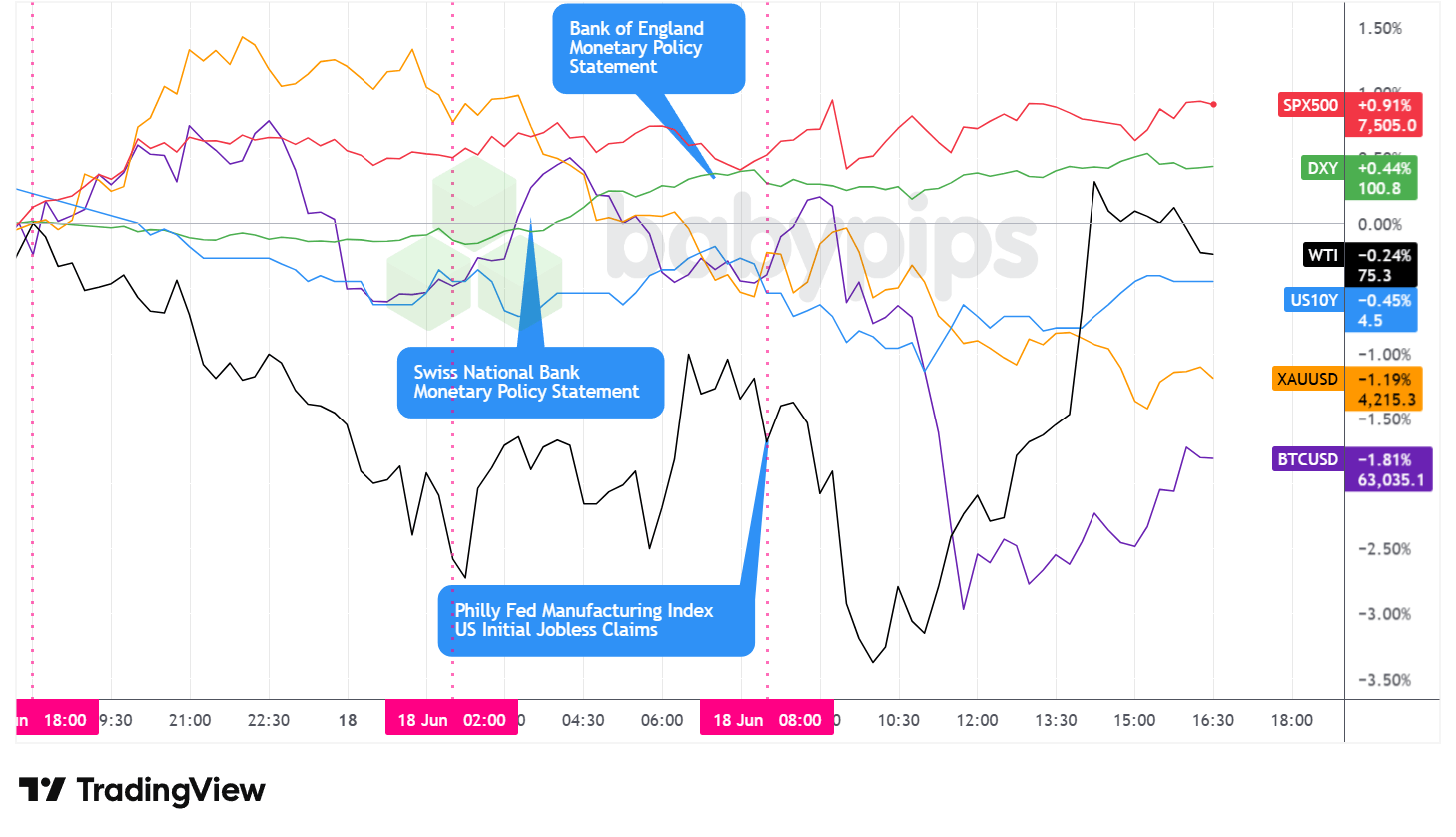
Dollar Index, Gold, Oil, S&P 500, U.S. 10-yr Yield, Bitcoin Overlay – Chart Faster With TradingView
Thursday delivered a broadly risk-on session as the U.S.-Iran signing eased concerns that constrained energy supply would keep inflation elevated. Stocks and bonds rose together, while commodity and crypto performance was more mixed.
The S&P 500 climbed roughly 0.81% to close near 7,498. The advance was supported by a record run in chipmakers, with Intel reportedly set to work alongside Apple to design and produce semiconductors domestically, according to Reuters coverage citing comments from President Trump.
WTI crude oil finished close to flat, though that close masked a volatile session. Oil slid to an intraday low near $72.70 around late morning in New York as the reopening of the Strait of Hormuz and the return of stranded cargoes pointed to easing supply risk, before rebounding sharply through the early afternoon to a session high near $75.90. One possible explanation for the afternoon recovery is the recognition that physically normalizing flows through Hormuz could take months even with the blockade lifted, though no single catalyst clearly accounted for the bounce.
Gold extended its decline, falling about 1.16% to trade near $4,216. The move may reflect a continuation of the hawkish repricing that followed Wednesday’s Federal Reserve decision, possibly compounded by some unwinding of safe-haven demand as the peace agreement took effect. It is worth noting that gold had clawed back part of its post-Fed losses during the Asian session before resuming lower.
Bitcoin slipped around 1.65% to trade near $63,138, underperforming the broader risk-on tone in equities. With no clear crypto-specific catalyst, the decline possibly reflected the higher-yield backdrop following Wednesday’s hawkish Fed signals and some rotation out of speculative assets, though this remains speculative.
The U.S. 10-year Treasury yield eased, retreating to around 4.46% after Wednesday’s hawkish-Fed-driven spike. The pullback in longer-dated yields was likely driven by expectations that lower energy costs would ease forward inflation pressures. Intraday, the yield dipped to roughly 4.42% in the late U.S. morning session before recovering through the afternoon.
Promoted: Profitable Trading Isn’t Reserved for Wall Street.
Most traders quietly wonder if consistent profitability is actually achievable for someone like them—or if it’s just a story people tell. Jack Schwager’s newest book, “Market Wizards: The Next Generation,” answers that question directly. The legendary author behind the original Market Wizards series interviews a new generation of successful traders—many self-taught—who built real wealth and income through the markets. Their common thread isn’t genius or insider access. It’s a deliberate process, disciplined risk management, and the conviction to take trading seriously as a pursuit worth mastering.
If that sounds like something worth exploring, this is a good place to start.
Get Market Wizards: The Next Generation on Amazon!
Disclosure: We may earn a commission from our partners if you sign up through our links, at no extra cost to you.
FX Market Behavior: U.S. Dollar vs. Majors
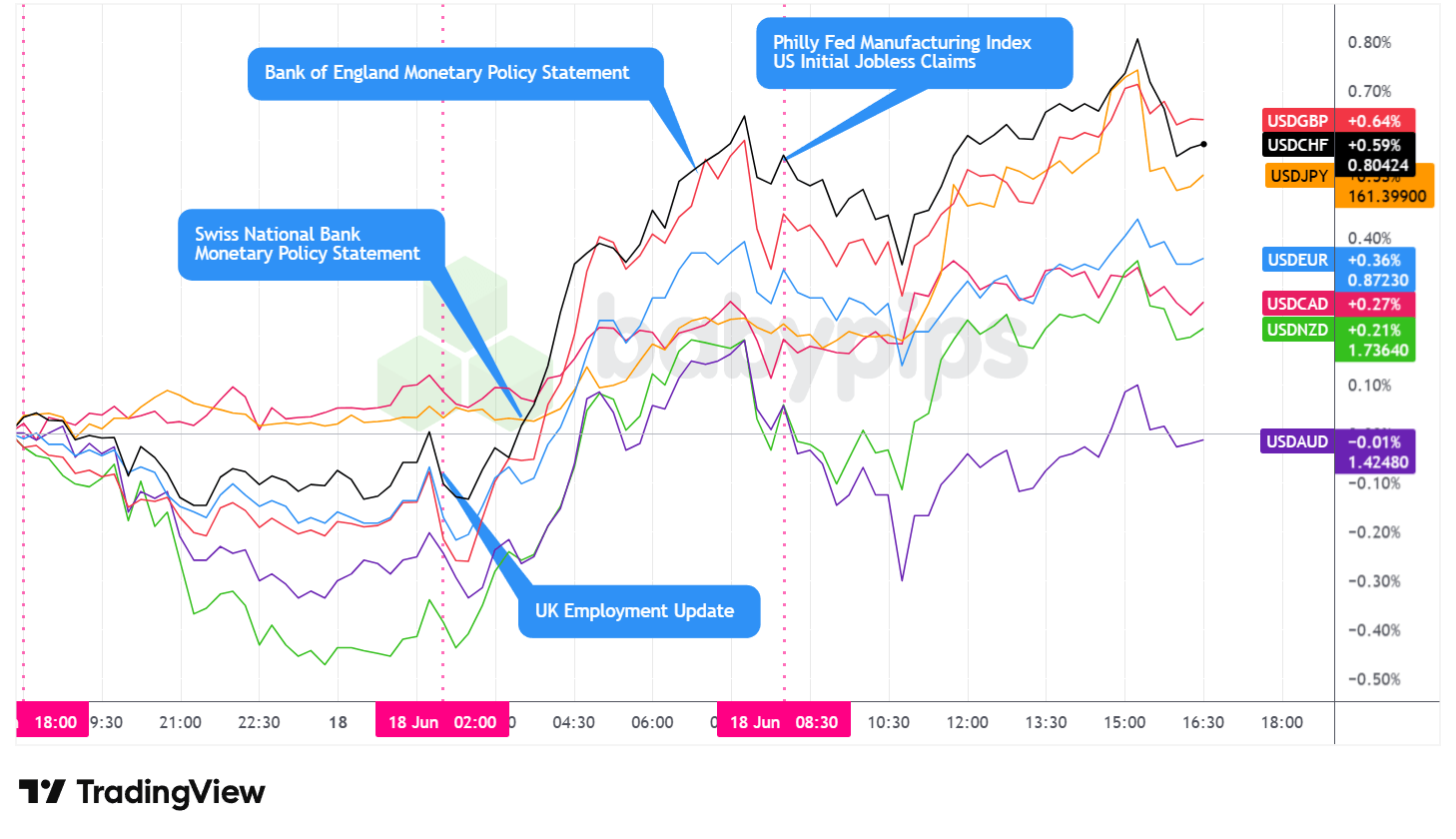
Overlay of USD vs. Majors – Chart Faster With TradingView
The U.S. dollar firmed on Thursday, ending the session as one of the best-performing major currencies despite an uneven intraday path.
From the Asian open through the European open, the dollar traded mixed against the majors but arguably leaned net negative overall, with no single regional catalyst driving clear direction. New Zealand’s Q1 GDP beat on the annual measure at 1.5% versus the 1.0% forecast, while the 0.8% quarterly print matched consensus but fell short of the RBNZ’s own 1.0% projection. The New Zealand dollar crept higher, though the modest move appeared driven more by broad dollar softness than by the data itself. Japan’s Chief Cabinet Secretary Kihara ran through the standard verbal-intervention script on yen weakness without offering anything that moved the market, and USD/JPY held its ground.
After the London open, the dollar dipped quickly before rebounding steadily into the U.S. session open. The Swiss National Bank left its policy rate unchanged at 0.00% as expected but added language flagging a higher readiness to intervene in FX markets “if necessary.” The franc initially held steady, then weakened after SNB Chairman Schlegel declined to explain why the new line had been added, a reticence the market appeared to read as dovish.
The Bank of England held the Bank Rate at 3.75%, also as expected, though the MPC split 7-2 with two members voting for an immediate quarter-point hike. The UK labor market report released earlier had come in firmer than anticipated, with the unemployment rate ticking down to 4.9% from 5.0% and average earnings including bonuses accelerating to 4.4% against a 4.0% forecast, nudging BoE rate-hike expectations slightly higher.
After the U.S. open, the dollar pulled back, then stabilized just ahead of the London close before rebounding through the remainder of the day. The afternoon recovery coincided with the broader risk-on tone and the easing in Treasury yields. By the close, the greenback had posted gains against most majors, with its firmest performance against the British pound and Swiss franc and its softest against the Australian dollar, where it finished roughly unchanged on the day.
Promoted: Day traders & Scalpers have better odds of making great decisions if they see market catalysts right away. Get the real-time feed that pros use to catch the news.
Join FinancialJuice for Free to learn more!
Disclosure: We may earn a commission from our partners if you sign up through our links, at no extra cost to you.
Upcoming Potential Catalysts on the Economic Calendar
- New Zealand Balance of Trade for May 2026 at 10:45 pm GMT
- U.K. Gfk Consumer Confidence for June 2026 at 11:01 pm GMT
- Japan CPI Growth Rate for May 2026 at 11:30 pm GMT
- BoJ Monetary Policy Meeting Minutes at 11:50 pm GMT
- Germany PPI for May 2026 at 6:00 am GMT
- U.K. Retail Sales for May 2026 at 6:00 am GMT
- ECB Lane Speech at 7:10 am GMT
- Canada CFIB Business Barometer for June 2026 at 11:00 am GMT
- Canada Retail Sales Prel for May 2026 at 12:30 pm GMT
- Euro area ECB Lane Speech at 2:30 pm GMT
Friday’s calendar leads with Japan’s May CPI and the Bank of Japan’s meeting minutes during the Asian session, both of which could stir USD/JPY given the renewed focus on yen weakness. The European morning brings UK retail sales and German PPI, while ECB Chief Economist Philip Lane is scheduled to speak twice, offering possible guidance on the eurozone inflation path.
Canadian preliminary retail sales round out the North American session. With the U.S.-Iran framework now in force, traders will likely keep watching energy markets for confirmation that supply is normalizing, alongside any fresh Fed commentary following Wednesday’s hawkish projections.
Stay frosty out there, forex friends!
When a geopolitical event shifts market risk appetite, currencies respond in complex patterns that aren’t always obvious from price action alone. Premium members can read our lesson:
📖 Risk-On / Risk-Off: How Global Mood Moves Currencies
Reading this helps you understand how risk appetite drives currency flows, which currencies benefit when traders embrace risk versus when they retreat to safety, and how to read the market’s appetite for risk before placing a trade.
And if you’re not a Premium subscriber yet, consider joining.
With Babypips Premium, you get full access to School of Pipsology lessons that help you understand the mechanics driving currency flows when market sentiment shifts, giving you the edge to anticipate moves before they happen.