


Monday’s session was a study in geopolitical whipsaw, as markets lurched between risk-off and risk-on on the Iran-US nuclear negotiations front while a blowout ISM Manufacturing PMI sharpened the hawkish case for Federal Reserve policy.
Iran’s suspension of nuclear talks in protest over Israeli strikes in Lebanon pushed equities sharply lower at the US open, before President Trump announced an Israel-Hezbollah ceasefire and declared that Iranian negotiations were moving at a rapid pace, driving a recovery toward all-time highs. Oil surged on Hormuz supply disruption fears while gold and Bitcoin retreated as safe-haven demand faded and rate hike expectations rose.
Check out the forex news and economic updates you may have missed in the latest trading session!
Forex News Headlines & Data:
- China NBS Manufacturing PMI for May 2026: 50.0 (50.5 forecast; 50.3 previous)
- China NBS Non Manufacturing PMI for May 2026: 50.1 (49.9 forecast; 49.4 previous)
- Japan S&P Global Manufacturing PMI Final for May 2026: 54.5 (54.5 forecast; 55.1 previous)
- Australia S&P Global Manufacturing PMI Final for May 2026: 50.7 (50.2 forecast; 51.3 previous)
- Australia ANZ-Indeed Job Ads for May 2026: 1.8% m/m (-0.4% m/m forecast; -0.8% m/m previous)
- Australia TD-MI Inflation Gauge for May 2026: -0.3% m/m (0.6% m/m forecast; 0.6% m/m previous)
- Swiss Retail Sales for April 2026: 1.6% y/y (1.0% y/y forecast; 0.5% y/y previous)
- Swiss GDP Growth Rate for Q1 2026: 0.3% y/y (1.0% y/y forecast; 0.7% y/y previous)
- Swiss procure.ch Manufacturing PMI for May 2026: 57.3 (53.8 forecast; 54.5 previous)
- U.K. S&P Global Manufacturing PMI Final for May 2026: 53.9 (53.7 forecast; 53.7 previous)
- U.K. Nationwide Housing Prices for May 2026: 1.7% y/y (2.9% y/y forecast; 3.0% y/y previous)
- Germany Retail Sales for April 2026: -0.3% y/y (-1.4% y/y forecast; -2.0% y/y previous)
- Euro area ECB Consumer Inflation Expectations for April 2026: 4.0% (4.3% forecast; 4.0% previous)
- Euro area S&P Global Manufacturing PMI Final for May 2026: 51.6 (51.4 forecast; 52.2 previous)
- Euro area Unemployment Rate for April 2026: 6.3% (6.2% forecast; 6.2% previous)
- U.S. ISM Manufacturing PMI for May 2026: 54.0 (53.0 forecast; 52.7 previous)
Promotion: When the ISM Manufacturing repot came in strong and the dollar pivoted, was your execution clinical or emotional? TradeZella’s trade replay & AI assistant tools lets you revisit your past trades tick-by-tick. See exactly where your entry slipped or why you hesitated, so you can dominate the next volatility spike with a data-driven playbook. Start Your Journal with Tradezella
Disclosure: To help support our free daily content, we may earn a commission from our partners if you sign up through our links, at no extra cost to you.
Broad Market Price Action:
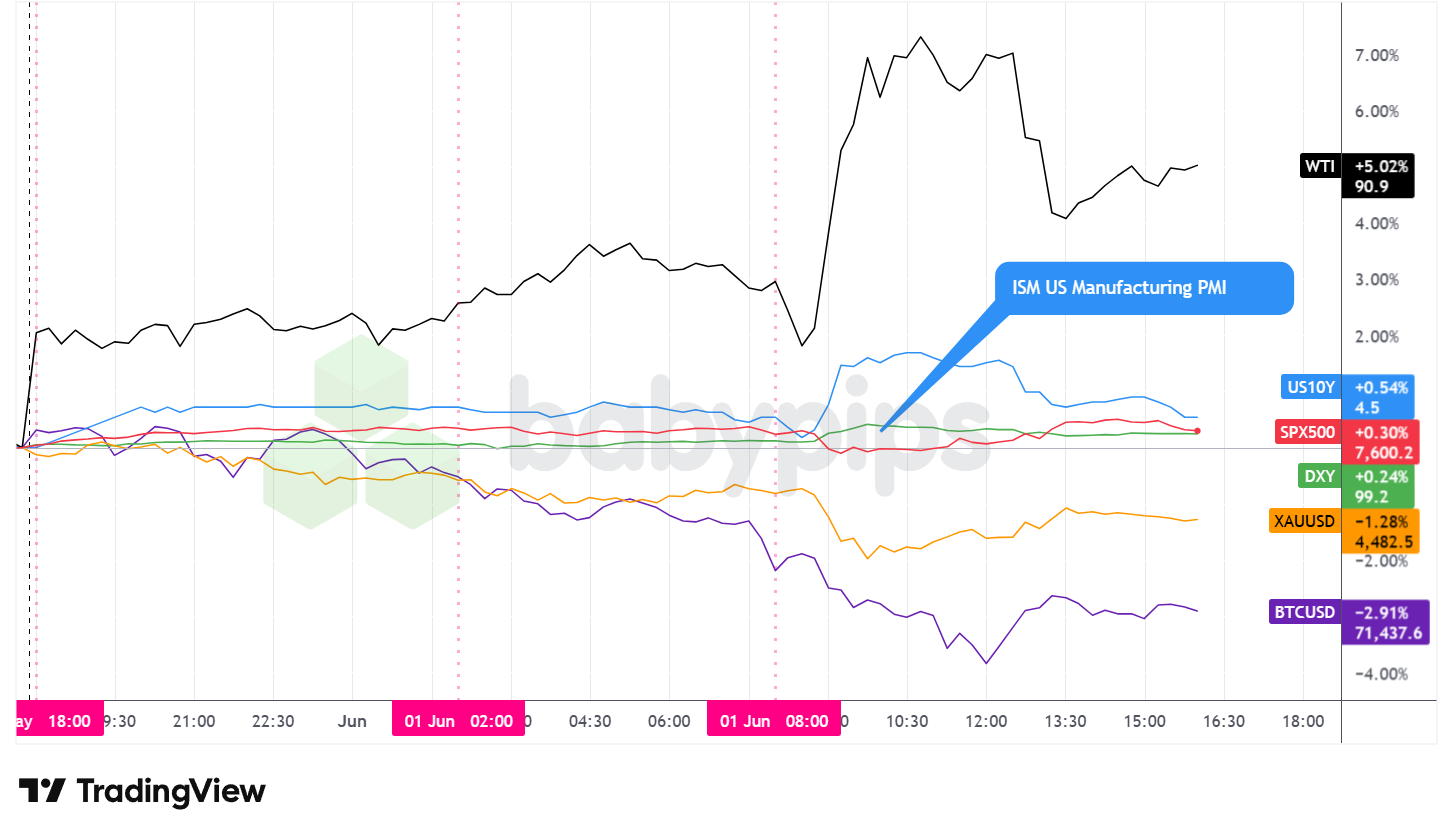
Dollar Index, Gold, Oil, S&P 500, U.S. 10-yr Yield, Bitcoin Overlay – Chart Faster With TradingView
WTI crude oil was Monday’s dominant performer, climbing approximately 5% to close near $90.90 per barrel on intensifying Hormuz supply disruption fears. Oil began the week near $87.76, already elevated by the unresolved US-Iran ceasefire framework, and climbed steadily through both the Asia and London sessions as the diplomatic backdrop darkened. Iran’s threat to fully close the Strait of Hormuz if Israeli attacks on Lebanon continued added further supply risk premium, and reports of missile strikes on a US airbase in Kuwait this weekend underscored the active hostility in the region. After the US open, crude extended sharply to an intraday high near $93.10 before retreating back toward $90, a pullback that may have partially reflected President Trump’s ceasefire announcement for Lebanon and his declaration that Iranian talks were advancing at a rapid pace, which could have reduced some of the perceived near-term risk of a full Strait closure. The session’s overall gain nonetheless reflected the market’s assessment that conditions in and around the Strait remain fragile and unresolved.
Gold declined approximately 1.28%, trading near $4,482 per ounce, unwinding earlier safe-haven gains as the diplomatic picture shifted and the macro backdrop turned more hawkish. The precious metal started the Asia session near its intraday high and sold off progressively through both the Asia and London sessions. The decline accelerated sharply after the US open, with gold reaching a session low near $4,448, as the ISM Manufacturing PMI’s blowout reading reinforced expectations of Federal Reserve rate hikes and Trump’s ceasefire signals further reduced the immediate geopolitical risk premium. Gold partially recovered from its lows into the afternoon close.
The S&P 500 added approximately 0.30%, closing near 7,600 and extending its winning streak to eight consecutive sessions, though the intraday path was volatile. The index climbed through Asia and then stabilized through the morning London session before dropping sharply after the New York open, touching a low near 7,562 in what appeared to coincide with Iran’s announcement of suspended nuclear talks and the threat of a full Strait closure. A strong recovery followed as Trump’s ceasefire announcements and his “rapid pace” comments on Iran lifted risk sentiment, with the S&P extending to an intraday high near 7,619. Gains were possibly supported by the ISM Manufacturing PMI beat, though the data’s hawkish implications for the interest rate path appeared to cap further upside late in the session.
Bitcoin fell approximately 2.91%, trading near $71,437 after opening the session closer to $73,800. The cryptocurrency declined throughout most of the day without a readily identifiable direct catalyst, possibly reflecting broader negative sentiment on crypto and US dollar strength after the latest manufacturing data reinforced the rate hike narrative.
US 10-year Treasury yields rose approximately 0.54%, with the rate trading near 4.50% at its intraday peak before settling slightly below that level. Yields held relatively steady through the Asia and early London sessions before jumping sharply after the US open, a move that closely correlated with the May ISM Manufacturing PMI reading of 54.0, its highest level since May 2022. ISM survey respondents continued to flag the Iran war and Strait of Hormuz disruptions as significant cost and supply chain pressures, with the prices subindex remaining historically elevated at 82.1 despite easing modestly from April’s 84.6. The strong data added material weight to the view that the Fed’s next policy action may be a rate increase rather than a cut.
Promoted: Pay Once. Trade Forever.
Most prop firms quietly drain your account with monthly subscription fees long before you ever see a payout. Tradeify operates differently — evaluations are a one-time purchase with no recurring charges. Pass the eval, get activated instantly, and keep more of what you earn. With ~$200M paid out and growing, the math speaks for itself.
Learn More About Tradeify! Limited Time offer: Code “JUNE” for 35% off!
Disclosure: We may earn a commission from our partners if you sign up through our links, at no extra cost to you.
FX Market Behavior: U.S. Dollar vs. Majors
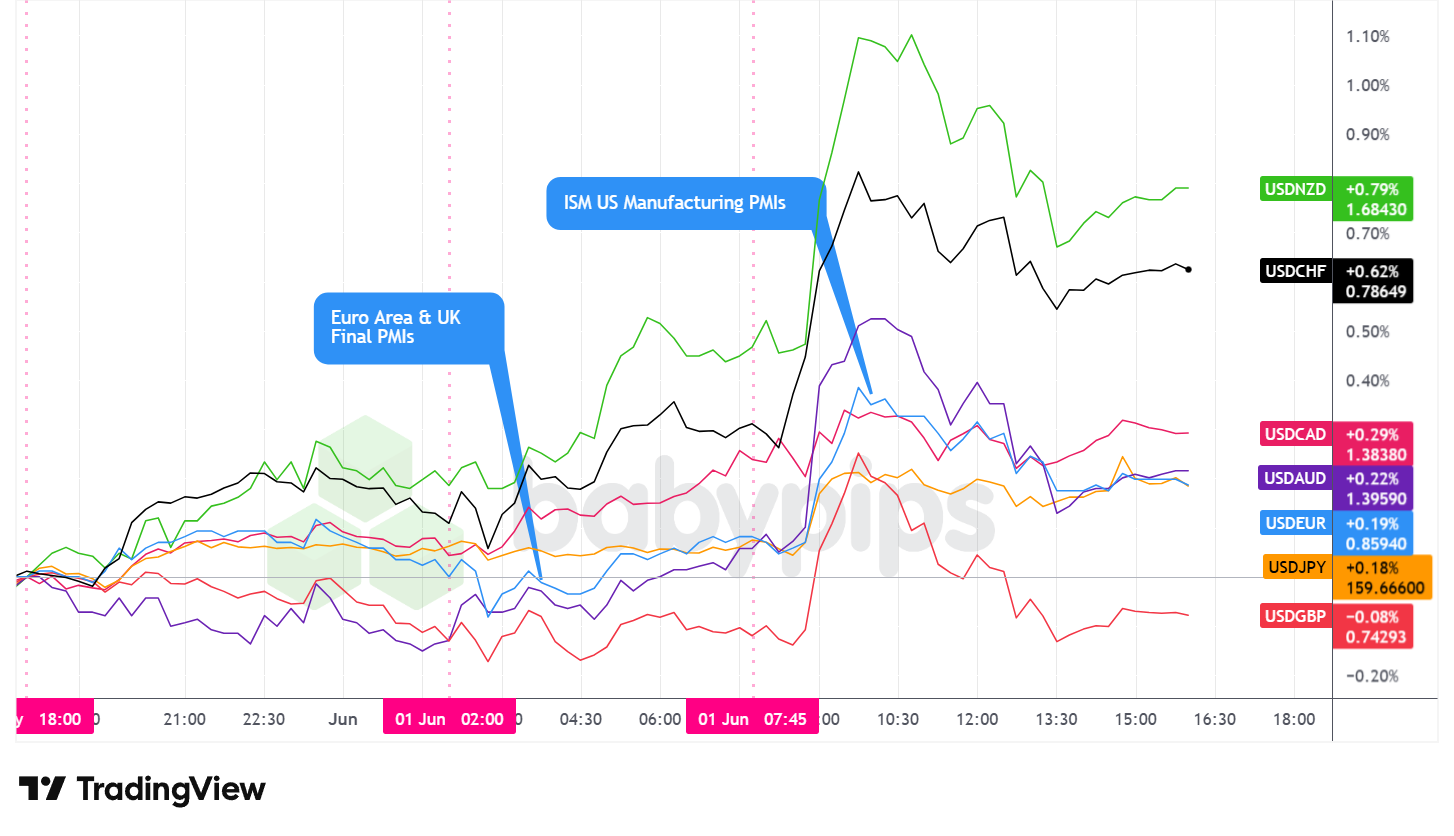
Overlay of USD vs. Majors – Chart Faster With TradingView
The US dollar closed Monday as the second-best performing major currency, posting broad-based gains across most pairs as geopolitical uncertainty, strong US economic data, and rising rate hike expectations likely combined to underpin the greenback throughout the session. Sterling was the sole major currency to finish the day with a modest gain against the dollar.
During the Asian session, the dollar traded mixed and mostly sideways against the major currencies, with an arguably net bullish bias but no decisive directional conviction. Price action was choppy across most pairs as the unresolved Iran-US ceasefire situation and escalating regional headlines kept positioning cautious on both sides of the market.
The London session brought a more defined and consistent bullish lean. A slate of final manufacturing PMI readings from Europe provided limited surprise: the UK came in at 53.9, slightly above its preliminary estimate, while Germany’s figure edged back above the expansion threshold at 50.1 and the euro area printed 51.6, marginally beating the 51.4 forecast.
With the data broadly confirming expectations rather than dramatically reshaping the policy outlook, the releases had a limited immediate impact on the FX markets. The greenback nonetheless continued to drift higher against most peers through the European morning, building momentum heading into the US session.
The US session delivered the day’s most pronounced dollar move. After the New York open, the greenback surged broadly and sharply, with the advance appearing ahead of the release of the ISM Manufacturing PMI, likely due to reports of Iran’s announcement of suspended nuclear talks and the threat of a full Strait closure
But dollar shifted once again, correlating with the ISM Manufacturing PMI, where saw the blowout reading of 54.0 versus the 53.0 forecast, combined with a still-elevated prices subindex of 82.1, which reinforced the view that the Federal Reserve may face upward pressure on its rate path. But the turn lower was more likely Trump’s diplomatic signals, which introduced a risk-on element that limited follow-through buying. The greenback then eased modestly from its intraday highs and stabilized through the remainder of the afternoon, ending broadly higher on the day.
Promoted: The Strategy is Half the Battle; Your Mindset is the Rest.
In “Unknown Market Wizards,” (⭐ 4.6★ | 1,400+ reviews on Amazon) Jack Schwager interviews successful traders to reveal a common truth: their edge isn’t just knowledge or skills—it’s their psychological resilience and rigid risk control. Whether you’re navigating shifting geopolitical themes or top tier economic data, learn how the “wizards” stay clinical when the rest of the market is emotional.
Master Your Trading Mindset with Market Wizards!
Disclosure: We may earn a commission from our partners if you sign up through our links, at no extra cost to you.
Upcoming Potential Catalysts on the Economic Calendar
- Australia RBA Harper Speech at 12:00 am GMT
- Australia Building Permits Prel for April 2026 at 1:30 am GMT
- Australia Private House Approvals Prel for April 2026 at 1:30 am GMT
- U.S. Fed Kashkari Speech at 5:50 am GMT
- Swiss Balance of Trade for April 2026 at 6:00 am GMT
- U.K. Monetary Developments for April 2026 at 8:30 am GMT
- Euro area CPI Growth Rate Flash for May 2026 at 9:00 am GMT
- U.S. Fed Hammack Speech at 12:30 pm GMT
- New Zealand Global Dairy Trade Price Index for June 2, 2026
- U.S. JOLTs Job Openings & Quits for April 2026 at 2:00 pm GMT
- U.S. RCM/TIPP Economic Optimism Index for June 2026 at 2:10 pm GMT
- U.K. BoE Greene Speech at 3:00 pm GMT
- U.S. API Crude Oil Stock Change for May 29, 2026 at 8:30 pm GMT
Tuesday’s calendar centers on the euro area’s May CPI flash estimate at 9:00 am GMT, which could prove particularly significant given ECB Executive Board member Schnabel’s hawkish signals. A print that confirms or exceeds current price pressures may accelerate market pricing of ECB rate hikes and lift the euro, while a softer reading could complicate her framing.
US JOLTS job openings and quits for April, due at 2:00 pm GMT, will offer a read on labor market demand ahead of Friday’s nonfarm payrolls report, with rate expectations sensitive to any signs of continued labor market resilience.
Fed’s Kashkari appears again at 5:50 am GMT and Fed’s Hammack speaks at 12:30 pm GMT, both offering opportunities for further color on the rate hike narrative that gained traction following Monday’s ISM data.
BoE’s Greene at 3:00 pm GMT will also be monitored given the ongoing recalibration of UK rate expectations.
Stay frosty out there, forex friends!
Monday’s currency swings weren’t random. They reflected coordinated moves across oil, gold, equities, and Treasury yields, each responding to geopolitical signals and economic data while simultaneously influencing each other. Premium members can read our lesson:
📖 What Is Intermarket Analysis?
Reading this helps you understand how oil and gold moves affect currency pairs, why rising Treasury yields strengthen the dollar, and how equity market sentiment drives forex flows.
And if you’re not a Premium subscriber yet, now’s a good time to sign up.
With Babypips Premium, you get full access to School of Pipsology lessons that help you understand how to connect the dots between commodities, bonds, equities, and currencies instead of analyzing them in isolation.