


It’s still a pretty light day in terms of economic data, so I’m gonna stick with this technical play on USD/JPY.
Think the U.S. dollar can keep holding on to its safe-haven status?
Even though the lower-yielding yen has taken advantage of risk-off flows, talks of more stimulus from the BOJ could keep its gains in check.
Currency Snapshot:

Fresh Market Headlines & Economic Data:
- Trump: USD is relatively strong, economy will reopen “sooner rather than later”
- Mnuchin: Gov’t seeking $250 billion in aid for small businesses
- U.S. consumer credit up from $12.1 billion to $22.3 billion in Feb
- Wuhan ends lockdown, local coronavirus cases rise
- New Zealand GDT auction yielded 1.2% rebound in prices after earlier 3.9% drop
- Japanese core machinery orders up 2.3% vs. expected 2.9% slump
- Japanese current account surplus widened from 1.63T JPY to 2.38T JPY
- New Zealand ANZ business confidence index down from -63.5 to -73.1
- Source: U.S. oil state senators to talk with Saudi officials on Sat
- Oil prices tick higher in hopes of OPEC and Russia meeting
- S&P downgraded outlook on Australia’s AAA rating
- Japanese Economy Watchers’ Sentiment index down from 27.4 to 14.2 vs. 22.2 consensus
Upcoming Potential Catalysts on the Economic Calendar:
- U.K. and German bond auctions coming up
- Canadian housing starts and building permits at 1:15 pm GMT
What to Watch: USD/JPY
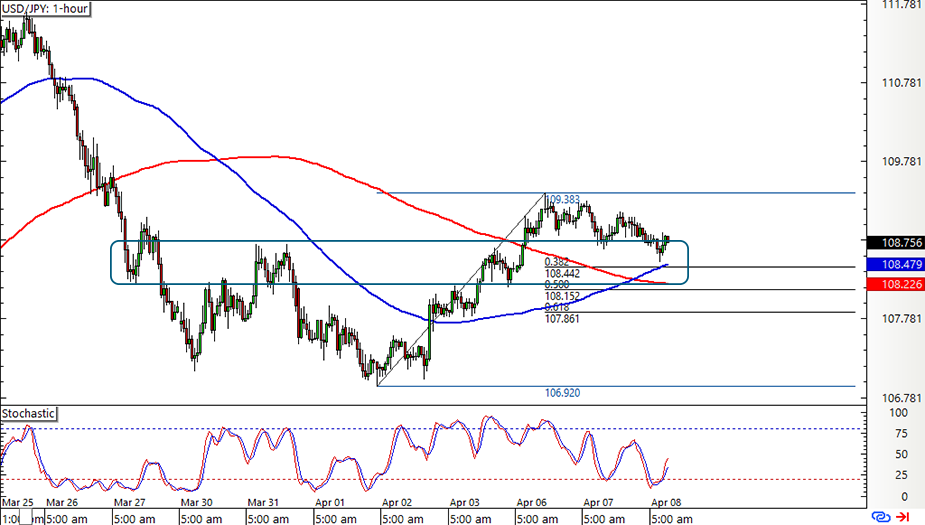
USD/JPY just busted through the neckline of a double bottom pattern visible on its short-term chart, suggesting that a climb is underway.
Price hit a ceiling around 109.40 and is now in the middle of a correction, closing in on the 38.2% Fibonacci retracement level. This happens to be right smack in line with the broken neckline resistance that could now hold as support.The moving averages’ bullish crossover and stochastic pulling up from the oversold region confirm that support levels are more likely to hold than to break.
If you’re thinking that a deeper retracement is due, you could wait for a test of the 50% or 61.8% levels, which might offer a better return-on-risk. Just make sure you look at the average USD/JPY volatility to have a better idea where to put your exit levels!