The Bank of Canada left its overnight rate at 2.25%, marking its seventh straight meeting on hold.
Still, the Canadian dollar rallied against every major currency as Governor Tiff Macklem struck a much more hawkish tone than the unchanged decision suggested.
It was another reminder that, in forex, what a central bank says about tomorrow can matter far more than what it does today.
What Did the Bank of Canada Actually Do?
Seven straight holds might look like inaction, but there’s more to the story. The bank’s last move was a 25 basis point rate cut in October 2025. Since then, it’s kept the policy rate at 2.25% even as the economic backdrop has grown considerably noisier.
What made the September 2 decision different was the removal of a key line in the statement.
Previous statements said the policy rate was “at the right level” to keep inflation near target while supporting the economy. Its removal suggests the BOC no longer considers rates settled, opening the door to a move.
This shift is a big deal because Canada’s inflation pressure is coming from two areas the overnight rate can’t directly control. Tariffs raise import prices regardless of borrowing costs. Energy prices are also elevated, with Brent crude trading near $90 a barrel, well above the BOC’s July assumption of $75. That gap has helped push the Consumer Price Index to 3%, its highest level since 2023.
But interest rates work best against demand-driven inflation, which happens when too much spending chases too few goods. Cutting rates during a supply-side cost shock could add to inflation. Raising them too aggressively could weaken a recovery that’s only just taken hold.
Canada’s economy grew at a 3.3% annualized pace in the second quarter, while employers added 75,000 jobs in July. That leaves the BOC with little room for error and makes every word from policymakers more important than usual.
In his press conference, Macklem said that “inflation is running too high,” pointing to the conflict in the Middle East and its effect on energy costs. He also warned that the BOC could raise rates more than once if inflation remained elevated, and markets wasted little time responding.
Promoted: A rate hold doesn’t always mean nothing changed. As CAD’s rally showed, traders often have to make decisions based on subtle signals and shifting probabilities.
In “Thinking in Bets”, former poker champion Annie Duke explains how to make smarter choices when you don’t have all the facts. Learn to think in probabilities, adjust when new information arrives, and stop treating every outcome as proof that your decision was right or wrong.
Develop a probabilistic mindset with “Thinking in Bets” by Annie Duke!
Disclosure: We may earn a commission from our partners if you sign up through our links, at no extra cost to you.
Why Did CAD Strengthen on a Hold Decision?
Because the BOC held the rate steady, but changed what markets could expect next. Specifically, the bank’s forward guidance turned noticeably more hawkish.
Removing the phrase “at the right level” opened the door to rate hikes, while Macklem’s willingness to raise rates more than once if inflation remained high reinforced that message.The yield on Canada’s two-year government bond, which closely tracks interest rate expectations, climbed above 3.09% during the session to reach its highest level since March. Money markets also began pricing in a meaningful chance of a December hike, followed by further increases in early 2027.
Pricing in higher interest rates widens the yield differential, or the gap between the returns offered by assets in different countries, in Canada’s favor and attracted more demand for the Loonie.
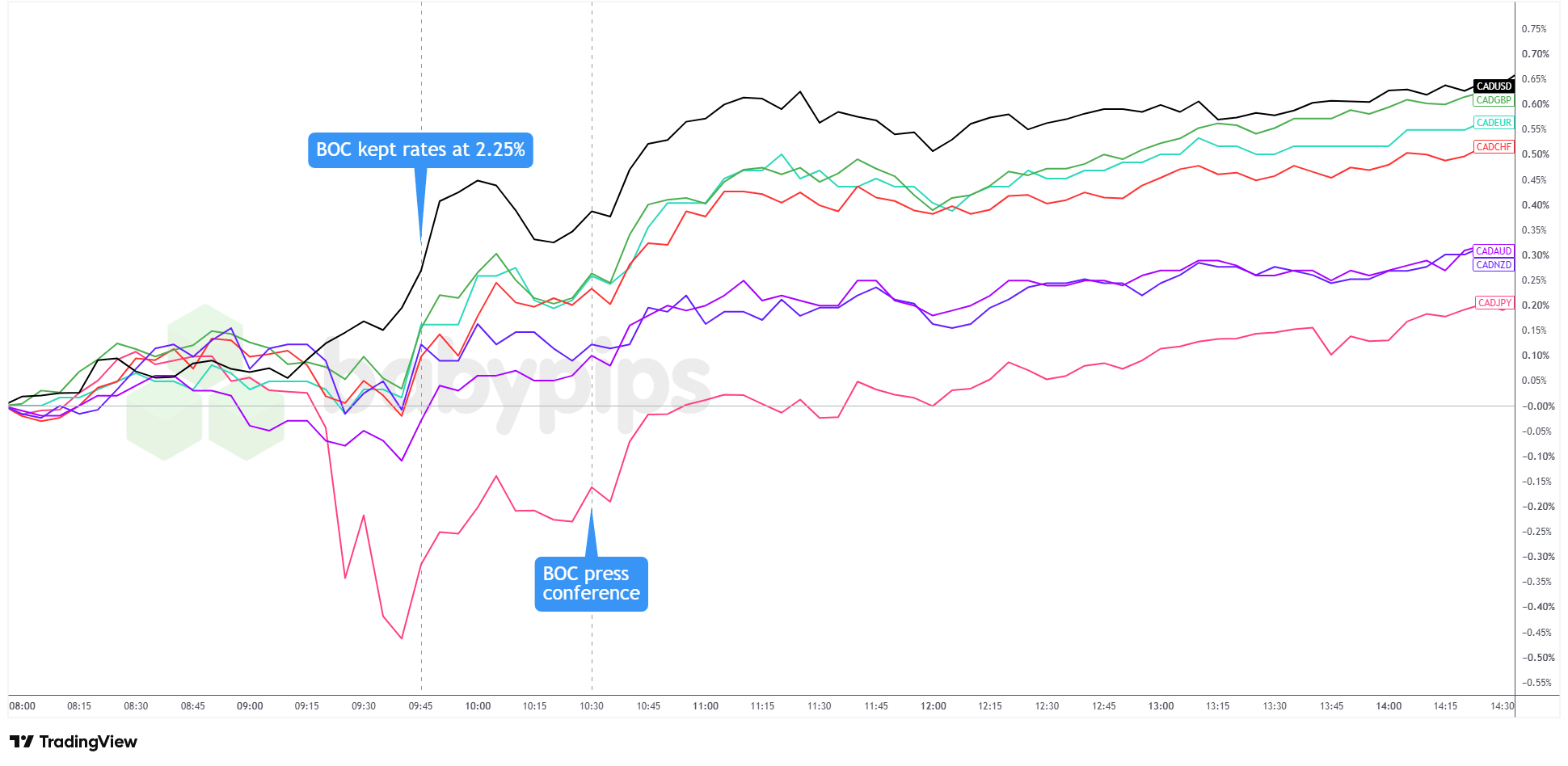
The chart below shows that shift playing out in real time. CAD strengthened across the board as soon as the decision came out at 9:45 a.m. ET, then extended its gains when Macklem began speaking at 10:30 a.m.
CAD Charts: 5-min
CAD 5-minute Forex Charts Chart Faster with TradingView
CAD/USD led the gains through the U.S. session, but the Loonie also posted smaller gains against AUD and NZD because tightening cycles at the RBA and RBNZ were already lending support to those currencies. CAD/JPY initially fell sharply as hawkish comments from Bank of Japan officials boosted demand for the yen. It later recovered and finished with the Loonie’s only major currency loss of the day.
What Should Traders Be Watching Now?
Canada’s tariff package on September 8 is the first big test. If the new duties start pushing consumer prices higher, the case for a BOC hike before year-end will grow stronger.
Oil prices remain the bigger wildcard. Macklem made it clear that elevated energy costs pose a greater inflation threat than the trade dispute, and the conflict in the Middle East has no obvious end in sight.
The upcoming Canadian inflation and employment reports will help determine whether the BOC’s hawkish stance strengthens or begins to fade. Its next policy decision is due in October.
Bottom Line
The BOC’s September 2 hold was hawkish in every way except the rate decision itself. By removing the phrase “at the right level,” the bank signaled that 2.25% might not be the final stop. With energy and tariff pressures building, the bar for another rate hike is getting lower. Sometimes the most important words in a central bank statement are the ones that disappear.
The bigger issue is the supply shock dilemma. When tariffs and energy costs drive inflation, interest rates become a blunt tool. Raise rates and the BOC risks choking off a fragile recovery. Hold steady, and it risks letting inflation stay high for longer. Macklem has made it clear that if inflation doesn’t cooperate, the bank is prepared to tighten. Canada’s September 8 tariff package and the October CPI report will offer the next clues.
The Bank of Canada held its overnight rate unchanged, yet the loonie rallied sharply, and that reaction comes down to how central banks signal future policy direction. Premium members can read our lesson:
📖 Hawkish vs. Dovish: How to Read Central Bank Language
Reading this helps you understand hawkish and dovish signals, how a single phrase removed from a central bank statement can shift rate expectations, and why a press conference can move a currency further than the rate decision itself.
And if you’re not a Premium subscriber yet, now’s a good time to sign up.
With Babypips Premium, you get full access to School of Pipsology lessons that help you understand not just what a central bank decided, but how to read the language and tone behind the decision to anticipate where a currency is headed next.