


When U.S. President Donald Trump rejected Iran’s latest peace proposal over the weekend, calling it “totally unacceptable,” oil markets and the U.S. dollar didn’t just shrug.
The Strait of Hormuz, the narrow waterway through which roughly 20% of the world’s traded oil flows, had been at the center of tense negotiations in the past week.
That rejection slammed the door on hopes for a quick resolution, and for traders, the implications ripple well beyond the price of crude.
What Actually Happened?
Let’s rewind a little. For much of last week, markets were buzzing with cautious optimism that the U.S. and Iran were moving toward a deal that would reopen the Strait of Hormuz.
Geopolitical tensions had been rattling the region, and the prospect of smooth oil flows was enough to push risk appetite higher in Asia. Japan’s Nikkei surged more than 4% in a single session, commodity-linked currencies like the Australian dollar (AUD) and New Zealand dollar (NZD) caught a bid, and even the S&P 500 briefly touched record territory near 7,385.
But then reality intervened. On Sunday (May 10), Bloomberg reported that President Trump had rejected Iran’s latest peace offer, describing it as “totally unacceptable.” The weekend news landed on markets that had already been shaken by late Thursday reports of explosions near a southern Iranian port and unverified claims that the U.S. military had attacked an Iranian oil tanker.
This illustrates how oftentimes the expectation of good news moves markets more than the news itself. And when that expectation collapses? The reversal can be sharp.
Promoted: When geopolitical surprises trigger volatility, disciplined traders need more than hot takes.
We’re breaking down how de-escalation hopes and letdowns can shake up commodity and currency markets. For traders looking to take those macro themes into a more structured trading environment, Lux Trading Firm offers funded trading programs with real capital, certified track records, and potential long-term opportunities for qualified performers.
Learn More at Lux Trading Firm
Disclosure: To help support our free daily content, we may earn a commission from our partners if you sign up through our links, at no extra cost to you.
Why Does the Strait of Hormuz Matter So Much?
The Strait of Hormuz is a narrow channel (about 21 miles wide at its narrowest point) between Iran and Oman. It connects the Persian Gulf to the Arabian Sea, and roughly 20 million barrels of oil pass through it every day, according to the U.S. Energy Information Administration (EIA). That’s approximately 20% of global oil trade moving through a single maritime chokepoint.
Why is this a big deal for forex traders?
Oil prices and currency markets are more connected than many beginners realize. Here’s the basic chain reaction:
- Oil prices rise → energy-importing economies like Japan and the Euro Area face higher costs → their currencies may come under pressure, as they need to buy more dollars to pay for oil (which is priced in USD)
-
 Oil prices rise → energy-exporting currencies, like the Canadian dollar (CAD), and Norwegian krone (NOK), often get a boost from higher export revenues
 - Oil prices spike due to geopolitical risk → the U.S. dollar often strengthens as investors seek safety
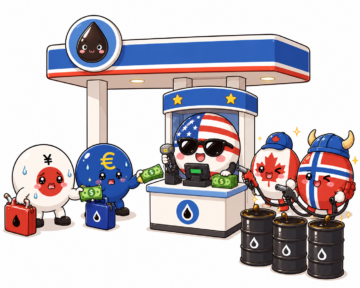 Oil prices rise → energy-exporting currencies, like the Canadian dollar (CAD), and Norwegian krone (NOK), often get a boost from higher export revenues
On Thursday, May 7, WTI crude oil swung wildly, dropping below $90 before briefly recovering to near $94, before settling around $92.68. That kind of intraday volatility of nearly a $4 range is unusual even for oil, and it closely tracked the swinging optimism and then skepticism around the Hormuz deal.
As for Trump’s rejection over the weekend: while full details of Iran’s proposal weren’t publicly disclosed, early news reports indicated Trump viewed the terms as far from acceptable. That development likely reintroduced significant uncertainty about when or whether normal oil flows through the strait might resume.
What Does This Mean for Markets?
Oil volatility is back on the menu. The energy commodity price will likely continue to fluctuate wildly until the deal outlook becomes clearer. With Trump’s rejection, the uncertainty meter just went back up. WTI crude’s dramatic intraday swings last Thursday offered a preview of how sensitive oil can be to deal-headline risk.
The U.S. dollar may remain supported, but it’s complicated. The dollar closed as arguably the best-performing major currency on Thursday’s session, buoyed in part by Minneapolis Federal Reserve President Neel Kashkari’s warning that a prolonged Strait of Hormuz closure could force the Fed to raise interest rates to combat war-related inflation. Higher interest rates generally support a currency, so Kashkari’s hawkish tone appears to have contributed to greenback strength through the U.S. afternoon.
If oil disruption persists, this dollar-positive dynamic may continue, though it’s worth noting that multiple factors, including the broader geopolitical environment and Friday’s U.S. jobs report, were also in play.
Risk currencies bear watching. The euro may face headwinds if European energy costs remain elevated. Meanwhile, commodity-linked currencies like AUD and NZD, which rallied on deal optimism last week, appear vulnerable to reversal if oil risk premiums stay high.
The Canadian dollar presents an interesting counterpoint: Canada is a major oil exporter, and higher crude prices can be a tailwind for CAD, making USD/CAD a pair worth watching closely.
Gold is behaving like a geopolitical hedge. Gold hit $4,750 on Thursday, outperforming equities and Bitcoin. Its relative resilience likely reflects its long-standing role as a safe-haven asset during periods of geopolitical stress. If Middle East tensions escalate further following Trump’s rejection, gold may continue to attract safe-haven demand.
Bitcoin moved like a risk asset, not a safe haven. Despite occasional narratives to the contrary, Bitcoin’s 1.56% decline to near $80,159 on Thursday, steeper than equities, suggests it was trading more like a high-beta (meaning higher volatility, higher risk sensitivity) asset in this environment rather than a store of value.
The Bottom Line
- Geopolitical events can move markets fast and in both directions. The whipsaw in oil, stocks, and currencies on Thursday is a live example of how quickly expectations (not just confirmed facts) can drive price action.
- The Strait of Hormuz is a key “chokepoint variable” to understand. Any escalation or resolution there has direct implications for oil prices, inflation expectations, and by extension, central bank policy and therefore currencies.
- The dollar-oil-rates triangle matters. When oil disruption threatens inflation, central banks may be forced to respond hawkishly. Kashkari’s comments last week illustrate how this chain can feed dollar strength even in an uncertain geopolitical environment.
- Safe havens don’t all behave the same way. In last week’s session, gold behaved like a geopolitical hedge while Bitcoin moved with risk assets — an important distinction for traders who treat all “alternative assets” as equivalent.
- Watch deal headlines, not just data. In an environment like this, an unverified social media post, a Wall Street Journal scoop, or a presidential press conference can move markets more than a scheduled economic release.
What to Watch For
The situation remains fluid. Key catalysts to monitor heading into the new week:
- Further U.S.-Iran diplomatic developments: Any signals of reopened negotiations or further escalation will likely move oil and the dollar quickly
- Oil inventory data: Weekly U.S. crude inventory reports (EIA) may provide additional price signals
- WTI crude price action: The $90 level is now a technically significant support area to watch
The Strait of Hormuz situation is a reminder of how quickly geopolitical events can reshape currency markets, and some of the dynamics at play here may not be immediately obvious. Premium members can read our lesson:
📖 Geopolitical Risk, Trade Policy, and Safe Haven Flows
Reading this helps you understand how geopolitical shocks drive currency moves, which safe havens attract demand when risk spikes, and why the dollar, gold, and commodity currencies each respond differently to the same event.
And if you’re not a Premium subscriber yet, now’s a good time to sign up.
With Babypips Premium, you get full access to School of Pipsology lessons that help you understand not just what the charts are showing, but the geopolitical and macro forces driving the moves behind them.