


While wars and political crises grab the front page, the slow-burn trade war is still the dominant force behind commodity currency direction, quietly signaling something traders can’t afford to miss.
Learn why the Australian dollar and Canadian dollar still take direction from tariffs headlines these days, and what history says about what comes next.
The Basics: What’s Up with Tariffs These Days?
With geopolitical headlines dominating the news cycle lately, it makes sense to first have a quick rundown of how trade-related developments are going:
U.S. President Trump has spent much of 2025 and into 2026 in a rolling trade war, imposing sweeping tariffs on imports from the likes of China, Canada, and Mexico.
On April 2, 2025 a.k.a. “Liberation Day“, the U.S. announced tariffs on imports from virtually all trading partners: a flat 10% universal rate plus “reciprocal” tariffs calibrated to each country’s trade imbalance with the U.S.
The escalation with China was the most dramatic: tit-for-tat responses pushed tariffs to extraordinary levels, with the U.S. imposing rates as high as 145% on Chinese goods and China countering with 125% on U.S. products.
A temporary truce in May 2025 pulled tariffs back from those extremes. Then, in February 2026, the U.S. Supreme Court struck down certain tariffs that had been imposed under the International Emergency Economic Powers Act, forcing the administration to recalibrate.
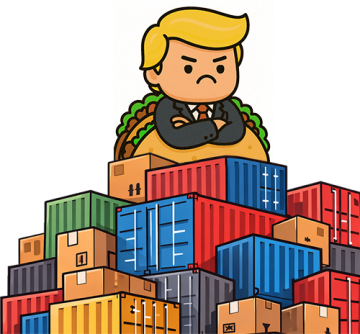
This tariffs uncertainty — the constant “will they, won’t they” around threats and TACO announcements — has shaken confidence in U.S. assets and, along with other factors, appears to have contributed to a meaningful decline in the U.S. Dollar Index (DXY), which fell approximately 9.1% last year.
The ripple effects landed squarely on two currencies that new traders hear about constantly: the Australian dollar (AUD), the New Zealand dollar (NZD) and the Canadian dollar (CAD), also known as the Aussie, Kiwi and Loonie respectively.
Promoted: Commodity Currencies Are Still Sensitive to Tariffs News, Even When Geopolitics Is Hogging The Spotlight
Commodity currencies are facing additional headwinds while tariffs concerns remain in play, adding another layer of uncertainty to global growth prospects amid the US-Iran conflict
When markets are being pushed around by persistent underlying forces that aren’t exactly under the limelight, traders need both clarity and enough capital to execute without hesitation.
Alpha Capital Group gives you access to simulated funded accounts up to $200K, so you can trade multi-driver markets like gold with the flexibility and size your strategy actually requires.
Learn more about Alpha Capital Group!
Disclosure: We may earn a commission from our partners if you sign up through our links, at no extra cost to you.
Why Are AUD, NZD, and CAD Affected?
A commodity currency is one whose value tends to move alongside the price of the raw materials that country exports in large quantities.
The reasoning is simple: when commodity prices rise, export revenues climb, money flows into the economy, and demand for the currency tends to increase. When commodity prices fall or when global demand for those commodities looks shaky, the currency often follows.
- Australia exports iron ore, copper, coal, and gold in vast quantities, particularly to China, its largest trading partner.
- New Zealand is heavily dependent on dairy exports and is also deeply tied to Chinese demand given that China is New Zealand’s single biggest trading partner.
- Canada is the world’s fourth-largest oil producer and is economically intertwined with the United States, sharing the world’s largest bilateral trade relationship.
When the U.S. imposes sweeping tariffs on global trade, it tends to slow global growth expectations, reduce industrial activity (particularly in China), and dampen demand for the raw materials these countries produce. That can weaken commodity prices, which can then weigh on the currencies.
Think of them as the forex market’s version of a “global growth barometer.” When the outlook is bright, they tend to shine. When trade wars cloud the horizon, they’re often the first to feel it.
What Does This Mean for Markets?
While AUD, NZD, and CAD are all lumped together as “commodity currencies,” they each have their own personality, their own commodity drivers, and their own relationship with the tariff story.
The Aussie and Kiwi have typically benefited from a weakening U.S. dollar, firm commodity prices, and better-than-feared Chinese economic data in early 2026. But both remain vulnerable to any fresh escalation of U.S.-China tensions.
The Kiwi has an additional wildcard: its hotter-than-expected inflation data in Q1 2026 has introduced the possibility of RBNZ rate hikes, which would typically support the currency, but it also reflects partly tariff-driven cost pressures working through the supply chain, adding complexity to the picture.
The Loonie faces the specific pressure of the USMCA renegotiation timeline in July 2026. A positive resolution could boost the CAD; a breakdown would likely send USD/CAD higher again. Also, Middle East tensions have a specific impact on crude oil prices, and therefore the correlated Loonie, so resurfacing supply concerns tend to keep CAD supported or its losses limited.
The broader takeaway is that the tariff story hasn’t ended but has simply evolved into a lower-intensity and higher-uncertainty chronic condition.
The U.S.-China tariff reduction is scheduled to expire in November 2026. The Supreme Court ruling earlier this year forced a recalibration but didn’t eliminate tariff risk. And with U.S. midterm elections approaching, political pressure around trade policy isn’t going anywhere.
The Bottom Line
AUD, NZD, and CAD tend to act as global growth barometers. When tariff fears threaten to slow global trade and Chinese industrial demand, these three currencies often show the strain first.
China is the connecting thread for all three, but in different ways. The Aussie tracks Chinese industrial demand (iron ore, copper). The Kiwi follows Chinese consumer demand (dairy, food exports) and is sometimes called a “China proxy.” The Loonie is more directly tied to U.S.-Canada trade and oil prices, but isn’t immune to broad China-driven risk-off moves.
Tariff events create fast, sharp currency moves. Liberation Day in April 2025 caused AUD/USD to drop nearly 15% from its pre-tariff highs to the 0.5912 low in a matter of days. Truce signals reversed much of that just as quickly. For new traders, this is a reminder that macro events can dwarf normal day-to-day ranges.
Don’t let geopolitical noise drown out the tariff signal. Wars and political drama are loud. Trade policy tends to be slow, technical, and easy to tune out, but as AUD, NZD, and CAD have shown over the past year, it’s often the quiet story that does the most work.
BabyPips Premium Annual Members have exclusive access to our highest-tier partnership deal: 30% off your first purchase of a TradeZella annual subscription! To level up the rate of progress towards mastering your performance and psychology, TradeZella’s AI-powered journaling and backtesting tools are the industry gold standard.
This discount effectively covers a large portion of an annual BabyPips Premium subscription!To Claim the Exclusive 30% off, email us at [email protected] to verify membership status and receive the promo code. Please reference “TradeZella Annual Plan Promo Code” in your email subject line.