Manufacturing hit its strongest reading since May 2022 at 54.0. Services surpassed expectations at 54.5 versus 53.7.
In both cases, employment is contracting while prices continue to run hot.
Here’s why the latest ISM PMI surveys could make the Fed’s policy headache get worse.
What Are PMIs Anyway?
The Purchasing Managers’ Index (PMI) is a composite reading based on a monthly survey of business managers asking a simple question: Is business getting better or worse than last month?
The dividing line is 50. Above it means expansion. Below it means contraction. The further from 50, the stronger the signal.
Two major reports dropped this week from the Institute for Supply Management (ISM):
ISM Manufacturing PMI
- Headline: 54.0 — up from April’s 52.7, its highest reading since May 2022
- New Orders: 56.8 (growing faster, 5th consecutive month)
- Production: 54.3 (7th consecutive month of expansion)
- Employment: 48.6 (contracting, its 32nd consecutive month below 50)
- Supplier Deliveries: 60.6 (slowing, signaling supply chain strain)
- Prices: 82.1 (still near historically extreme levels, down just 2.5 points from April’s 84.6)
ISM Services PMI
- Headline: 54.5 — up from April’s 53.6, marking its 23rd consecutive month in expansion
- Business Activity: 57.7 (second highest since October 2024)
- New Orders: 57.3 (surged 3.8 points, well above the 12-month average)
- Employment: 47.9 (contracting, 3rd consecutive month below 50)
- Prices: 71.3 — highest reading since August 2022, with prices now above 60 for 18 straight months
- Inventories: 62.5 — tied for the highest reading since ISM began collecting services data in 1997
Both reports beat expectations and pointed to real economic momentum, but they’re also quietly flashing warning signs at the same time.
Promoted: When the Fed Has No Easy Move, Your Trading Costs Shouldn’t Add Pressure.
High inflation, slowing employment, and shifting Fed odds can make markets messy fast.
Tradeify helps traders stay focused with evaluations that are a one-time purchase with no recurring charges, so you’re not racing the clock or bleeding fees while waiting for cleaner setups around PMI surveys and Fed headlines. With ~$200M paid out and growing, Tradeify gives active traders a more straightforward path to funded trading.
Learn More About Tradeify! Limited Time offer: Code “JUNE” for 35% off!
Disclosure: We may earn a commission from our partners if you sign up through our links, at no extra cost to you.
Why Strong Results Aren’t Always Good News
Strong economic data doesn’t automatically mean good news for markets. It depends on what kind of strength it is.
What the May ISM reports are showing is a split economy. Demand is healthy since new orders beat in both manufacturing and services, and ISM’s own modeling suggests both PMI readings correspond to roughly 2.0–2.2% annualized real GDP growth.
But look at what’s happening underneath:
Prices are not coming down. Services prices have now risen for 108 consecutive months — that’s nine straight years! And ALL 18 industries reported paying higher prices this May.
Manufacturing’s prices index of 82.1% means roughly two-thirds of purchasing managers are still paying more for inputs. ISM Manufacturing Chair Susan Spence identified three culprits:- Steel and aluminum prices affecting the entire value chain
- Tariffs on imported goods, and
- Petroleum-based product cost increases tied directly to the Middle East conflict
Employment is contracting in both sectors simultaneously. Manufacturing’s employment index has now contracted for 32 of the past 41 months since January 2023. Services employment has contracted three months running. Companies are managing headcounts down or simply not backfilling when people leave.
Put it together: the economy is expanding, prices keep rising, and employers are quietly reducing workforces.
That’s the textbook description of stagflation: slow growth with sticky inflation.
What Does This Mean for the Fed and Forex?
The Federal Reserve sets interest rates to balance two goals: keeping inflation near 2% and keeping employment healthy.
Right now, both goals are being challenged at the same time, and in opposite directions.
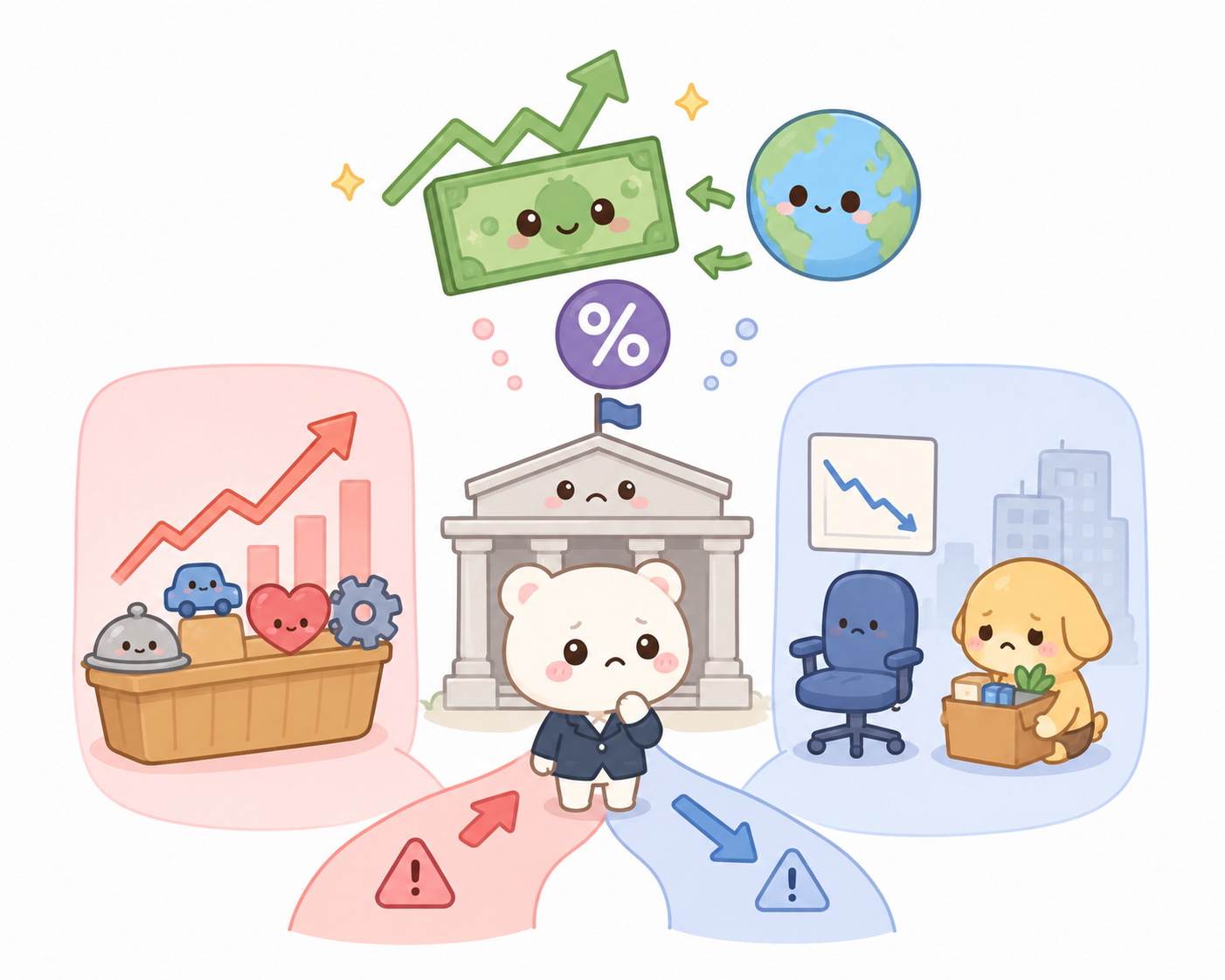 Coming into June, many market participants had been pricing in Fed rate cuts later in 2026, on the theory that slowing growth (Q1 GDP was revised to 1.6% annualized) would eventually force the Fed’s hand. Monday’s manufacturing print started cracking that narrative, then Wednesday’s services print arguably completed the job.
Higher interest rate expectations tend to strengthen the U.S. dollar since higher rates make U.S. assets more attractive to global investors seeking yield, pulling capital toward dollar-denominated investments and bidding up the currency.
The services price index is at its highest since August 2022, with all 18 industries reporting increases, giving the Fed very little cover to cut. And the employment weakness creates the other half of the dilemma: raising rates to fight inflation risks deepening the labor market softness that’s already underway.
The Bottom Line
- Manufacturing PMI hit 54.0 in May — its strongest reading since May 2022 — with ISM’s own model suggesting this pace corresponds to approximately 2.2% annualized GDP growth
- Services PMI hit 54.5 — its 23rd consecutive month of expansion, with business activity and new orders both accelerating sharply
- Both sectors are contracting employment simultaneously — manufacturing for the 32nd month in 41, services for the third consecutive month — a combination that keeps the stagflation debate very much alive
- Prices are the Fed’s real problem. Services prices hit their highest since August 2022. Manufacturing prices remain near historically extreme levels. No commodities were reported down in price in either report
- The dollar found support and rate-cut bets faded after the manufacturing data on Monday; the services report confirms the hawkish tilt. EUR/USD and GBP/USD upside may face headwinds until the inflation picture softens
This article covers stagflation, a scenario where slowing growth and rising inflation arrive at the same time, and if you’re not clear on how inflation works and what it means for central bank policy, that context is easy to miss. Premium members can read our lesson:
📖 Inflation: The Force That Moves Central Banks
Reading this helps you understand how CPI, PCE, and PPI measure inflation, why the Fed targets 2%, and how inflation regimes like stagflation shape currency values and trading decisions.
And if you’re not a Premium subscriber yet, now’s a good time to sign up.
With Babypips Premium, you get full access to School of Pipsology lessons that help you understand not just what the data is showing, but the inflation dynamics and central bank constraints driving the Fed’s impossible position.