Oil traders got almost no weekend off. President Trump announced Sunday he’s holding off on new strikes against Iran, citing progress toward a deal to reopen the Strait of Hormuz.
Crude dropped hard at the reopen, though Iran hasn’t confirmed any of it.
Here’s what happened over the weekend and why one country’s silence matters more than the other’s headline.
What Actually Happened This Weekend?
Let’s start with last Friday. Late in the day, a tanker operating near Oman was struck, and a second vessel reported an explosion close by. That’s the kind of headline that normally pushes oil higher, because it signals the Strait of Hormuz is still a live flashpoint.
Then, on Sunday, Trump told reporters aboard Air Force One that he’d canceled a planned attack on Iran. He said Gulf allies, Saudi Arabia, the UAE, and Qatar among them, had asked him to hold off. He called a deal to reopen Hormuz “imminent” and said talks between the U.S. and Iran would resume Monday.
But here’s the catch: Iran hasn’t said any of that back. Its state-run Fars news agency described the U.S. announcement as a retreat, not a breakthrough. Iran’s foreign minister spent Saturday on the phone with officials in Pakistan, Turkey, and Saudi Arabia, warning against new U.S. strikes rather than confirming new terms.
One side is talking about a deal. The other side is talking about not getting bombed. Those aren’t the same conversation.
To top it off, OPEC+ approved another 188,000 barrels a day of output for September. That’s more supply landing on a market that was already digesting de-escalation headlines.
Why Did Oil Fall So Hard on the News?
Oil had closed out last week already jumpy. Brent, the international benchmark, settled near $90.12 a barrel on Friday. WTI, the U.S. benchmark, closed around $84.67. Both had swung hard through the week, including a sharp selloff early on and a late bounce on the tanker attack near Oman.
Then the weekend news hit an empty market, an empty markets move fast. Brent futures fell roughly 5.6% at the Sunday reopen, to around $83 a barrel. WTI dropped about 5.5%, to near $80. A full week’s worth of volatility, compressed into a single reopen.
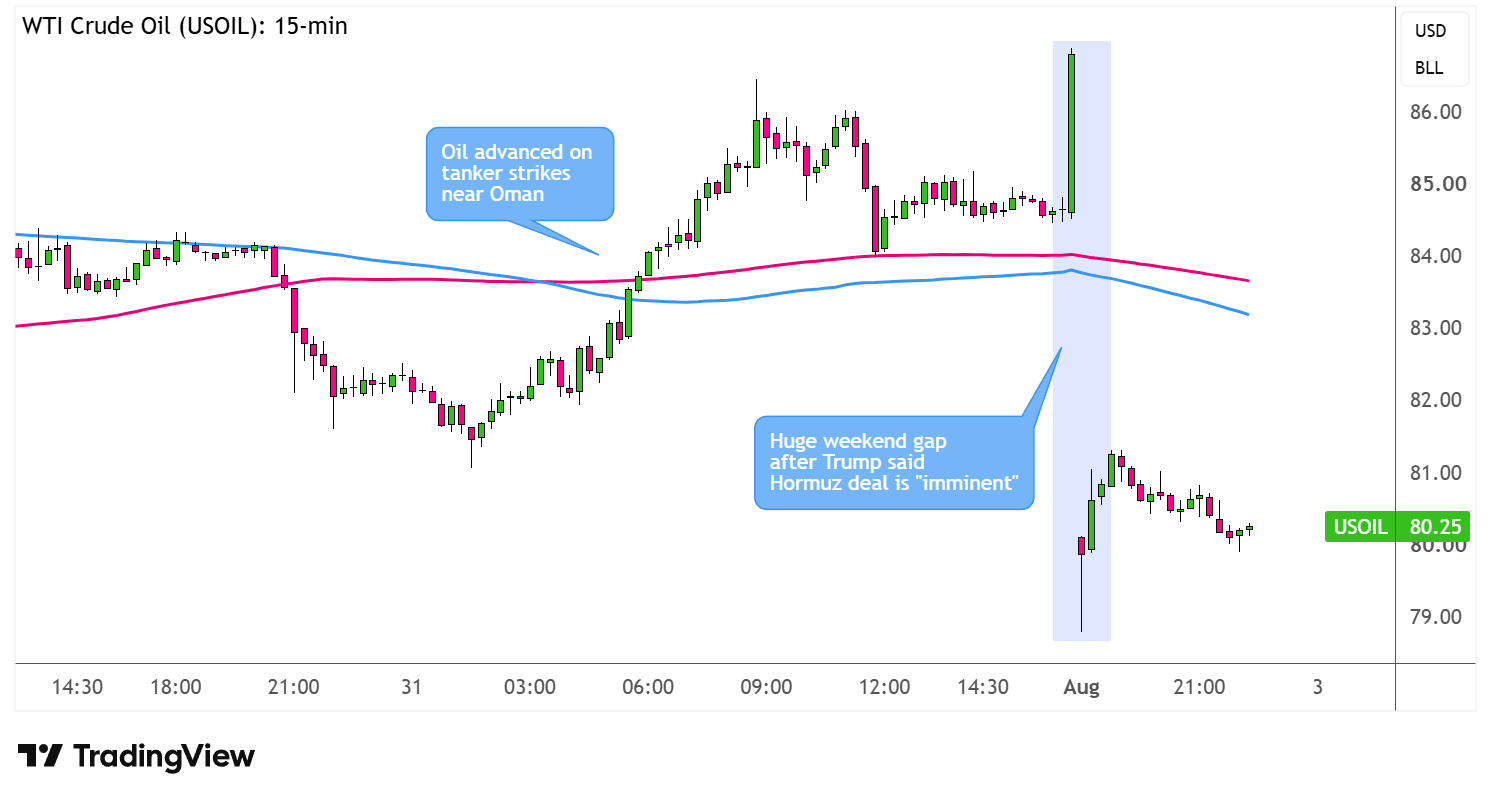
WTI Crude Oil (USOIL) 15-min Chart Faster with TradingView
Some of the price traders had been paying for oil was fear, which was already priced in. Markets call this a risk premium: extra price built into an asset because of an unresolved danger, separate from supply and demand.
With Iran’s foreign minister threatening strikes and tankers getting hit near Oman, this risk premium had every reason to stick around. But when Trump announced they’re pausing strikes and that a deal is imminent, some of that fear drained out even before official confirmation.
The drop in oil prices also lined up with the OPEC+ output increase, which adds supply regardless of what happens in the strait. So this move likely reflects a mix of genuine relief, added supply, and a market that’s gotten quicker to price optimism first and ask questions later.
Promoted: Markets move on surprises, not just headlines.
When central bank decisions hit, FinancialJuice helps traders track the data, commentary, and market expectations shaping price action in real time.
Join FinancialJuice for Free to learn more!
Disclosure: We may earn a commission from our partners if you sign up through our links, at no extra cost to you.
What Does This Mean for Traders?
Beyond the price movements, the real story is the mismatch. One government confirmed a policy change: holding off on strikes. The other government hasn’t confirmed a deal exists. Markets reacted as though both had.
That gap tends to matter most at the next data point, not immediately. Monday’s negotiations, and whatever Iran’s officials say publicly after them, could either close that gap or blow it wide open again.A single Iranian statement rejecting the “imminent deal” framing could send both benchmarks right back toward where they closed Friday, or further, since a chunk of the drop assumed a deal that doesn’t formally exist yet.
This kind of move could affect markets as well. A falling oil-linked risk premium tends to ease pressure on the currencies of oil-importing economies and can lift risk appetite in equities broadly. It also interacts with the U.S. dollar, since a calmer Middle East generally reduces safe-haven demand for the greenback, all else equal.
It’s important to note that none of that is guaranteed. Multiple forces are moving at once this week, including a heavy U.S. jobs calendar, so oil isn’t the only thing traders are digesting.
The Bottom Line
- Trump paused planned strikes on Iran over the weekend and called a Hormuz reopening deal “imminent.” Iran has not confirmed a deal.
- Oil futures fell roughly 5.5% at Sunday’s reopen (Brent near $83, WTI near $80) after Friday closes of $90.12 and $84.67.
- OPEC+ approved another 188,000 barrels a day for September, adding supply on top of the de-escalation headlines.
- Weekend geopolitical headlines can move markets before any facts on the ground actually change, which is why the size of a gap doesn’t always match the size of the news.
- Watch what each side says after Monday’s talks, not just the fact that talks are happening. Confirmation (or its absence) usually matters more than the announcement that started the move.
Monday’s negotiations between the U.S. and Iran are likely the immediate catalyst; any statement from Iranian officials afterward could confirm or unravel the “imminent deal” framing.
Beyond that, the week is stacked with U.S. labor data, including Friday’s nonfarm payrolls report, which will compete with oil headlines for the dollar’s attention.
This weekend’s Iran and oil price swings hinge on a concept many traders skim past: the risk premium built into prices during an unresolved conflict. Premium members can read our lesson:
📖 Geopolitical Risk, Trade Policy, and Safe Haven Flows
Reading this helps you understand how geopolitical events like the Strait of Hormuz standoff get priced into markets before facts are confirmed, why safe haven flows into the dollar rise and fall with tension levels, and how to read the gap between a headline and the underlying policy reality.
And if you’re not a Premium subscriber yet, now’s a good time to sign up.
With Babypips Premium, you get full access to School of Pipsology lessons that help you understand not just the headline that moved oil, but the risk premium, safe haven flows, and currency ripple effects sitting underneath it.