

The Bank of Canada kept its policy rate on hold for the fourth straight time this April, but with tariffs squeezing growth and an oil-driven inflation spike on the way, the Loonie story is anything but simple.
The decision came alongside the BOC’s quarterly Monetary Policy Report (MPR), which is the central bank’s full economic report card, published four times a year alongside select rate decisions.
During the event, Governor Tiff Macklem delivered an opening statement that laid out three core messages: Canada’s economy is growing, inflation is being temporarily pushed up by higher global energy prices, and monetary policy is focused on making sure that energy price spike doesn’t become a permanent inflation problem.
The Basics: Why Did the BOC Hold?
The short answer: the Bank of Canada is caught between two opposing forces, and holding steady is its way of NOT making things any worse.
The Tariff Drag
U.S. tariffs on Canadian goods have been reshaping the Canadian economy for over a year. According to the Bank of Canada’s April 2026 statement, the Canadian economy contracted by 0.6% (annualized) in Q4 2025, largely due to a pullback in business inventories and declining exports in tariff-exposed sectors.
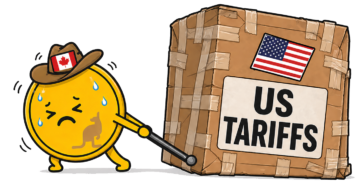 In the previous year alone, GDP in tariff-impacted industries declined 4.0%, with particularly steep drops in aluminum (-15.5%) and motor vehicle manufacturing (-11.6%).
The labor market reflects this strain. The BOC’s statement noted the unemployment rate remains in the 6.5%–7% range, with job losses concentrated in steel, lumber, and automotive sectors directly targeted by US tariffs.
In short, Canada’s economy is too soft for rate hikes, but inflation is too sticky for easy rate cuts.
The Oil Price Wildcard
Complicating everything is the ongoing conflict in the Middle East that has sent global oil prices sharply higher. This matters for Canada because its economy is a large net exporter of oil and natural gas.
That creates an unusual dynamic. Higher oil prices simultaneously:
- Help Canada’s energy sector and national income (more export revenue)
- Hurt Canadian consumers and businesses through rising gasoline and fuel costs
- Push inflation higher (CPI rose from 1.8% in February to 2.4% in March 2026, and the BOC projects it could climb to around 3% in April 2026)
Governor Macklem acknowledged this tension directly, noting that “the surge in gasoline prices combined with still-elevated food price inflation is squeezing more Canadians.”
This is textbook stagflation, and this makes central bankers nervous because the usual tools don’t work cleanly. Fighting inflation by raising rates can deepen a slowdown; cutting rates to support growth can worsen inflation.
Promoted: When Central Bank Rhetoric Shifts, Execution Matters More Than Ever.
The Bank of Canada’s April monetary policy statement revealed that not every decision to hold interest rates is the same, as navigating a stagflationary environment amid geopolitical tensions and tariffs risks proves complex.
Lux Trading Firm gives serious traders access to real capital, structured evaluations, and the chance to build a verified track record in any market condition.
Learn More at Lux Trading Firm
Disclosure: To help support our free daily content, we may earn a commission from our partners if you sign up through our links, at no extra cost to you.
What Does This Mean for the Canadian Dollar?
Under normal circumstances, when a central bank holds rates while inflation rises and growth stays weak, the currency tends to come under pressure. Traders usually prefer currencies where interest rates are rising, as higher yields attract capital. So you’d expect the Canadian dollar to be weakening.
But that’s not quite what’s been happening. The Loonie had actually been outperforming other G10 currencies since March, supported by rising oil export revenues flowing into Canada’s financial system.
This highlights an important concept: commodity-linked currencies don’t always behave the same way as currencies tied purely to interest rate differentials. Canada’s dollar is heavily influenced by oil prices as well as rate policy, which makes it a more complex instrument to trade than, say, EUR or GBP.
Two Forces Pulling in Opposite Directions
For CAD traders, the April decision creates a tug-of-war:
- Bearish (CAD-negative) signals: Weak domestic growth, soft labor market, four consecutive rate holds, US tariff uncertainty, and housing market softness
- Bullish (CAD-positive) signals: Rising oil prices boosting export revenues, BOC signaling rates will stay near current levels (no imminent cuts), and potential for rate hikes if oil prices remain elevated
Governor Macklem was unusually direct about the hike scenario when he stated:
“If oil prices continue to increase, and particularly if they remain elevated, the risk that higher energy prices become ongoing generalized inflation increases… there may be a need for consecutive increases in the policy rate.”
That hawkish-leaning comment appears to have tempered expectations for near-term CAD weakness.
The Bottom Line
Key takeaways for developing traders:
- Holding rates isn’t the same as doing nothing. The BOC has now held at 2.25% for four consecutive meetings, but the language in each statement evolves. Learning to read the tone of central bank communications — what’s emphasized, what’s new — is a crucial skill for any forex trader.
- CAD is a commodity currency. The Canadian dollar doesn’t just respond to interest rate decisions; oil price movements can dominate. When trading the Loonie, always check what crude oil is doing.
- Stagflation creates policy ambiguity. When rising prices and weak growth arrive together, central banks can’t rely on their standard playbook. This uncertainty often leads to elevated volatility in the affected currency — something to keep in mind when sizing positions in CAD pairs.
- Forward guidance matters. Macklem’s comment that “something close to the policy rate that we have today is probably about right” gave markets a clearer signal than they sometimes get. Forward guidance (central bankers giving hints about future decisions) can move currencies as much as the actual rate decision.
- Multiple factors drive market moves. CAD’s performance right now reflects US tariff policy, Middle East oil prices, domestic growth data, and Fed policy simultaneously. Rarely does one factor tell the whole story.
What to Watch Next
- Bank of Canada’s next rate announcement (June 10, 2026, at 09:45 ET): the next key decision point for CAD traders
- Canada’s April CPI data: Expected to show inflation approaching 3%; if it comes in higher, rate hike talk could intensify and support CAD
- Oil prices: If crude pulls back toward the BOC’s assumption of US$75/barrel by mid-2027, rate hike risk eases, and CAD may soften; if oil stays near $90, watch for a more hawkish BOC tone in June
- US-Canada trade developments: Any changes to the current tariff regime — up or down — could rapidly reprice USD/CAD
BabyPips Premium Annual Members have exclusive access to our highest-tier partnership deal: 30% off your first purchase of a TradeZella annual subscription! To level up the rate of progress towards mastering your performance and psychology, TradeZella’s AI-powered journaling and backtesting tools are the industry gold standard.
This discount effectively covers a large portion of an annual BabyPips Premium subscription!To Claim the Exclusive 30% off, email us at [email protected] to verify membership status and receive the promo code. Please reference “TradeZella Annual Plan Promo Code” in your email subject line.