


The Reserve Bank of Australia (RBA) kept its cash rate at 4.35% this August.
Markets expected the hold, but what they didn’t fully agree on was the central bank’s tone.
Governor Michele Bullock struck a hawkish note, and AUD/USD whipped through a choppy session as traders tried to figure out what “still too high” really meant for the months ahead.
What Actually Happened?
The RBA’s Monetary Policy Board voted unanimously to leave the cash rate at 4.35%. This marks the second consecutive hold, following a pause in June that broke a run of three straight hikes earlier in the year.
Those three hikes, in February, March, and May, added 75 basis points to the cash rate. The RBA now judges that rate as “somewhat restrictive,” meaning it’s actively slowing the economy rather than just sitting neutral.
So why hold instead of hike again?
According to the RBA’s official statement, inflation is still too high, but the effects of those earlier increases are starting to show.
Consumer spending growth is slowing. Housing prices have fallen in some capital cities. New housing loans have dropped noticeably. The labour market has eased “a little more than expected” in recent months.
Put together, that’s the RBA’s evidence that policy is working, even if slowly.
Have a solid trading strategy but lack the capital? FundedNext empowers disciplined traders by providing simulated trading accounts up to $200K.
Unlike other prop firms, FundedNext imposes no artificial time limits on challenges. You even earn a unique 15% profit share during your evaluation! Once funded, you keep up to a 95% profit split with guaranteed 24-hour payouts. Trade CFDs or Futures your way—even during major news events.
Join over 400K traders who have received $300M+ in payouts. Ready to back your edge?
Learn More About FundedNext! Limited time offer: Use code BPFN for discounts on both CFD & Futures plans! T&C apply.
Disclosure: We may earn a commission from our partners if you sign up through our links, at no extra cost to you.
Decoding the RBA Decision
Two forces are pulling in opposite directions here, and the RBA’s statement lays out both.
On one side: inflation. Trimmed mean inflation (a measure that strips out the most extreme price swings to show the underlying trend) remains elevated and is “little changed” from the March quarter. Headline inflation picked up materially in the second half of 2025, and the RBA says some of that reflects genuine capacity pressure in the economy, meaning businesses are running close to their limits and passing costs on to customers.
Adding fuel to that fire is the Middle East conflict. Oil and related commodity prices remain higher than before the conflict began, and the RBA notes that firms facing higher fuel costs are raising prices, with others “looking to do so.” The Bank was careful to say the inflation impact “has so far been less than expected,” which is a small silver lining, but it still flagged that continued disruption to global oil supply could keep inflation elevated for longer.
On the other side: a cooling economy. Growth in business debt and investment remains strong, but consumer spending is slowing as planned. The housing market has shifted noticeably, and labour market leading indicators point to only limited further easing near term. This is the RBA trying to thread a needle: slow the economy enough to tame inflation without tipping it into a deeper downturn.
The RBA’s own forecast now pushes the return to the middle of its 2-3% inflation target out to late 2027, according to the rate decision statement, though the accompanying Statement on Monetary Policy points to early 2028 for the same milestone.That gap between the two RBA documents likely reflects different modeling assumptions or publication timing rather than a shift in the Bank’s actual outlook, but it’s a good reminder that even central banks don’t publish perfectly matched numbers across every release.
What Does This Mean for Markets?
AUD/USD had a choppy day. The pair traded as high as roughly 0.7075 before the announcement, dipped below 0.7050 as Bullock spoke, then bounced back above 0.7060 later in the session. That kind of two-way chop is typical when a decision itself is fully priced in, but the accompanying language still carries surprises.
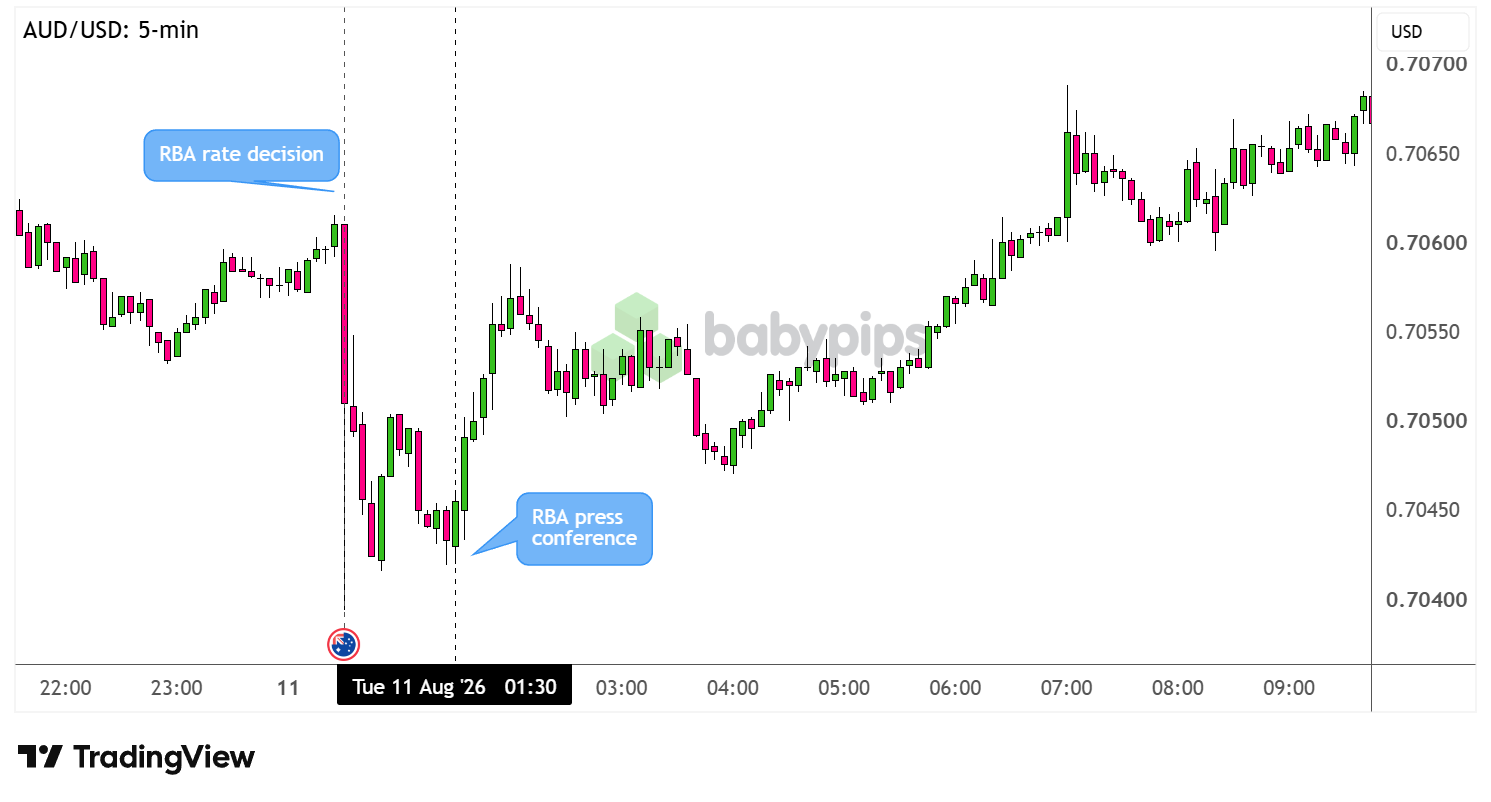
AUD/USD 5-min Forex Chart Faster with TradingView
When a central bank holds rates but signals it’s willing to hike again, it removes near-term downside risk for the currency (rate cuts aren’t coming) while also removing near-term upside catalysts (no fresh hike just happened).
Bullock reinforced this by telling reporters the Board “will raise rates again if needed” and that policymakers want to see clearer progress on inflation before gaining confidence in current settings. The unanimous vote itself dampened hike expectations somewhat, even as the RBA left the door open.
For AUD/USD specifically, the next real test is today’s incoming U.S. inflation data and Australia’s own July CPI print due August 26. Rate differentials, the gap between what two countries pay on their government debt, tend to drive currency pairs over time, so any surprise on either side could matter more than this meeting did.
The Bottom Line
- The RBA held its cash rate at 4.35% for a second straight meeting, a widely expected outcome that still triggered volatile AUD/USD trading.
- Inflation remains above the RBA’s 2-3% target, and trimmed mean inflation hasn’t moved much since March, which is why the Bank kept a hiking bias alive.
- Falling housing prices and slowing consumer spending suggest earlier rate hikes are starting to bite, giving the RBA room to pause rather than hike again immediately.
- Central bank statements can be internally inconsistent (note the late-2027 vs. early-2028 inflation timeline here), a good habit-forming reminder to read the primary source rather than a single headline.
- Interest rate differentials between countries are a core driver of currency pairs. Watching what the RBA does relative to the Fed matters more for AUD/USD than the RBA’s decision in isolation.
What to Watch Next
Australia’s July CPI data lands August 26 and will shape expectations heading into the RBA’s next meeting.
In the meantime, U.S. inflation figures (CPI and PPI) this week could move AUD/USD just as much as anything coming out of Sydney, since the pair reflects the policy gap between two central banks, not just one.
This article covers the RBA’s decision to hold rates while Governor Bullock struck a hawkish tone, a distinction that may be unfamiliar if you’re used to focusing on the rate decision itself. Premium members can read our lesson:
📖 Hawkish vs. Dovish: How to Read Central Bank Language
Reading this helps you understand how to identify hawkish versus dovish language, why a central bank’s tone can move a currency more than the actual rate decision, and how to read where a bank like the RBA sits on the policy spectrum before its next move.
And if you’re not a Premium subscriber yet, now’s a good time to sign up.
With Babypips Premium, you get full access to School of Pipsology lessons that help you understand not just what the rate decision says, but the language and tone that often move currency pairs more than the number itself.