


You check the calendar. A Fed decision sits three days away, and traders already put the odds of an interest rate hike at 85%.
Sure thing, right? So why even bother watching?
Here’s what new traders miss: a near-certain outcome can still shake the market, just not in the way they expect.
The Simple Version
“Priced in” means the market has already reacted to something before it actually happens.
Traders don’t wait for news to print; they act on what they expect the news to say, days or weeks ahead of time. By the time the event arrives, most of the buying or selling it would cause has already happened.
Think of it like a surprise party where half the guests already texted the birthday celebrant, “Can’t wait for tonight!” The surprise is gone before the door even opens.
Example: September FOMC Decision
Take the Fed’s upcoming statement as an example. Before Friday’s inflation report, money markets priced roughly a 67% chance of a hike. After the report came in hot, those odds jumped to about 85%.
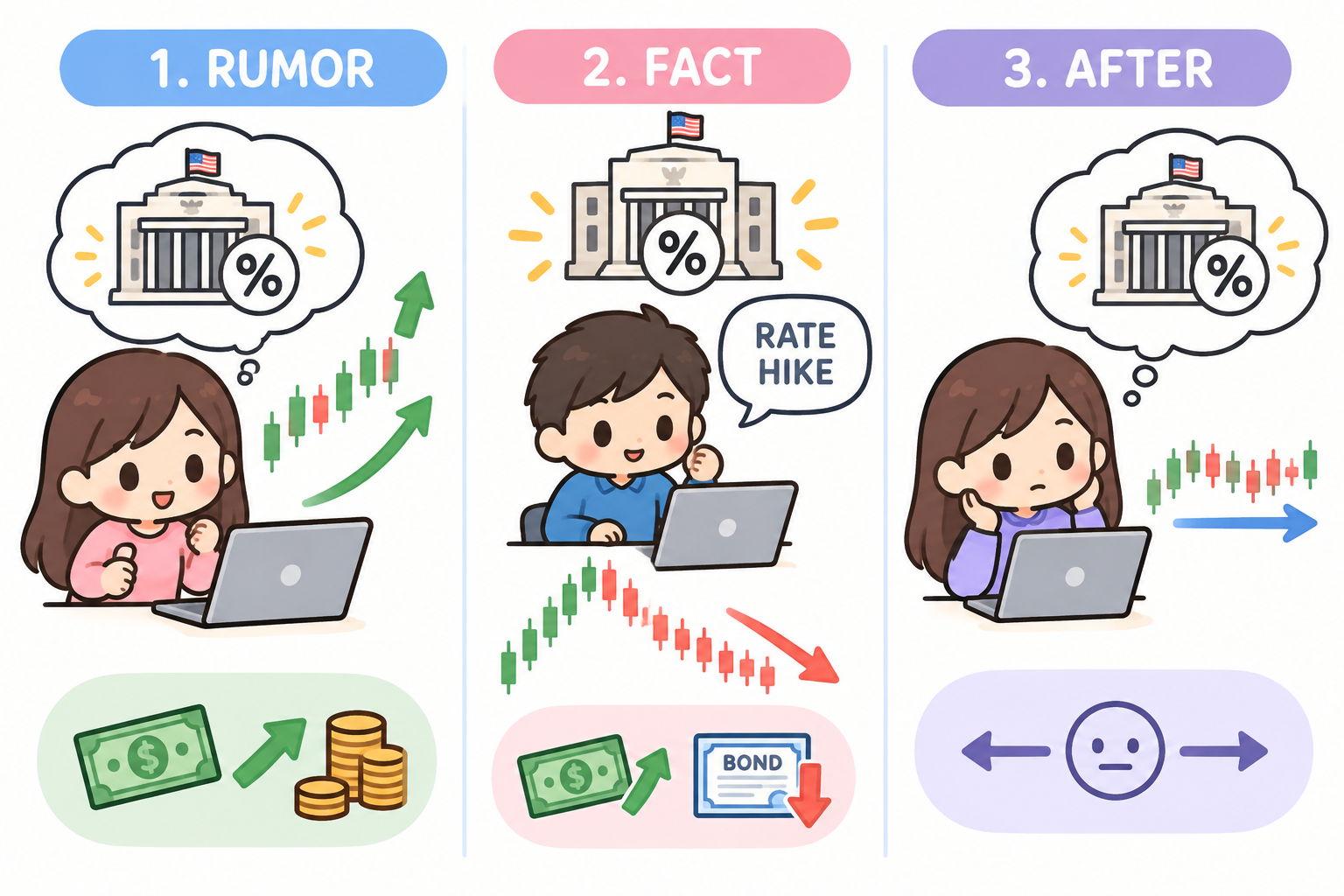 An 85% probability means a vast majority of traders assume the hike is coming. Many have already adjusted their positions for it: buying the dollar, selling bonds, whatever a hike would trigger.
If the Fed raises rates as expected on Wednesday, traders would likely find nothing new to react to. The news confirms an assumption instead of correcting one.
This explains a pattern traders call “buy the rumor, sell the fact.” Price tends to move hardest before an expected event. Then it does the opposite, or nothing, once the event confirms what everyone assumed.
You probably saw a version of this during the U.S. CPI release: the hot inflation report should have hurt stocks, but stocks rose instead, because falling oil prices gave traders a reason to treat the inflation spike as temporary.
Promoted: Keep Your Automated Edge Running 24/7.
Your algorithmic strategy shouldn’t rely on your home Wi-Fi. In high-volatility events, execution speed and uptime are what separate a winning backtest from a live market success. ForexVPS provides ultra-low latency, dedicated trading servers that keep your algos executing trades around the clock without interruption. Stop letting connectivity issues erode your edge.
Explore VPS plans at ForexVPS!
Disclosure: To help support our free daily content, we may earn a commission from our partners if you sign up through our links, at no extra cost to you.
What CAN Still Move the Market?
If the hike is already baked in, traders will look elsewhere for the surprise. At the September meeting, three things could still move markets:
The dot plot. This is a chart where each Fed official marks where they think interest rates should sit in the future. While the rate decision tells us whether the Fed is hiking now, the dot plot gives us a sense of how many more hikes officials expect. Nobody had priced that answer yet, because nobody could see it before Wednesday.
The press conference. Fed Chair Warsh framing the hike as a temporary response to oil prices would send a very different message from warning that inflation is spreading beyond energy. Same hike, very different outlook.The gap between the two. The dot plot and press conference don’t always point in the same direction. A hawkish dot plot, meaning one that points to higher rates, paired with a calmer press conference can leave traders unsure which signal to follow. When that happens, the first market move may not stick.
Why This Matters for You
A new trader watching only the headline rate decision misses the real story. The number that grabs the news alert rarely tells you much. The market already traded around it the week before.
Before any high-probability event, ask yourself two questions:
- What does the market already assume, and how sure does it seem?
- What happens if reality matches that assumption and when it doesn’t?
The gap between those two outcomes is where price moves.
A rate decision sitting at 85% doesn’t mean nothing is left to trade. It means the decision itself isn’t where the trade lives.
The event around it, the guidance, the tone, the surprise buried in the details, still holds the part nobody has priced in yet.
This article explains why an 85% priced-in Fed rate hike can still move markets, a concept many new traders overlook. Premium members can read our lesson:
📖 Market Expectations: Why Good News Can Tank a Currency
Reading this helps you understand why currencies react to the deviation from expectations rather than the headline outcome, how “buy the rumor, sell the fact” plays out in practice, and how to spot where the real surprise in an event might be hiding.
And if you’re not a Premium subscriber yet, now’s a good time to sign up.
With Babypips Premium, you get full access to School of Pipsology lessons that help you understand not just what the headline number says, but why the market’s reaction depends entirely on what it already expected.