-
Preschool>
-
Kindergarten>
Kindergarten
= Lesson Status ? -
Elementary>
Elementary
= Lesson Status ?-
Grade 1 Support and Resistance Levels
-
Grade 2 Japanese Candlesticks
-
Grade 3 Fibonacci
-
Grade 4 Moving Averages
-
Grade 5 Common Chart Indicators
-
-
Middle School>
Middle School
= Lesson Status ?-
Grade 6 Oscillators and Momentum Indicators
-
Grade 7 Important Chart Patterns
-
Grade 8 Pivot Points
-
-
Summer School>
Summer School
= Lesson Status ? -
High School>
High School
= Lesson Status ?-
Grade 9 Trading Divergences
-
Grade 10 Market Environment
-
Grade 11 Trading Breakouts and Fakeouts
-
Grade 12 Fundamental Analysis
-
Grade 13 Currency Crosses
- What is a Currency Cross Pair?
- Crosses Present More Trading Opportunities
- Cleaner Trends and Ranges
- Taking Advantage of Interest Rate Differential
- Obscure Crosses
- Planning Around News and Fundamentals
- Creating Synthetic Pairs
- Euro and Yen Crosses
- How to Use Crosses to Trade the Majors
- How Cross Currency Pairs Affect Dollar Pairs
- Summary: Currency Crosses
-
Grade 14 Multiple Time Frame Analysis
-
-
Undergraduate>
Undergraduate
= Lesson Status ?-
Developing Your Own Trading Plan
-
Which Type of Trader Are You?
-
Create Your Own Trading System
-
Keeping a Trading Journal
- Why Keep a Trade Journal?
- Benefits of Keeping a Journal
- What Should You Record in Your Journal?
- Potential Trading Area
- Entry Trigger
- Position Sizing
- Trade Management Rules
- Trade Retrospective
- Trading Journal Statistics
- Reviewing Your Trading Journal
- Difficulties of Keeping a Trade Journal
- MeetPips.com
- Summary: Keeping a Trade Journal
-
How to Use MetaTrader 4
-
-
Graduation>
Graduation
= Lesson Status ?-
Forex Trading Scams
-
Binary Options 101
-
Personality Quizzes
- Which Trading Style is Best for You?
- Which Currencies Should You Trade?
- What is Your Level of Trading Experience?
- Should You Be a Discretionary, Mechanical, or Hybrid Trader?
- What Kind of Mechanical System Suits Your Personality?
- What is Your Attitude Towards Risk?
- What Kind of Stop Suits Your Trading Style?
-
Graduation Speech
-
Using Moving Averages
One sweet way to use moving averages is to help you determine the trend.
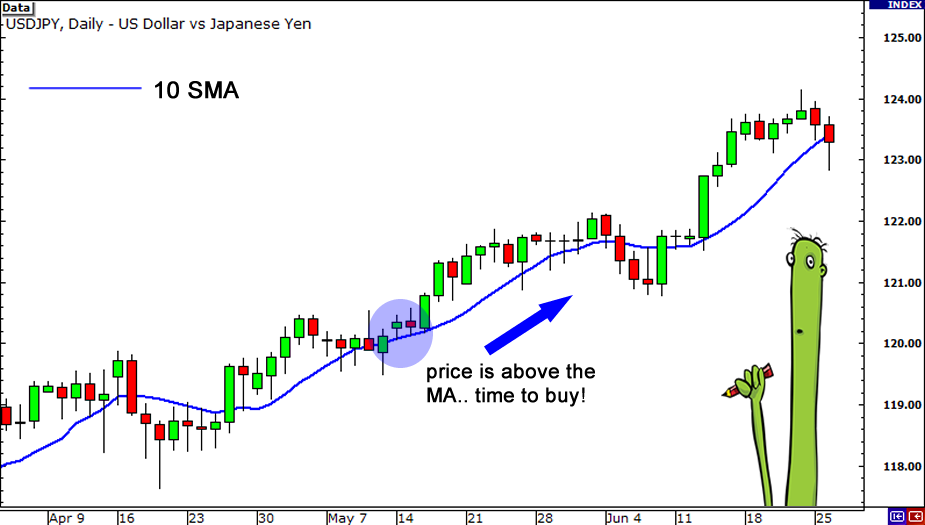
The simplest way is to just plot a single moving average on the chart. When price action tends to stay above the moving average, it would signal that price is in a general uptrend.
If price action tends to stay below the moving average, then it would indicate that it is in a downtrend.
The problem with this is that it's too simplistic.
Let's say that USD/JPY has been in a downtrend, but a news report comes out causing it surge higher.
You see that the price is now above the moving average. You think to yourself:
"Hmmm... It looks like this pair is about to shift direction. Time to buy this sucker!"
So you do just that. You buy a billion units cause you're confident that USD/JPY is going to rise.
Bammm! You got faked out! As it turns out, traders just reacted to the news but the trend continued and price kept heading lower!
What some traders do - and what we suggest you do as well - is that they plot a couple of moving averages on their charts instead of just one. This gives them a clearer signal of whether the pair is trending up or down depending on the order of the moving averages. Let us explain.
In an uptrend, the "faster" moving average should be above the "slower" moving average and for a downtrend, vice versa. For example, let's say we have two MAs: the 10-period MA and the 20-period MA. On your chart, it would look like this:
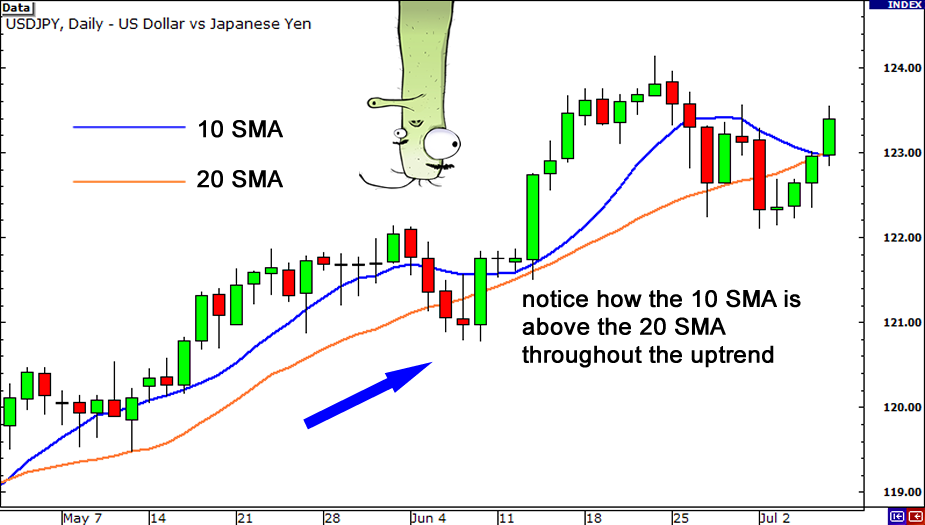
Above is a daily chart of USD/JPY. Throughout the uptrend, the 10 SMA is above the 20 SMA. As you can see, you can use moving averages to help show whether a pair is trending up or down. Combining this with your knowledge on trend lines, this can help you decide whether to go long or short a currency.
You can also try putting more than two moving averages on your chart. Just as long as lines are in order (fastest to slowest in an uptrend, slowest to fastest in an downtrend), then you can tell whether the pair is in an uptrend or in a downtrend.
While you are logged into your account,
you can save your progress in the School of Pipsology!
- Silky Smooth Moving Averages
- Simple Moving Averages
- Exponential Moving Average
- SMA vs. EMA
- Using Moving Averages
- Moving Average Crossover Trading
- Dynamic Support and Resistance
- Summary: Moving Averages