


The simplest way to use pivot point levels in your forex trading is to use them just like your regular support and resistance levels.
Just like good ole support and resistance, the price will test the levels repeatedly.
The more times a currency pair touches a pivot level then reverses, the stronger the level is.
Actually, “pivoting” simply means reaching a support or resistance level and then reversing.If you see that a pivot level is holding, this could give you some good trading opportunities.
- If the price is nearing the upper resistance level, you could SELL the pair and place a stop just above the resistance.
- If the price is nearing a support level, you could BUY and put your stop just below the level.
See? Just like your regular support and resistance! Nothing hard about that!
Let’s take a look at an example so you can visualize this. Here’s a 15-minute chart of GBP/USD.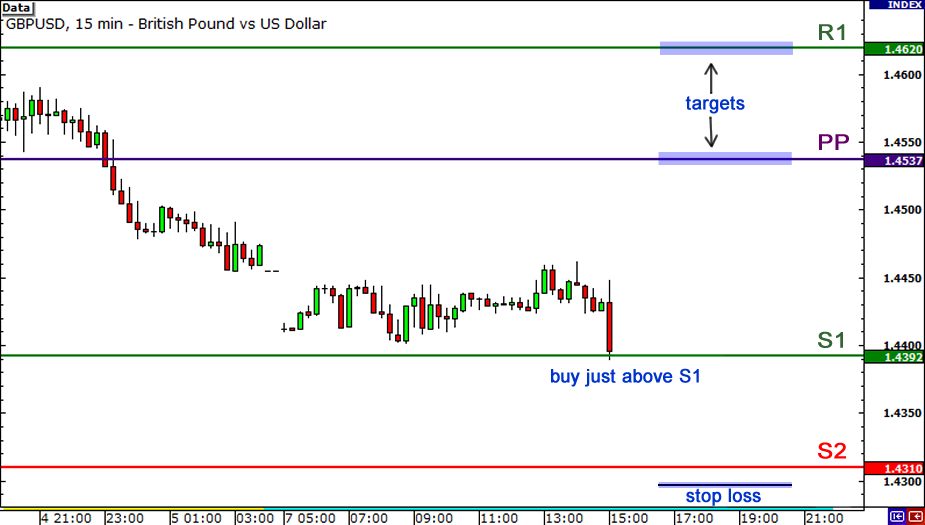
In the chart above, you see that price is testing the S1 support level. If you think it will hold, what you can do is buy at the market and then put a stop loss order past the next support level.
If you’re conservative, you can set a wide stop just below S2. If the price reaches past S2, chances are it won’t be coming back up, as both S1 and S2 could become resistance levels.
If you’re a little more aggressive and confident that support at S1 would hold, you can set your stop just below S1.
As for your take profit points, you could target PP or R1, which could also provide some sort of resistance. Let’s see what happened if you bought at market.

And bam! It looks like S1 held as support! What’s more, if you had targeted PP as your take profit point, you would have hit your PT! Woohoo! Ice cream and pizza for you!
Of course, it ain’t always that simple. You shouldn’t rely only on the pivot point levels. You should note whether pivot point levels line up with former support and resistance levels.
You can also incorporate candlestick analysis and other types of indicators to help give you more confirmation.
For example, if you see that a doji has formed over S1, or that the stochastic is indicating oversold conditions, then the odds are higher that S1 will hold as support.Also, most of the time, trading normally takes place between the first support and resistance levels.
Occasionally, the price will test the second levels and every once in a while, the third levels will be tested.
Lastly, you should also fully understand that sometimes, the price will just break through all the levels like how Rafael Nadal breezes through the competition on clay courts.
What will you do when that happens?
Continue to hold onto your trade and be a sucker and watch your account dwindle away? Or will you take advantage and get back some pips?
In the next lesson, we’ll teach you how to take advantage of when these levels break down.