-
Preschool>
-
Kindergarten>
Kindergarten
= Lesson Status ? -
Elementary>
Elementary
= Lesson Status ?-
Grade 1 Support and Resistance Levels
-
Grade 2 Japanese Candlesticks
-
Grade 3 Fibonacci
-
Grade 4 Moving Averages
-
Grade 5 Common Chart Indicators
-
-
Middle School>
Middle School
= Lesson Status ?-
Grade 6 Oscillators and Momentum Indicators
-
Grade 7 Important Chart Patterns
-
Grade 8 Pivot Points
-
-
Summer School>
Summer School
= Lesson Status ? -
High School>
High School
= Lesson Status ?-
Grade 9 Trading Divergences
-
Grade 10 Market Environment
-
Grade 11 Trading Breakouts and Fakeouts
-
Grade 12 Fundamental Analysis
-
Grade 13 Currency Crosses
- What is a Currency Cross Pair?
- Crosses Present More Trading Opportunities
- Cleaner Trends and Ranges
- Taking Advantage of Interest Rate Differential
- Obscure Crosses
- Planning Around News and Fundamentals
- Creating Synthetic Pairs
- Euro and Yen Crosses
- How to Use Crosses to Trade the Majors
- How Cross Currency Pairs Affect Dollar Pairs
- Summary: Currency Crosses
-
Grade 14 Multiple Time Frame Analysis
-
-
Undergraduate>
Undergraduate
= Lesson Status ?-
Developing Your Own Trading Plan
-
Which Type of Trader Are You?
-
Create Your Own Trading System
-
Keeping a Trading Journal
- Why Keep a Trade Journal?
- Benefits of Keeping a Journal
- What Should You Record in Your Journal?
- Potential Trading Area
- Entry Trigger
- Position Sizing
- Trade Management Rules
- Trade Retrospective
- Trading Journal Statistics
- Reviewing Your Trading Journal
- Difficulties of Keeping a Trade Journal
- MeetPips.com
- Summary: Keeping a Trade Journal
-
How to Use MetaTrader 4
-
-
Graduation>
Graduation
= Lesson Status ?-
Forex Trading Scams
-
Binary Options 101
-
Personality Quizzes
- Which Trading Style is Best for You?
- Which Currencies Should You Trade?
- What is Your Level of Trading Experience?
- Should You Be a Discretionary, Mechanical, or Hybrid Trader?
- What Kind of Mechanical System Suits Your Personality?
- What is Your Attitude Towards Risk?
- What Kind of Stop Suits Your Trading Style?
-
Graduation Speech
-
How to Calculate Pivot Points
The first thing you're going to learn is how to calculate pivot point levels.
The pivot point and associated support and resistance levels are calculated by using the last trading session's open, high, low, and close. Since forex is a 24-hour market, most traders use the New York closing time of 4:00pm EST as the previous day's close.
The calculation for a pivot point is shown below:
Pivot point (PP) = (High + Low + Close) / 3
Support and resistance levels are then calculated off the pivot point like so:
First level support and resistance:
First resistance (R1) = (2 x PP) - Low
First support (S1) = (2 x PP) - High
Second level of support and resistance:
Second resistance (R2) = PP + (High - Low)
Second support (S2) = PP - (High - Low)
Third level of support and resistance:
Third resistance (R3) = High + 2(PP - Low)
Third support (S3) = Low - 2(High - PP)
Keep in mind that some charting software plot intermediate levels or mid-point levels. These are basically mini levels between the main pivot point and support and resistance levels.
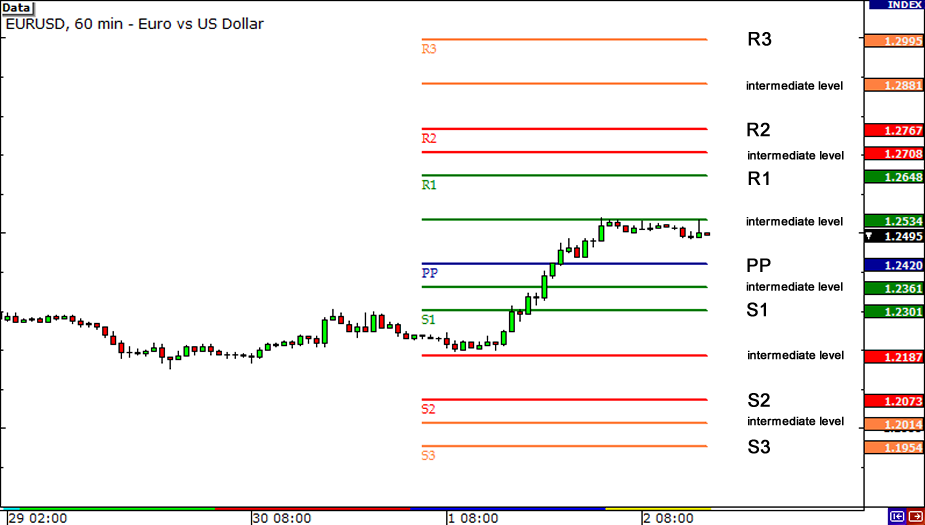
If you hated algebra, have no fear because you don't have to perform these calculations yourself. Most charting softwares will automatically do this for you. Just make sure you configure your settings so that it uses the correct closing time and price.
We here at BabyPips.com also have our very own Pivot Point Calculator!
The awesome part is, just like everything on the website, it's FREE!
The calculator can come in handy, especially if you want to do a little back testing to see how pivot point levels have held up in the past. Remember, one of the advantages of using pivot points is that it is objective, so it's very easy to test how price reacted to them.
Next up, we'll teach you the various ways in which you can incorporate pivot points into your trading strategy.
While you are logged into your account,
you can save your progress in the School of Pipsology!
- Forex Pivot Points
- How to Calculate Pivot Points
- Range Trading with Pivot Points
- Playing the Breaks with Pivot Points
- Using Pivot Points to Determine Market Sentiment
- Other Pivot Point Calculation Methods
- Summary: Pivot Points