


We covered regular divergences in the previous lesson.
Now, let’s discuss what hidden divergences are.
What’s a Hidden Divergence?
Divergences don’t only signal a potential trend reversal.
They can also be used as a possible sign for a trend continuation (price continues to move in its current direction).
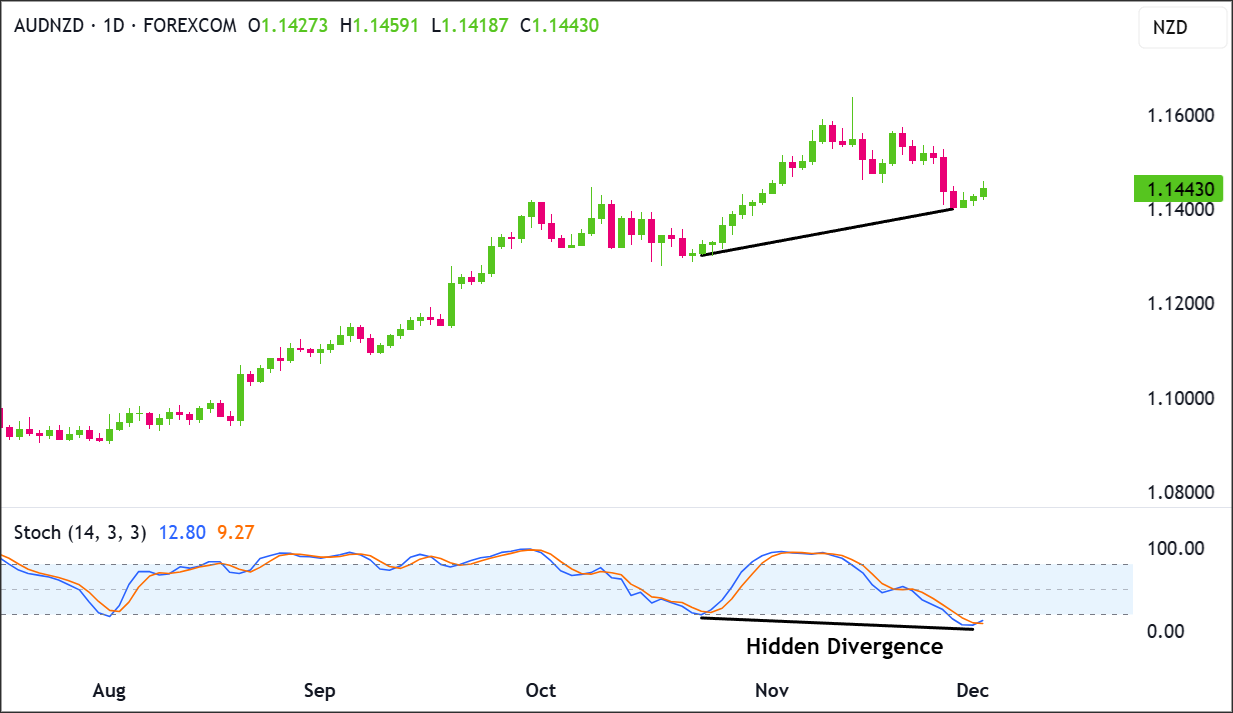
If regular divergence is the trend gasping for air, hidden divergence is the trend catching its second wind. It pulled back for a breather, but it’s not done running yet.
Always remember, the trend is your friend, so whenever you can get a signal that the trend will continue, that’s worth a closer look.
How Hidden Divergence Compares to Regular Divergence
Here’s the key difference that trips up a lot of beginners:
With regular divergence, the interesting action is happening on the oscillator. The oscillator disagrees with the price and hints at a reversal.
With hidden divergence, it’s flipped. The price is the one telling the real story (holding the trend), while the oscillator temporarily fakes you out in the other direction.
Think of it this way:
- In regular divergence, the oscillator is the whistleblower saying, “This trend is a fraud.”
- In hidden divergence, the oscillator is the one bluffing, and the price trend calls its bluff.
Keep that distinction in mind as you read through the two types below.
Why Does Hidden Divergence Happen?
In the regular divergence lesson, we explained that oscillators measure the strength and speed of price movement, not just direction.
That same concept is the key to understanding hidden divergence, but the story plays out differently.
With regular divergence, momentum fades while price pushes to a new extreme. With hidden divergence, momentum overreacts during a pullback while the overall trend stays healthy.
Here’s what that looks like in practice.
Let’s say a currency pair is in a solid uptrend.
- Price rallied from 1.2000 to 1.2500, then pulled back to 1.2300.
- The RSI drops during that pullback. Normal stuff.
- Then price resumes the uptrend and eventually pulls back again, this time only to 1.2350, which is a higher low.
- The trend structure is intact.
- But during that second pullback, the selling was sharper and faster than the first time, even though the price didn’t fall as far.
- Maybe a news event spooked the market, or maybe traders took profits aggressively.
- The RSI, which measures the intensity of the move, plunges to a lower low than the first pullback.
So now you’ve got price holding a higher low (bullish structure) while the RSI is printing a lower low (suggesting weakness).
That’s the hidden divergence.
Why doesn’t this signal a reversal?
Because the thing that matters most for trend health is where price holds, not how dramatic the pullback felt along the way.
The oscillator is reacting to the speed of the pullback, but the price is telling you the buyers are still stepping in at higher price levels.
The trend’s foundation is solid, even if the oscillator had a temporary panic attack.
Think of it like a market selloff caused by a scary headline. Everyone rushes to sell, fear spikes (that’s your oscillator dropping), but within a day or two, the market recovers and resumes its rally.
The panic was real, but it wasn’t structural. The trend was never in danger.
That’s the hidden divergence in a nutshell: The oscillator overreacts to a pullback, but the trend structure holds firm, and price continues in its original direction.
Now let’s look at the two types.
Hidden Bullish Divergence
Hidden bullish divergence happens when the price is making a higher low (HL), but the oscillator is showing a lower low (LL).
This can be seen when the pair is in an uptrend.
Once price makes a higher low (HL), look and see if the oscillator does the same. If it doesn’t and makes a lower low (LL), then we’ve got some hidden divergence on our hands.
What’s happening here?
Price pulled back but held above its previous low, which is a sign of strength. The oscillator dipped to a lower low, which might look scary, but it’s actually just resetting while the uptrend stays intact.
It’s like a runner slowing down to tie their shoe. They’re not quitting the race. They’re about to pick up the pace again.

Hidden Bearish Divergence
Lastly, we’ve got hidden bearish divergence.
This occurs when the price makes a lower high (LH), but the oscillator is making a higher high (HH).
By now, you’ve probably guessed that this occurs in a downtrend.
When you see hidden bearish divergence, chances are that the pair will continue to shoot lower and continue the downtrend.
The oscillator bouncing higher might tempt you into thinking the selling pressure is easing up. Don’t fall for it.
Price is still making lower highs, which means the bears are firmly in control. The oscillator makes a higher high, but is just bluffing.
The downtrend is likely to resume.

Quick Recap
Let’s recap what you’ve learned so far about hidden divergence.
If you’re a trend follower, then you should dedicate some time to learning how to spot hidden divergence.
If you do happen to spot it, it can help you jump into the trend early, giving you a better entry and a more favorable risk-to-reward ratio.
Sounds good, yes?
Here’s the simplest way to keep it all straight:
- Regular divergences = signal possible trend reversal
- Hidden divergences = signal possible trend continuation
Or if you prefer a memory trick: Regular = Reversal. Hidden = Hold the trend.
Easy enough to remember, right?
One more thing: Just like with regular divergences, hidden divergences work best when you confirm them with other tools.
A hidden bullish divergence that lines up with a key support level or a rising trendline? That’s a much stronger signal than a hidden divergence floating out in the middle of nowhere.
What’s Next?
In the next lesson, we’ll show you some real-world examples of when divergences existed and how you could have traded them.
Time to see this stuff in action!