-
Preschool>
Preschool
= Lesson Status ?-
What is Forex?
-
Why Trade Forex?
-
Who Trades Forex?
-
When Can You Trade Forex?
-
How Do You Trade Forex?
-
-
Kindergarten>
Kindergarten
= Lesson Status ?-
Three Types of Analysis
-
Types of Charts
-
-
Elementary>
Elementary
= Lesson Status ?-
Grade 1 Support and Resistance Levels
-
Grade 2 Japanese Candlesticks
-
Grade 3 Fibonacci
-
Grade 4 Moving Averages
-
Grade 5 Common Chart Indicators
-
-
Middle School>
Middle School
= Lesson Status ?-
Grade 6 Oscillators and Momentum Indicators
-
Grade 7 Important Chart Patterns
-
Grade 8 Pivot Points
-
-
Summer School>
Summer School
= Lesson Status ?-
Elliott Wave Theory
-
Harmonic Price Patterns
-
-
High School>
High School
= Lesson Status ?-
Grade 9 Trading Divergences
-
Grade 10 Market Environment
-
Grade 11 Trading Breakouts and Fakeouts
-
Grade 12 Fundamental Analysis
-
Grade 13 Currency Crosses
- What is a Currency Cross Pair?
- Crosses Present More Trading Opportunities
- Cleaner Trends and Ranges
- Taking Advantage of Interest Rate Differential
- Obscure Crosses
- Planning Around News and Fundamentals
- Creating Synthetic Pairs
- Euro and Yen Crosses
- How to Use Crosses to Trade the Majors
- How Cross Currency Pairs Affect Dollar Pairs
- Summary: Currency Crosses
-
Grade 14 Multiple Time Frame Analysis
-
-
Undergraduate>
Undergraduate
= Lesson Status ?-
Market Sentiment
-
Trading the News
-
Carry Trade
-
The U.S. Dollar Index
-
Intermarket Correlations
-
Using Equities to Trade FX
-
Country Profiles
-
Developing Your Own Trading Plan
-
Which Type of Trader Are You?
-
Create Your Own Trading System
-
Keeping a Trading Journal
- Why Keep a Trade Journal?
- Benefits of Keeping a Journal
- What Should You Record in Your Journal?
- Potential Trading Area
- Entry Trigger
- Position Sizing
- Trade Management Rules
- Trade Retrospective
- Trading Journal Statistics
- Reviewing Your Trading Journal
- Difficulties of Keeping a Trade Journal
- MeetPips.com
- Summary: Keeping a Trade Journal
-
Risk Management
-
The Number 1 Cause of Death of Forex Traders
-
Position Sizing
-
Setting Stop Losses
-
Scaling In and Out
-
Currency Correlations
-
-
Graduation>
Graduation
= Lesson Status ?-
Brokers 101
-
Forex Trading Scams
-
Personality Quizzes
- Which Trading Style is Best for You?
- Which Currencies Should You Trade?
- What is Your Level of Trading Experience?
- Should You Be a Discretionary, Mechanical, or Hybrid Trader?
- What Kind of Mechanical System Suits Your Personality?
- What is Your Attitude towards Risk?
- What Kind of Stop Suits Your Trading Style?
-
Graduation Speech
-
Forex Pivot Points
Are you all excited? It's your last year in junior high before you head off to high school!
Professional traders and market makers use pivot points to identify potential support and resistance levels. Simply put, a pivot point and its support/resistance levels are areas at which the direction of price movement can possibly change.
The reason why pivot points are so enticing?
It's because they are OBJECTIVE.
Unlike some of the other indicators that we've taught you about already, there's no discretion involved.
In many ways, pivot points are very similar to Fibonacci levels. Because so many people are looking at those levels, they almost become self-fulfilling.
The major difference between the two is that with Fibonacci, there is still some subjectivity involved in picking Swing Highs and Swing Lows. With pivot points, traders typically use the same method for calculating them.
Many traders keep an eye on these levels and you should too.
Pivot points are especially useful to short-term traders who are looking to take advantage of small price movements. Just like normal support and resistance levels, traders can choose to trade the bounce or the break of these levels.
Range-bound traders use pivot points to identify reversal points. They see pivot points as areas where they can place their buy or sell orders.
Breakout traders use pivot points to recognize key levels that need to be broken for a move to be classified as a real deal breakout.
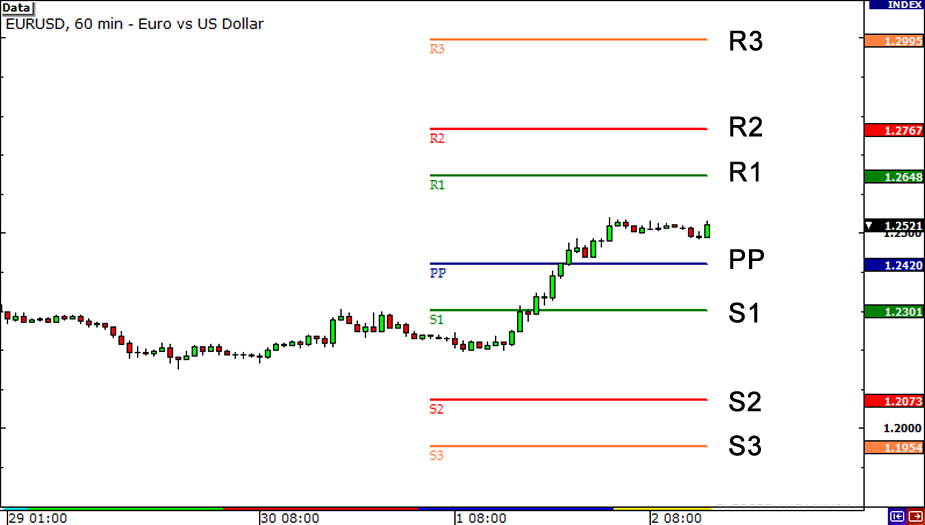
Here is an example of pivot points plotted on a 1-hour EUR/USD chart:
As you can see here, horizontal support and resistance levels are placed on your chart. And look - they're marked out nicely for you! How convenient is that?!
Here's quick rundown on what those acronyms mean:
PP stands for Pivot Point.
S stands for Support.
R stands for Resistance.
But don't get too caught up in thinking "S1 has to be support" or "R1 has to be resistance." We'll explain why later.
In the following lessons, you will learn how to calculate pivot points, the different types of pivot points and most importantly, how you can add pivot points to your trading toolbox!
- Forex Pivot Points
- How to Calculate Pivot Points
- Range Trading with Pivot Points
- Playing the Breaks with Pivot Points
- Using Pivot Points to Determine Market Sentiment
- Other Pivot Point Calculation Methods
- Summary: Pivot Points