It was an up and down year for the pound, which mostly traded to the beat of risk sentiment throughout the year. Let’s take a look at some of the headlines that dominated the U.K. in 2011 and how it affected pound traded.
William and Kate Tie the Knot
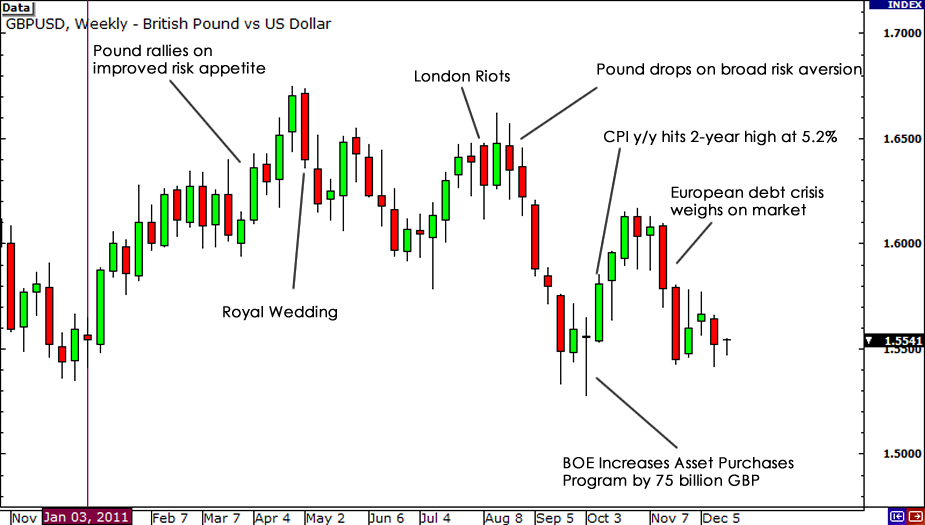
This past May, millions of people tuned in to watch the Royal Wedding of Prince William and Catherine Middleton. And unlike a certain reality TV-show couple (Kim Kardashian and Kris…what was his name again?), things appear to be going rather smoothly right now.
Not only was the wedding on the lips of every gossiper, but it also sparked some debates as to how it would affect the British economy. Some estimates were calling for losses in output of up to 6 billion GBP for the one day holiday. Others though pointed to increased tourism, memorabilia sales, and over 5,000 street parties as reasons why the wedding would boost the U.K.’s economic activity.
Of course, it’s difficult to measure the exact impact that the wedding could have had. For now, let me just say my congratulations to William and Catherine.
Riots Rock London
In early August, the streets of London hit news channels all over the globe, as we saw a series of violent riots take place. The trigger for the riots was when Tottenham local police shot Mark Duggan. The details were pretty sketchy, and unfortunately, what started out as a peaceful protest turned into a full-fledged riot.
The riots showed dissatisfaction with the government but thankfully, the riots only lasted a few days and authorities were able to prevent it from escalating. The effects of the riots were pretty evident on the pound though, as GBP/USD took a near 200-pip loss that week.
Bank of England: QE Round 2
After 22 months of sitting on their hands, the Bank of England finally decided that enough was enough and that it was time to act. Last October, the central bank shocked the markets by increasing its asset purchase facility by 75 billion GBP.
According to the central bank, the rate at which the global economy was growing was just too slow. Coupling this with real concerns about euro zone debt crisis, the BOE felt that they had to do something to help boost the British economy.
For now, the central bank is maintaining a wait-and-see approach. With inflation at a high, MPC members will remain cautious and only inject more stimulus in the markets if conditions worsen.
Inflation hits two-year high
Once again, one of the recurring economic trends that was on every MPC member’s minds was that of inflation. For over two years now, inflation has stubbornly stayed above the Bank of England’s target inflation band of 1%-3%. In fact, inflation hit a two-year high of 5.2% this past October.
The sharp rise in inflation, coupled with concerns about dismal 0.1% rise in GDP during the 2nd quarter, sparked concerns that the British economy may enter a period of stagflation. Still, the pound managed to rally that week, as minutes of the October MPC meeting revealed that all 9 members voted unanimously in favor of expanding the bank’s asset purchase facility. This indicated that despite the rise in inflation, the central bank would do what was necessary to boost the economy.
Euro zone debt crisis
In the third quarter of the year, risk aversion swept through the markets, sending equities, commodities, and high yielding currencies into a tailspin. Ratings agencies were hitting European countries with downgrades left and right. Meanwhile, bond prices plunged as well, as investors demanded higher yields for taking on European government bonds.
Markets participants moved their money out of riskier assets and parked them in safe-havens. This sent the pound drowning, which dropped just over 1,000 pips versus the dollar from August to September. The pair recovered a bit in October , due to a combination of profit taking and a boost in risk sentiment following the BOE’s announcement of QE2., but soon fell as political uncertainty and lack of action from the EU led to another round of risk aversion.
All in all, it was a pretty crazy year for the pound. From royal weddings, to riots in London, to more quantitative easing by the BOE, 2011 was a pretty eventful year. Interestingly, GBP/USD is now trading close to its opening price for the year. Will this continue to hold as a major support area for 2012?